



 Sign in with Google
 Vumani Ncube is the performance lead within the solutions team for Google sub-Saharan Africa. He is an advisor to strategic clients, building bespoke performance solutions and innovative approaches with Google’s advertising platforms to help them unlock their full potential.
What did an Ethiopian airline and a South African insurer have in common? A high volume of leads with a low conversion rate.
When campaign bidding strategies are fed bad data, they inevitably optimise for the wrong outcome: volume instead of value. And when measurement strategies are only half-complete, ad spend is wasted on non-performing campaigns. This was the scenario for Ethiopian Airlines and a well-known South African insurer, who were seeing their ROI nosedive.
See how they renovated their data streams, improving measurement and sales efficiency, and generated leads that doubled their conversion rate — and then some.
Case study 1: How quality data drives better leads
As an airline operating in multiple continents, Ethiopian Airlines offered a ‘book now, pay later’ option for markets with lower payment penetration. Customers enjoyed the convenience of reserving without paying immediately, but for the company, this resulted in poor ticket conversions. In fact, only 20% of total ticket bookings led to actual purchases.
This had a negative snowball effect on Ethiopian Airlines’ campaigns: because their conversion tracking counted a reservation as a conversion — regardless of whether payment was made — all future bidding strategies were trained on empty, inaccurate data.
In other words, bad data led their campaigns to continuously search for customers who booked but rarely paid.
The first step was to stop recording a website booking as a conversion event in Google Ads since it held no monetary value. Secondly, using the enhanced conversions feature in Google Ads, they began sending the data from completed ticket sales, once payment was made, to their campaigns. This new primary source of conversion data informed their AI-fueled bidding strategies to search for people most likely to move from an ad click to a paid ticket.
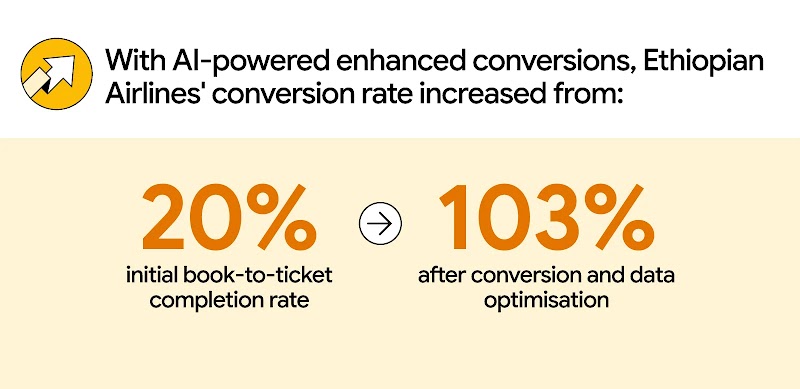
Data quality enabled booking quality, which further optimised their campaign’s automation and audience targeting abilities. As a result, Ethiopian Airlines more than doubled their book-to-ticket conversions (103%) in severely affected countries and saw an up to 17% increase in moderately affected countries.
Case Study 2: ROI soars with accurate, complete measurement
A South African insurer offering personal and business cover had a broad lead generation strategy that prioritised the volume of leads. However, they soon realised that this strategy was not driving valuable leads, resulting in a low conversation rate.
Secondly, the number of leads reported by their campaigns did not match with their internal sales data, showing that their measurement strategy could be deepened and strengthened. Their marketing team spent time analysing campaign and ad performance to see which ones brought in profitable leads, however, without complete measurement, an accurate picture could not be created.
To overcome this challenge, the team uploaded offline conversion data — such as sales made over the phone — into their Google Ads campaigns, which aligned reporting with their internal sales data. Additionally, they enabled enhanced conversions, which matched first-party customer lead data, like a completed submission form, with the final sales data in their system. This means they could accurately credit the original campaign click that resulted in a quote and an actual policy sale.
Finally, they flipped from broad, full-funnel lead generation to a data-driven plan by refining their keyword targeting and prioritising audiences that moved down the funnel towards a conversion. These changes not only set their bidding strategies up for conversions, but they filled the gap in their measurement strategy.
The lead-to-sale conversion rate increased from 12% to 31%, a major uplift in sales efficiency. Confidence in the new dataset and measurement blueprint allowed them to roll this strategy out across larger campaigns over the long-term.
Unlocking performance with AI
For both brands, AI-powered enhanced conversions also helped them unlock smart bidding and reporting, providing cleaner data and a clearer view of the customer journey. Optimising for quality over quantity not only reduced wasted ad spend on low-value leads, but significantly improved ROI.