





 Sign in with Google
Jim Lecinski is a clinical professor of marketing at Northwestern University’s Kellogg School of Management and author of “The AI Marketing Canvas” (Stanford Press, 2026), in which this concept originally appeared.
The opinions expressed are his own and may not reflect those of Google.

The annual plan, the product launch, the next big campaign, the agency brief: For decades, marketing work has been organized around discrete, episodic initiatives like these. Success went to the team that could produce the best output for each successive cycle.
Enter AI. The first wave of AI in marketing simply helped do that same work faster. Marketers used AI chats to summarize research, draft briefs, personalize content, automate reporting, and quickly evaluate results. Those were real speed and efficiency gains, but chat-based AI didn’t change the nature of marketing work. It just made it faster. What’s changing with agentic AI now is a much bigger deal.
The shift from episodic to agentic AI
AI is now moving rapidly toward agentic applications — systems that can execute tasks, manage parts of a workflow, and operate with increasing autonomy inside defined boundaries. That changes the logic of the work itself. It pushes marketing away from a model built around episodic deliverables and toward one built around repeatable, scalable, always-on systems that can produce strong AI-powered outputs again and again.
This requires marketing leaders to define their exact workflows, decision rules, testing loops, guardrails, and human-AI handoffs. It means a frontier CMO must master a fundamental shift toward “systems thinking.”
Does this mean marketers need to become software engineers? Thankfully, no. It does mean they need to start asking a different set of questions.
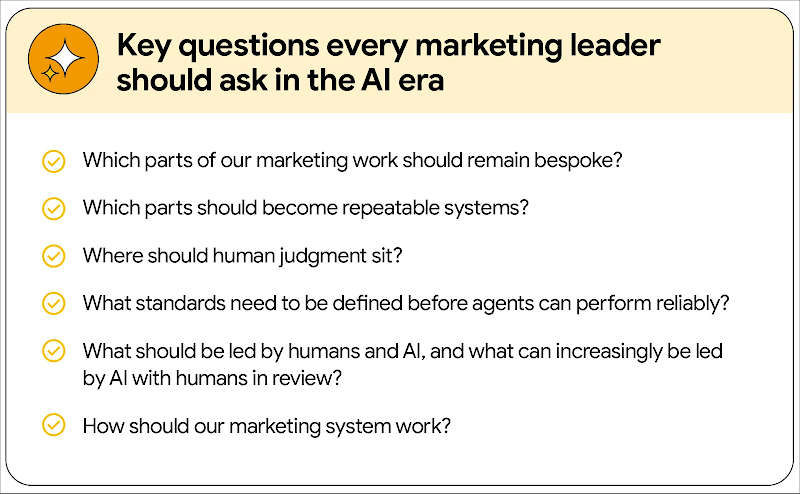
These are now core leadership questions for the marketing function.
Redesigning the work itself
Keep in mind that AI agents don’t succeed because you give them a clever prompt. They succeed because you define the workflow around them well enough for them to thrive. In practice, that means giving them the right context, a clear objective, decision boundaries, quality standards, and a concrete specification for what good looks like.
Once a workflow is set, parts of it can be supported or executed by AI agents. But only because the human team first defined the system.
Consider a familiar marketing task: moving from a pile of focus group transcripts to an executive report. An expert researcher does more than read and summarize. They orient toward the business question, extract the raw signal, cluster themes, judge which themes matter most, synthesize those themes into a decision narrative, and package the result in a form an executive can act on. That isn’t just a task. It’s a workflow. Once that workflow is set, parts of it can be supported or even executed by AI agents. But only because the human team first defined the system.
That example captures the broader shift now facing the CMO. Agentic AI creates its greatest value not when layered onto yesterday’s processes, but when marketing leaders redesign the workflow itself.
This changes the marketing operating model. A function built for the agentic AI era needs clear workflow ownership, decision rights, and guardrails. Informal experimentation with one-off pilots isn’t enough. Frontier marketing needs a model in which the center provides standards, governance, and shared systems, while local teams adapt those systems in context. The question is which workflows matter most, how those workflows should run, and where AI should sit inside them.
Better-designed systems improve decision quality, increase consistency across markets, and make marketing more scalable without sacrificing control.
This is a business performance issue, not just an operating model issue. Better-designed systems can reduce cycle time, improve decision quality, cut rework, increase consistency across teams and markets, and make marketing more scalable without sacrificing control. They can also make marketing more legible to the CEO and CFO, because the function starts to look less like a collection of episodic activities and more like a disciplined growth engine.
5 imperatives for the frontier CMO
So what should a frontier CMO do now to become a systems thinker? Work with your AI Marketing Champion to:
- Identify a small number of high-value workflows (not 20!) that matter the most to marketing performance. Start with three to five. These might include things like audience segmentation, creative testing, lead scoring, pricing and promotion planning, journey orchestration, or performance reporting. The key is to start with the work, not the tools.
- Map those workflows in detail. Where does the work begin? What inputs are required? Which decisions happen along the way? Where are the bottlenecks, judgment calls, delays, and handoffs? Many organizations quickly discover that the biggest barrier to AI is not the technology but that the underlying process is too fragmented, inconsistent, or informal to scale.
- Define the operating instructions for the workflow. Clarify the context the system needs, the objective it’s optimizing for, the trade-offs it should respect, the guardrails it must stay within, and the standards by which the output will be judged. Agents don’t do well with ambiguity. If strategic intent, approval logic, and quality standards remain fuzzy, agentic AI won’t solve the problem. It will simply expose the confusion faster.
- Decide where AI should assist, where it should automate, and where humans should remain firmly in control. Not every step or decision should be agentified. The goal isn’t to automate judgment away. It’s to be explicit about where judgment must remain human and where machines can take more of the load.
- Train in parallel. The next generation of marketing capability will come from the ability to redesign work well. Teams still need judgment, taste, creativity, strategic clarity, and deep knowledge of the craft of marketing. They also need to learn systems thinking — how to think in workflows, systems, and process design. Otherwise, you risk hollowing out the very layer of marketers who can translate AI analysis into sound commercial decisions.
For the CMO of the new agentic AI era, the job is to define and redesign the workflows, guardrails, and human-AI systems through which modern agentic marketing runs. AI is changing more than the tools of marketing. It is changing the operating logic of marketing itself. The CMOs and marketing leaders who see that clearly and start taking action now will build the organizations best prepared to win.
Social Module
Share