


 Sign in with Google
Investing in AI is the easy part. Frontier CMOs share how marketers can win 2027

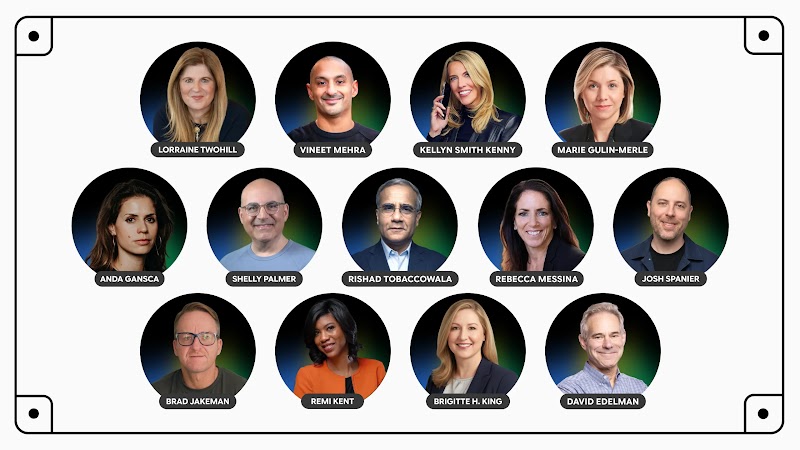
In 2027, the advantage goes to CMOs bold enough to rewire how their teams work and strategic enough to build their brands in the AI era.
We asked marketing leaders from our Frontier CMO community where they are placing their bets next year. Their predictions come down to four big shifts: how teams work, how marketing proves its worth to the board, how brands win customers, and how CMOs lead.

“A CMO’s job has always been to deliver business impact. How we do that is evolving. There is no doubt that AI is a game changer, helping us be more effective and do the work that seemed impossible before. But in this new world, a massive part of business impact will be driven by user trust. Without trust, there is nothing. As humans, we must never lose sight of the importance of people believing in us. That means doing the hard work to bring people with us on the journey, including our own teams, our customers, and society as a whole.”
“How we prove value isn’t changing. Efficient growth is still the job. It’s why we have a seat at the table. What’s changing is how we get there. When everyone has the same AI tools, human creativity, taste, and judgment become the differentiators. Yet most AI savings are showing up as cost cuts. We’re using the most powerful creative tools in history to make the same work cheaper. That money should be reinvested into the ideas we previously couldn’t pursue. The riskiest thing a CMO can do in 2027 is keep funding the safest bet.”
“In 2027, the most valuable experiences won’t be the most automated. They’ll be the most human. As AI makes speed, personalization, and content ubiquitous, people will value what technology alone cannot create: judgment, empathy, accountability, genuine connection, and human excellence. Winning brands will use AI not simply to improve transparency and remove friction but to give customers and employees a greater sense of confidence and being valued and appreciated.”

“Years ago, I argued we needed to kill the term ‘digital marketing’ because digital had simply become marketing. In 2027, the same thing will happen to ‘AI marketing.’ We are past the hype cycle and deep into the rewiring cycle. While almost every CMO is excited about AI, fewer than a third have actually redesigned their organizations around it. The winning CMOs next year won’t delegate AI to an innovation task force or wait for a slide deck. They will build fluency themselves and rewire how their entire team operates.”
“In 2027, an AI conversation will sell me on your brand, and then your own website will lose the sale. I learned this while shopping for an electric car that doesn’t look like a mom van. Gemini got to know me in 10 minutes, had me excited about its pick, and sent me to the car’s website, which promptly greeted me like a stranger. The handoff is where sales happen. If your site makes me start the conversation from scratch, I’m leaving. By next year, so is everyone else.”
“For my whole career, the atomic unit of business has been the deliverable. Creating them, presenting them, having them presented. AI is changing this. Imagine anyone in your organization, including you, being able to press a button and get an AI-generated deliverable. Not better than a human could create but absolutely fit for purpose. How will you adapt your organization as the atomic unit of business shifts from departments of human deliverable-makers to departments of human decision-makers? This is, without question, the biggest leadership challenge of our time.”

“The biggest challenge of the AI age will be organizational design. AI is like hydrochloric acid that burns through all the containers of the past. Different areas and tasks leak into each other while others evaporate away. Since any change in organizational design impacts roles, responsibilities, spans of power, and compensation, it is likely to be resisted. Therefore, it will take time. Jobs are a silly phase that work is going through. Agents care about outcomes, not process, and today’s silos make no sense to them. By the end of the decade, most of your talent will be fractional and agentic; many may sit outside your organization. This upends roles, power, and pay. Expect resistance. The best leadership teams talk openly and call out the turd on the table.”
“Shoppers care less about what a brand says and more about what it does and the experience it creates. Distinction and trust will decide who gets discovered. People will increasingly come in hot, already convinced. The brand will have done its work, the system will have influenced them, and, in many categories, consumers will have done their ‘homework,’ and they’ll be ready to buy. The whole purchase cycle will form a true loop, with great product experience working harder than ever to complement and build brand meaning.”
“Here’s my unpopular opinion for 2027: Too many marketing leaders are talking the talk on AI and not walking the walk. I can tell they’re faking it in 90 seconds or less. Their teams can tell. Their bosses can definitely tell. Meanwhile, the CMOs, teams, and agencies who did the work are pulling ahead, and, in 2027, that gap becomes a chasm. You don’t want to be on the wrong side of it. The good news? It’s not too late to put in the work and test the tools.”

“By 2027, the six-week creative brief will look like sending a fax. Teams will spend Monday spotting an unmet need, Tuesday making prototypes, and Wednesday watching real people reject most of them. AI will make production cheaper. Taste, judgment, and the nerve to back an unfamiliar idea will become expensive. Around the table there will be a brilliant creative, a behavioral scientist, someone who can build things, and a marketer empowered to decide. The 12-person approval committee can stay home, because it turns interesting ideas into beige ones and then requests a bigger logo.”

“In 2027, the board will ask who is really making the purchase decision: people, agents, or AI models? CMOs will return to the truest form of brand building, measured by recommendations, pricing power, and repeat buying. Marketers will still have to prove value in the board’s language. Recommendations must turn into new customers, higher prices must hit the bottom line, and loyalty must lower acquisition costs. Budgets will go to trust and relevance, so creators and experiences will keep benefiting.”

“Finding brands is nothing like it was when only physical shelves and linear TV ruled. Today, brands will need data that is ready to show up in AI answers. They’ll be chosen for the quality, depth, and breadth of their content across platforms, and they’ll derive staying power from data-rich, deeper consumer experiences that retain customers. What stops working is tactics and optimizations executed in silos and expecting full brand performance to change.”

“In 2027, marketing leaders will accelerate toward much more ‘always-on’ programs. Integrated pods will tap a constant stream of signals about customers, competitors, media shifts, and pricing. They’ll pull this into insights, develop content, rebalance media, and relentlessly test hypotheses. Personalization, real-time optimization, and crosschannel coordination will become core to how leaders operate. They won’t be buzzwords anymore. Data architecture strategy will fuse together with brand strategy, as marketers expand the range of possibilities for differentiating their brand experiences, jumping ahead of the market, and driving growth.”

Social Module
Share