



 Sign in with Google
 For retailers, satisfying modern shoppers with omnichannel experiences has become a top priority.
In 2026, global retailers surveyed by Deloitte believe most of their growth will come from enhancing omnichannel experiences.
Online-Merge-Offline (OMO) marketing, in particular, can help businesses grow profitably. When your brand merges online and offline store experiences using integrated data insights, you can improve marketing efficiency, especially for promotion spend.
By unifying your online, app, and physical channels into a seamless ecosystem, you can deliver the right value for customers — from relevant information to offers and discounts — at the right time. That lets you stay aligned with their needs while driving sustainable business growth.
But to make your OMO strategies truly effective, it’s critical to analyse your first-party data to capture deep, granular insights into customer journeys.
One company that is achieving data-led OMO success — as well as record high operating revenues and profits for the first half of its 2026 financial year — is Ryohin Keikaku. Its retail brand Muji has elevated the synchronisation of customers’ online and in-store experiences into something of an art form, by cultivating a “balanced relationship between people, nature, and objects.”
And to better understand how its products, services, stores, and marketing activities contribute to that vital relationship, Muji is collaborating with Google to uncover and curate data-led insights.
Here, we unwrap the AI-powered model that’s helping Muji optimise its OMO strategies and promotional activities for profitable sales.
Driving smarter data-led decisions: Muji’s Promotion Insights Hub
With about 1,470 physical stores and 17.5 million active app users worldwide, Muji has amassed consented first-party data across multiple product categories, including apparel, household goods and food.
Its teams wanted to accurately understand the causal relationships between incremental revenues and its customers’ online and offline shopping behaviours, under different conditions like weather and seasonal sales. However, they faced two challenges:
- Extracting the relevant data was time-consuming.
- Advanced technical tools were needed to turn data into actionable insights, such as optimising in-store sales and promotion budgets.
So it collaborated with Google to develop a Muji Promotion Insights Hub. It used causal machine learning to analyse privacy-safe, aggregated data from Google Analytics, Google Search Console, first-party store sales data, as well as external data like temperature, precipitation, and demographics.
The model was integrated with Gemini Enterprise to automatically analyse data and respond to users’ questions, meeting two key needs:
1. Easily accessible insights on OMO effectiveness
The causal ML model accurately and swiftly analysed the nuanced relationships between online store visitors’ conversions and in-store purchases.
It found that online engagement contributed to 14.8% of offline sales.1 That reflected the Muji app’s effectiveness as a digital product catalogue that spurs consideration, improves promotion effectiveness, and drives in-store purchases.
The model also featured a user-friendly, interactive chatbot powered by Gemini. Any team member could directly ask questions anytime — no technical skills needed. They received quick, reliable insights and easy-to-read reports.
Muji’s Promotion Insights Hub provides robust, easily accessible insights that help teams optimise their marketing.
2. Highly granular analyses
By feeding the model with data on variables like temperature and store location, Muji was able to better understand how such factors influence specific online events, and subsequently impact in-store sales.
For example, the model found that what drove offline sales in September 2025 differed significantly across regions.
In Hokkaido, the autumn chill influenced customers’ interactions on the website and app which were related to innerwear and thermal apparel. That significantly increased offline sales.
Meanwhile, in Osaka, where September is a popular time for moving house, people explored Muji’s furniture choices online first. They then went in-store to visualise how the product specifications would fit their relatively small homes, driving offline sales.
Those nuanced insights enabled Muji to optimise its marketing and promotional activities across customers’ “research online, purchase offline” journeys.
Maximising sales: How promotion insights improve Muji’s strategies
Using the Promotion Insights Hub’s analyses, Muji teams identified three sophisticated strategies for improving sales:
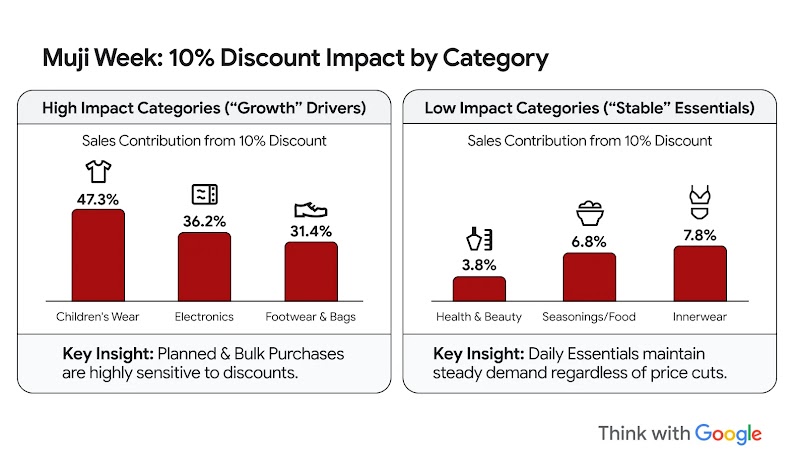
1. Optimise pricing and discounts for each category: The model evaluated the sales impact of a 10% discount offered during “Muji Week,” a customer appreciation initiative for Muji’s members held in October 2025.
The results showed that the promotion was highly effective in driving sales of categories that involve planned and bulk purchases, such as children’s wear, electronics, and footwear and bags. In comparison, the revenue impact was less significant for essentials like health and beauty; seasonings and food, and inner wear. That’s because regular, brand-loyal customers keep their demand steady, and are less swayed by price cuts.
Muji’s Promotions Insights Hub offered nuanced insights into how 10% discount promotion contributed to sales across different item categories:
2. Offer more promotions in specific regions: Muji found that promotions were especially well-received by its loyal customers in Japan’s suburban areas, such as Ehime. Muji Week resonated more strongly with them compared to customers in major cities like Tokyo, reflecting their deep connection with the Muji brand.
3. Offer differentiated discounts across categories and seasons: Promotions for apparel contributed significantly to incremental sales even during non-peak seasons, reflecting highly-engaged online customers’ year-round sensitivity to discounts.
As for categories like furniture, housewares and stationery, offering discounts lifted in-store sales during peak demand seasons. But during off-season periods, the incremental sales contribution from discounts was actually negligible or even negative.
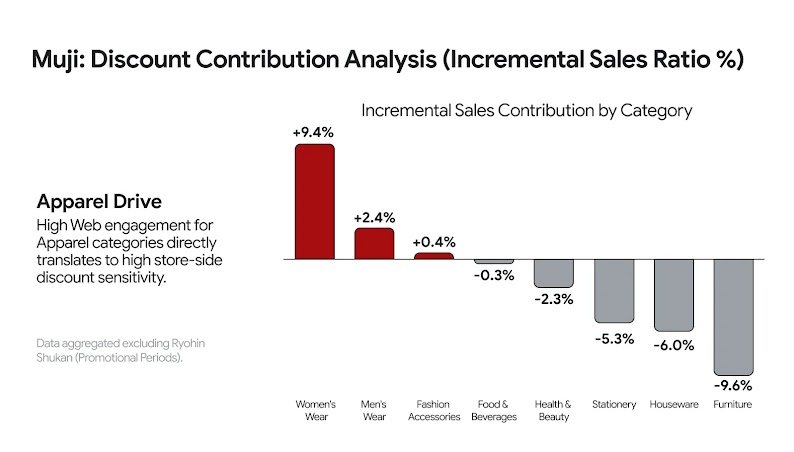
The counter-intuitive insight — that discount effectiveness can be negative for certain categories during specific periods — guided Muji’s teams to make smarter decisions for differentiated discounts and promotion timings across different product lines, thus improving ROI.
Promote profitably: Use OMO data insights to grow your business
Through its collaboration with Google, Muji is leveraging data beyond advertising campaigns, and driving efficiency in its promotional campaigns. In fact, recent promotions like Muji Week and Muji Good Price Festival doubled store and e-commerce sales year-over-year for the Japan business, and contributed to its robust 11.3% operating profit margins.
Indeed, when businesses use the right data-led insights and strategies to improve promotion efficiency, the discounts they spend on to acquire customers will lead to profitable sales. That’s backed by a BCG analysis for Google, which found that APAC’s businesses can achieve both customer growth and profitability by boosting critical promotions with advertising.
And to sustain profitable growth, you’ll need to continually deepen your understanding of OMO customers, as Muji is doing through its data-driven insights hub.
Your business, too, can improve promotion effectiveness by harnessing Google’s analytical and causal inference capabilities. Once you’re well-stocked with actionable insights, you’ll be ready to optimise both promotion and advertising for your best ROI.
Contributor: Dr. Martin Spindler, Professor of Data Science, Statistics & Econometrics, the University of Hamburg and the founder of Economic AI