





 Sign in with Google
 At Google, we treat responsibility not as a secondary layer, but as the foundational base of our AI-powered campaigns. Using AI effectively represents a significant opportunity for advertisers to scale across diverse inventory without compromising the values that define their brand.
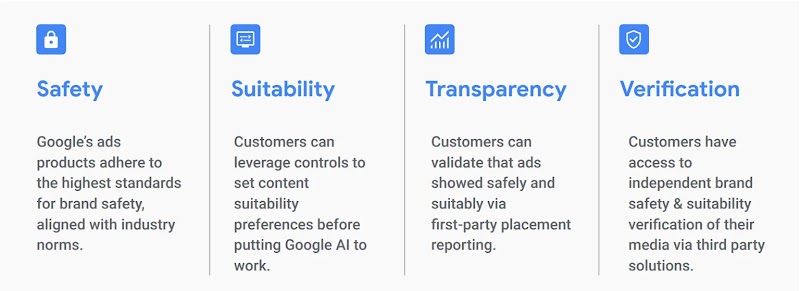
The Four Pillars of Media Responsibility
Our commitment to a trusted ecosystem is built on four fundamental principles designed to provide both protection and agency.
Navigating Responsibility Across the Ecosystem
AI-powered campaigns expand your reach across a multifaceted landscape. Understanding the specific guardrails for each environment is key to a sophisticated media strategy.
YouTube, Shorts & Feed
- YouTube: Videos on YouTube must meet YouTube’s Community Guidelines and Advertiser Friendly Guidelines in order to monetize videos. As a result YouTube advertising maintains a 99% effectiveness rate for brand safety across In-stream, Shorts, and the Watch Next feed.
- YouTube Shorts & Feeds (Home & Watch Next): We only serve ads adjacent to content that adheres to YouTube’s Advertiser Friendly Guidelines. For feeds, we follow the industry standard where brand safety protections apply to the video content immediately before and after the ad (+1/-1).
- Discover: Uses Search content policies as a baseline, with additional Discover specific policies. It only surfaces content that meets standards for expertise, authoritativeness, and trustworthiness.

“YouTube advertising meets 99% effectiveness for brand safety across In-stream, Livestream, Shorts, and Watch Next & Home feed content as determined by the industry-defined Brand Safety Floor.”(Google Internal Data, Global, 2025)
Search & Search Partner Network (SPN)
On Search, content policies apply, and all publishers admitted to any Google-based network are required to adhere to our Publisher Policies. Search Partner Network uses best-in-class Google technology to increase reach on high-quality 3rd-party search engines around the world.
Google Display Network (GDN) & 3rd-Party Exchanges
Our Publisher Policies outline strict limits on what can and cannot be monetized in order to maintain a trusted ads ecosystem. All publishers admitted to any Google-based network or selling inventory through 3rd party exchanges are required to adhere to these policies.
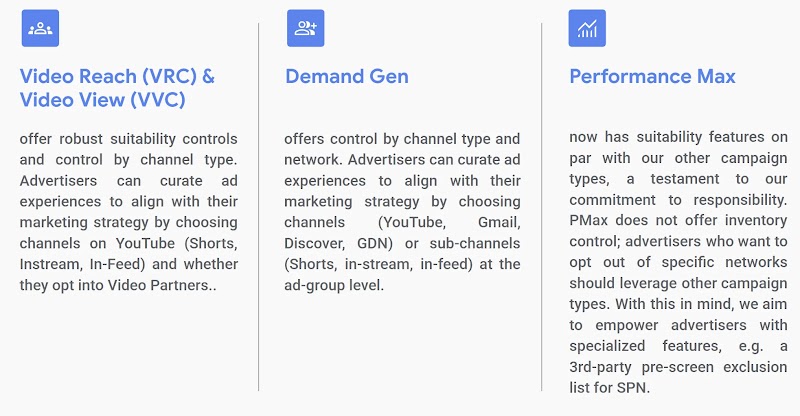
Understanding Suitability Steering by Campaign Type
As AI-powered campaigns expand reach across a diverse ecosystem of inventory, different campaign types offer different sets of suitability controls. Here is how our AI-powered formats allow for suitability steering:
Mastering Suitability: The Performance Trade-off
Mastering Suitability is a balancing act. While tighter controls ensure tighter alignment with your brand’s content standards, they can also impact the efficiency and ROI of your AI-Powered Campaigns. To maximize both reach and safety, consider following these best practices:
| Control Type | Recommended Best Practice | Estimated Impact on CPM |
| Inventory Modes | Use Maximum (formerly Expanded) or Moderate (formerly Standard) Inventory to balance reach and suitability. | Limited Mode CPMs can be >35% higher than Standard. |
| Content Types | Use as needed (e.g., excluding live streams). | Exclusions can lead to >60% higher CPMs |
| Excluded Themes | Select 1–3 themes based on brand preference. | Excluding >5 themes can raise CPMs by >40%. |
| Keyword Exclusions | Limit to fewer than 1,000 keywords. | >1k keyword exclusions can raise CPMs by >20%. |
| Placement Exclusions | Use exclusions rather than inclusion lists. | Inclusion lists can spike CPMs by over 60%. |
Taking Action: Your Responsible AI-Powered Campaign Strategy
As you continue to leverage AI-Powered campaigns to expand your reach, consider these next steps to ensure your strategy remains responsible:
- Audit your inventory opt outs: Review your current inventory exclusions to ensure they align with your latest brand guidelines. Consider opting into Feed and other formats where robust controls exist.
- Test new campaign types: Review your campaign types and consider testing AI-powered formats like Video Reach Campaigns (VRC) or Demand Gen, which offer robust suitability controls across YouTube In-stream, Shorts and In-feed.
- Review your suitability controls: Re-evaluate your suitability settings against the CPM impacts listed above. Aim for the broadest possible “safe” setting to allow the AI-Powered campaign to find your lowest-cost conversions.
