


 Sign in with Google
How AI is changing Google Search behavior and what it means for advertisers
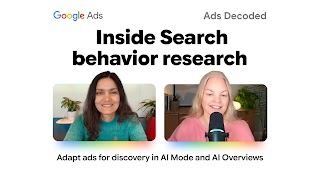
Join Google’s Ads Product Liaison, Ginny Marvin, and Shivani Mohan, Search Vice President of Data Science and User Experience Research (UXR), for a look under the hood at how billions of people search today. Together, they unpack how shifting behaviors across AI Overviews and AI Mode are reshaping discovery and what it means for your Google Ads strategy.
Episode overview
AI is expanding what people bring to Google Search. With the friction of translating complex curiosities into short keywords removed, people are asking net-new, detailed questions that run three times longer on average in conversational Search*, following up with back-and-forth context, and using voice and images across one in every six searches*.
As queries move up the funnel toward early discovery and brainstorming, searchers look for both quick orientation from authoritative sources and authentic human perspectives from reviews, podcasts, and videos. For advertisers, meeting those moments means pairing AI-powered campaign foundations with specific landing pages, diverse creative assets, and detailed product feeds designed for a low-friction customer journey.
In this episode:
- Inside Google Search Data Science and UXR: How Shivani Mohan’s teams pair one-on-one human interviews with behavioral data at scale to understand why and how billions of people search.
- Why this is an expansionary moment for Search: Why removing keyword friction leads people to ask net-new, three-times-longer questions, go deeper with conversational follow-ups, and use multimodal search.
- Balancing quick summaries with authentic human voices: Why searchers comparing options seek out original sources, customer reviews, podcasts, and how-to videos alongside AI-powered overviews.
- How Search is moving up the discovery funnel: What shifting upper-funnel brainstorming and exploratory queries mean for reaching customers well before their final purchase decision.
- Actionable takeaways for landing pages, feeds, and Google Ads: How to move past generic copy with specific landing pages, conversational Merchant Center attributes, and low-friction post-click journeys.
Want Ginny’s key takeaways and tips from this conversation? Subscribe to the Ads Decoded newsletter, watch the Ads Decoded series on YouTube, and connect with Ginny on LinkedIn and X.
**All data applies to AI Mode in the U.S. unless otherwise noted and is sourced from internal Google Search data, including Google Trends data. For more details on this information, see page 27 of How people are using AI Mode in the US.
Additional resources
Access the official announcements and guides you need to build higher-performing assets faster.
Put your best foot forward in evolving shopping journeys with strong feed data.
Transcript
Shivani: We have interviews with people on a one-on-one basis. We ask them a lot of questions to be able to unearth why they have certain ideas, and why they actually want to ask questions in a certain way.
***
Ginny: I’m Ginny Marvin, Ads Product Liaison at Google, and this is Ads Decoded, practical talk to help you navigate change, be in the know about new and upcoming features, and ultimately drive more value from Google Ads.
We are doing something a little different today and getting out of the advertising world and into the organic Search world. The massive changes that are happening in Search today - new experiences, new capabilities, shifts in user behavior - of course also have direct implications for the businesses advertising.
I am joined today by Shivani Mohan, Search Vice President of Data Science and UXR, which stands for User Experience Research. We’re going to learn more about that. She gives us a lens into how Search behaviors are shifting with the rise of AIO, or AI Overviews, and the rollout of AIM, or AI Mode.
You’ll hear them referred to as AIO and AIM in our conversation today. Shivani and her teams study how billions of users are searching. Join us as she gives us a look under the hood into her work, the modern Search experience, and what these long-form query trends mean for businesses. Enjoy.
***
Ginny: We talk a lot in the advertising community about ways in which Search behaviors are evolving and Search experiences are evolving, which obviously has distinct implications for advertisers and how they’re managing their campaigns. I am thrilled for this conversation. You sit right at the heart of these shifts in your work, so why don’t we start by having you tell us a little bit about your role and where you’re sitting in this moment?
Shivani: First off, thank you for this discussion. I’m Shivani, and I lead the Data Science and UXR teams in Google Search on the consumer side. What this means is that from UXR, we are the team responsible for deeply understanding the nuance behind user preferences, their motivations, and how they express their curiosities. On the Data Science side, we try to understand how to quantify the truth in a really principled way.
The interesting thing over here is that I arrived in this profession in an unconventional way. I started in industrial design, and what’s interesting about industrial design is that you get one shot to really nail the user understanding, because once you build the product, you can’t really iterate on it. I actually started as a bicycle designer, and that’s where my real passion for understanding users really began, because you really had to get in and understand what the user wants and what they want you to build.
As I got into this world of understanding user preferences and needs, I came into the world of tech. What’s really intriguing about tech is that this is not for a few thousand users - a lot of these companies serve billions of users. At that level of usage, you have to deeply understand the nuance of what people want and also quantify it in a really rigorous way, and that’s why the worlds of UXR and Data Science are really well positioned to drive product direction.
Ginny: We could have a whole other conversation about bike design. I do want to back up a little bit. With UXR, can you explain what User Experience Research is for those who may not be familiar?
Shivani: User Experience Research aims at understanding people’s preferences, their motivations, and really the why behind why they do certain things. We have interviews with people on a one-on-one basis, and we ask them a lot of questions to be able to unearth why they have certain ideas and why they actually want to ask questions in a certain way. Another thing that we often do is observe their behaviors on how they interact with, let’s say, a coach or a mentor, and how they ask questions in these scenarios so that we can translate these experiences and what they actually value about these discourses into our products and Search.
Now, UXR is very good at the deep understanding of why and the nuance. On the other side, Data Science is about actual observed behavior on the platform. You are looking at logs of how people are behaving, and then you’re able to quantify it to generate a truthful picture of how users are behaving today.
Ginny: User Experience Research might be new to some folks who may not be aware that the human element of behavioral research is happening on this front, so it is very helpful to get more insight on that.
I want to switch to Search itself. We hear often that this is an expansionary moment for Search, but what does that mean and what are you seeing?
Shivani: We are absolutely seeing this as an expansionary moment. If you zoom back a bit, people have asked questions and they have a lot of curiosities, but historically only a very small fraction of those could be easily translated and verbalized to ask in a search engine. What we are seeing in this moment is that a lot of those friction moments - where people had to translate their original curiosity into a keyword or a set of words - are now gone.
They can express themselves exactly how they wanted to ask the question. Now we are seeing that people are asking much longer, much more detailed questions. Even in Search, we can see that query length has increased 3x, and it isn’t just that they’re replacing their keyword queries with longer queries - they’re asking net-new types of queries that they would have never thought to ask before.
Another interesting thing is that people are now also asking their queries in new and novel ways, like asking a question about an image or a video. Earlier, it was much harder for them to do that or to provide that context for their question, but now we’re seeing more and more people able to do that.
A lot of our curiosities are also very conversational. When you’re having a conversation, you can go back and forth and learn more and more about a subject in a stateful, conversational way. What we are realizing is that in Search, people are just asking more questions because it is much more natural and frictionless.
Ginny: Actually, it was funny - I was just talking to a friend over the weekend, and I always love talking to people who are not in this world. I can’t remember what the context was, but she said, “The last time I typed in a three-word search in Google, I can’t even remember. Most of my searches are voice texts now.” It was funny seeing the real-world anecdotes come to life.
Sometimes when we say that people are searching more often or coming back to Search more often, the assumption is: does that mean they’re not getting the responses or the answers they wanted as quickly as they want, or at the accuracy or level of results they wanted? What do you say when people ask whether this actually means people are coming to Search to ask follow-on questions because they’re going deeper in their search, or because they’re not getting the responses they wanted so they have to keep asking questions?
Shivani: That’s a very good question. To begin with, it is very much the fact that people are coming to ask more and more new and novel questions, not that they’re coming back because they didn’t get the original question answered. Actually, in our Data Science practice, we penalize queries that we call “man refs,” or manual refinements, because we believe that we want to be very attuned to the original user intent. If we did not serve the original user intent well and we noticed that they had to write a few more words in to get the exact kind of answer they want, we don’t see that as a good signal.
What we’re actually seeing in this new world of the conversational paradigm is first, as I mentioned earlier, people are asking much more detailed, nuanced questions. Second, what we are noticing is that there’s a lot less friction, so you can actually ask a lot more curiosities much more easily. In a conversational paradigm, you can ask a question like, “What’s the weather in San Francisco today?” and as a follow-up, you can ask, “What about Austin?”
“What about Austin?” is not a standalone query, but because it’s a follow-up query, it’s already adding context from the original, so you can explore a lot more curiosities in a much more frictionless way.
Ginny: Very interesting. There’s been a lot of discourse in the industry about how AI and transformation are impacting the open web. What are you seeing from a Data Science or UXR perspective?
Shivani: I think a lot of people are still very clear that they want to hear authoritative voices and authentic human voices. We see that there is an interesting bridge between seeing a summarized theme, but wanting to dig deeper and see what actual authentic human reviewers say, what the voices on podcasts say, and what the voices on YouTube say. We actually see that users want both, and we have to build products that are able to meet that balance.
Ginny: From a specific behavior standpoint, what are you seeing in terms of how people are engaging with these new experiences? What’s the kind of content that they’re looking for in these experiences, and has that been evolving over the last year or couple of years?
Shivani: This goes back to what I was originally discussing, where people ask follow-up questions. Either they dive deeper and deeper into a topic - and through that deep dive, they can get more and more links that are much more attuned to exactly what they’re looking for - or they are in the world of exploration, where they really want to have a lean-back experience and see a lot more content presented to them in thematic ways. They really want to be able to explore the ecosystem in a way that is much more structured and see tranches of interesting content, and in that way, I think there’s an enormous opportunity for the ecosystem to continue to play.
Ginny: Businesses are thinking a lot about their content today - where their website fits in, where their engagement happens, and how they’re showing up across forums, YouTube, podcasts, and other content opportunities. From a user research standpoint, what are you seeing users gravitating toward, and what kinds of resources are they seeking out in Search today?
Shivani: There are a few different things. First, we are seeing that users obviously continue to seek out relevant websites and authoritative content. In the cases where they’re going after one right answer, they want to be able to see the actual original source of the content to gain confidence and trust.
There are other moments where users want to hear a lot more from authentic human voices, so they are gravitating a lot more to podcasts and review sites to hear from the voice of the original user. We are seeing a lot of these moments when people are diving into a comparison - trying to understand whether they should buy this or that. In that moment, they really don’t want to just see the summary; they want to hear from reviews about what people experienced using either product, and what the experiences were of people who are in their exact circumstance.
Additionally, in what we call “how-to” questions, where people are trying to get to the bottom of a problem or understand how to do something, they really appreciate videos that walk them through those how-to scenarios. Another thing we notice - especially as we get much more into personalized answers and meeting the user where they are - is that users really appreciate nuanced, detailed content. We are seeing a move away from more generic content toward much more specialized, detailed content, so authentic user voices and deeply personalized, unique content play a much larger role alongside evergreen authoritative content.
Ginny: Interesting. I think that is an especially good takeaway for business audiences listening to this as they think about their own content - making sure it’s in depth, answering specific questions, and solving or addressing pain points with more nuanced content than maybe they’ve focused on previously.
Shivani: That’s correct.
Ginny: We’ve talked a bit about evolving queries, and we’ve also heard about Search becoming more of a discovery vehicle. I would love to hear more about that, and also what actions people are taking from Search.
Shivani: What we’re seeing more and more with AI is that people’s queries are moving up the funnel. They’re actually asking a lot more brainstorming questions and a lot more questions on how to think about a space altogether. We are seeing a lot more discovery-oriented queries on Search, so I think it’s a very exciting moment for us to be operating across the funnel - from discovery to evaluation to purchase.
Ginny: I think that is also really interesting and an important takeaway for people to recalibrate how they’re thinking about Search outside of last-click action - thinking about ways of meeting users farther up in that discovery, research, awareness, and consideration phase.
We often get questions about how we derive the stats that we put out and how those come together. From your vantage point, I thought it would be a great opportunity to share what that process looks like internally, as it’s something I was very interested to understand more about when I came to Google.
Shivani: Absolutely. We put a lot of rigor behind all of our analysis, and obviously we put a lot of additional rigor behind any numbers that we put out. One of the things we look at very closely is the repeatability of that insight. We want to make sure that anything we put out has been rigorously tested to the point that if we were to run the analysis several times, we would get the same result. We don’t want to put out any number that is at a peak point or liable to change, so we put out numbers that are tested very strongly for durability.
Ginny: Switching gears a little bit, I want to talk about how marketers can ensure that their landing pages, their ad assets, and their totality of content better address the deeper questions you’re seeing and the deeper level of research that consumers are doing and expecting from Search.
Shivani: I think the fundamentals thankfully remain the same: you have to continue to develop really relevant content, because our ability to surface these websites in our ranking systems remains very steady. The nuance over here is that we’re increasingly seeing users gravitate toward more specific, more detailed, and more unique answers to their specific questions. To the extent that publishers and businesses can ensure they’re offering a lot more uniqueness in their answers that truly meets user needs, that will be really helpful - whereas generic answers in this moment in time are not hitting the mark quite as much. Overall, focusing on authenticity, factuality, and uniqueness is always going to be evergreen.
Ginny: To wrap up, if a digital marketer or an agency lead is looking at their Search strategy tomorrow morning, what are the top two or three actions that you would recommend they take to align with how people are searching today?
Shivani: People are asking longer and longer queries with a lot more nuanced, detailed personal context, and therefore they expect answers that are much more relevant, nuanced, and unique. People are also asking questions in new and novel ways with multimodal searches - one in every six searches is multimodal. Meeting those moments with really fresh content, authentic human voices, and information that is extremely specific and unique is going to serve our Search users extremely well.
Ginny: Great. And one last question: with your deep User Experience Research understanding, what could marketers learn from that? They may not have a UXR team or resources to dedicate specifically to UXR, so what are one or two UXR principles they could apply to the way they’re approaching marketing?
Shivani: A lot of UXR principles come down to how you align your product as closely to a human mental model as possible. Oftentimes we create products or experiences that are a little bit complex and don’t exactly match how a human being thinks through things. There are a few shorthands to meet that requirement: people usually find the path of least friction, human beings gravitate toward things that are simpler, and people gravitate toward things that provide delight. If you can hit those three meaningfully, it really helps the user navigate a lot of hard and difficult-to-understand content.
Ginny: All right, thank you so much, Shivani. This has been a very illuminating conversation for me. I think it’s going to be very helpful for the marketers listening, and thank you for sharing your expertise and insights into UXR and the evolution of Search.
Shivani: Thank you. Pleasure.
***
Ginny: I hope you found this deeper look into the latest in Search helpful. When we take a step back from the daily mechanics of managing campaigns, understanding actual human behavior can ultimately give us an edge as marketers. Here are the three main things that stood out to me from my conversation with Shivani:
First, Search is playing a bigger role in upper-funnel discovery, and that requires a mindset shift for a lot of us. With queries in conversational Search running three times longer on average and one in six searches now multimodal, users are relying on Google for discovery well before they reach their final purchase decisions.
Second, users are looking for real perspectives - like podcasts, video reviews, and nuanced insights. This means you must really understand what people are saying about your business online, and for advertisers, it points to new opportunities for landing pages. Remember that ads in AI Mode and AI Overviews are matched to both the query and the content of the AI response - the entire user context as a whole. Your ads should position your business as the natural next step in that user journey, and generic, surface-level content won’t cut it. And if you have a Merchant Center account, don’t forget to explore the new conversational attributes we discussed in our holiday ROI episodes. These six optional product data fields help you provide the exact nuance needed to answer highly conversational shopper queries.
Third, take a page from UXR and align your customer journey with how real people think and behave. As Shivani noted, users naturally gravitate toward the path of least friction.
Now is a really good time to audit your landing pages and asset mix, and move away from generic product blurbs and high-level corporate copy. If you’re in lead gen, build out rich, specific content that addresses conversational customer pain points. For retailers, make sure you’re paying extra attention to your product feed details, including those conversational attributes. No matter your business model, if you aren’t offering this level of depth, you’re bound to miss the moments where searchers are discovering, researching, and making up their minds.
Test expanding your creative assets to capture that upper-funnel discovery moment, and focus on reducing post-click friction. It’s likely that many of these tasks don’t sit directly in your wheelhouse, so partner with your Search, content, and CRO teams. Thank you so much for listening to Ads Decoded. We really appreciate all the feedback and questions we’re getting along the way. Until next time.
