




 Sign in with Google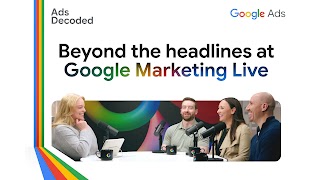
Join us for the season one finale of Ads Decoded: a special live recording at Google Marketing Live with the product teams behind the day’s biggest announcements across Search, YouTube, agentic commerce, creative and measurement.
Episode overview
First, host Ginny Marvin is joined by Google’s Head of Ads and Commerce, Vidhya Srinivasan, fresh off the keynote stage. They discuss how Gemini is fundamentally transforming intent understanding to keep with consumer behavior and deliver ads on longer, more complex searches, as well as unlocking performance on YouTube. Vidhya also shares the skills and mindsets she’s seeing in the teams who are succeeding in adapting and rewiring for the AI era.
That’s followed by an in-depth, technical roundtable with product leaders to double-click on the why and how behind the headlines:
- Reinventing ads for AI Search: Chris Monkman, Senior Director for Ads in AI Experiences, breaks down how AI Max and Performance Max deliver ads that provide rich answers to complex queries in AI Mode, and how the new AI Brief delivers the brand control and audience constraints you need.
- Graduating measurement from report card to performance driver: Christine Turner, Managing Director for Measurement, Data & Audiences, talks about the compounding effects of data strength and details the rollout of new metrics like Campaign Type Attribution for Demand Gen, Attributed Branded Searches, and Qualified Future Conversions
- Generating high-performing ad creative at scale: Josh Moser, Advertising Platform Senior Director, shares how bringing our most advanced AI Models into Asset Studio really is allowing advertisers to quickly build and scale creative assets that are optimized for performance.
Want Ginny’s key takeaways and tips from this conversation? Subscribe to the Ads Decoded newsletter.
Additional resources
Explore the Google Marketing Live hub
Get the complete recap of the biggest ads innovation event of the year.
Transcript
Vidhya: I get that change is hard. It’s hard for everybody, but the thing to lean into is we are also all consumers. And I’m sure all of us have benefited from having these conversational experiences of Search in so many, so many ways.
And now if you step back and say, okay, people’s behaviors are changing, they’re getting more natural and how they behave with other people, but ads have to just be part of that experience. Now the tech is there, the tech can do all of this. What that means is the advertiser, the way they provide assets, the way they define their campaigns and how they go about it, has to keep up with all of this that is changing.
**
Ginny: Hello, I’m back from Google Marketing Live, Google’s annual ads event with the latest innovations. Had a great time meeting a whole lot of new marketers and catching up with old friends in the ad industry. I also sat down with product leaders to learn more about some of the biggest announcements of the day and get their perspectives on industry shifts. If you caught Ads Decoded on the Google Marketing Live livestream, we have an extended version for you today.
Including my interview with Vidya Srinivasan, Google’s Head of Ads and Commerce. That’s followed by my backstage conversation with Christine Turner on Measurement, Chris Monkman on the new ads experiences in AI Search, and Josh Moser on Scaling Creative. We’re going to talk Search, YouTube, and so much more. Let’s go backstage.
**
Ginny: Vidhya, you’re fresh off the stage at GML and we saw Gemini front and center. We are also seeing consumers adopting AI so rapidly and see it in my own behavior.
Marketers are having a challenge keeping up and it reminds me a lot of the mobile shift where, again, we saw that pace of change going really fast - although in retrospect, that feels like it’s molasses compared to where we are now.
It seemed a lot of the announcements today were really aimed at helping close that velocity gap between consumer and marketer.
Search is obviously a space where we’re seeing rapid change, and I’m sure though we’ve been on this path for a while. We saw a lot of ears perk up when you said we are gonna be moving beyond picking keywords. so two things.
One is: how is Gemini changing Google’s understanding of intent? And two: how do you reassure advertisers who are hesitant about loosening their grip on their well honed keyword lists?
Vidhya: Great question. It’s really an expansionary moment for search, I would say. People are asking a lot of questions where they want quick answers, but they’re also asking these very, very long complex questions in conversational mode where they wanna go back and forth with Gemini - sometimes they’re happy with AI Overviews, or the conversations in AI Mode.
And it’s fascinating to see the kind of depth of conversation that happens now and really just how well Gemini can understand what people are asking for and come back with results.
Now, when you talk about, what does it mean for the advertiser, first thing I’ll say is: I get that change is hard - it’s hard for everybody, but the thing to lean into is we are also all consumers. And I’m sure all of us have benefited from having these conversational experiences of Search in so many, so many ways.
And I think, you sort of start with leaning into that. And then I think the few things that have changed is, Gemini is incredibly good at understanding content. We didn’t used to be able to have a system that just quickly went to all the advertiser assets and be able to aggregate all of that and come back with an answer the way we can do with these models today. And that’s an incredibly powerful tool at our disposal when it comes to ads and what we can do.
The other thing is, it’s so much better at multimodal input and the world is multimodal. We see, we talk, we hear all of these things come together, and I think that is another reason to really lean in because we are getting closer and closer to how people naturally behave.
And now if you step back and say, okay, people’s behaviors are changing, they’re getting more natural and how they behave with other people but ads have to just be part of that experience. Now the tech is there, the tech can do all of this.
What that means is advertisers, the way they provide assets, the way they define their campaigns and how they go about it, has to keep up with all of this that is changing and many, many things to do. But I, I really believe it’s a moment where leaning into this and really honing in on what’s unique about every business about your business. And figuring out the right assets for it can make a massive difference to how you show up for people.
Ginny: We talked about this with Brandon Irvin in an earlier episode about how keywords are becoming just another signal of intent - not the like north star that we used to have to rely on so much for keywords to be that signal. So I think that is just so interesting in terms of how people need to rethink the role of keywords.
We heard about Gemini’s also improving the ability to understand intent. We’re also seeing helping marketers be able to discover and partner with creators much more easily than in the past.
For marketers who’ve historically seen YouTube as a brand play, how is Gemini working to unlock performance opportunities for marketers with YouTube?
Vidhya: Marketers actually use YouTube to drive performance a fair bit, and one of the ways that we’ve really accelerated on that front is with Demand Gen. It’s something that we’ve spent a lot of, our own investment in coming up with new formats and really ensuring that it gives the best performance for people, for advertisers who use the product.
And we’re seeing great results from what Demand Gen is able to drive for advertisers. The other big priority for us is really to make this connection where brands can find the right creators and creators can find the right brands because it’s a way for them to connect to the right audiences, make that whole thing a lot easier, and happen in a scaled fashion.
And again, it really goes back to the incredible capabilities we see in the Gemini models, because it is able to both understand the requirements that the brands have in terms of what they wish to achieve. And it understands the creator’s voice and their audience and what they bring to the table, and it’s able to suggest matches at scale so that we can make this happen more organically across the board.
And it’s something that we are super excited about, because YouTube does have the most trusted creators and incredible audiences that the brands really want to get to.
Ginny: And we’re seeing ad formats becoming more shoppable, being able to connect your product feed - so all of those things are coming together, and then backend updates with Demand Gen, really to help drive performance, whatever your goals are.
Vidhya: Right. So I think the ads themselves becoming shoppable is going to be very key to consumers because imagine you are watching YouTube on your TV. And then you see an ad that you really like. Now with the UCP type integration, you can have a buy button that’s right there.
So in a couple of clicks you can actually go from, you know, looking at something that you like to actually purchasing it. And it’s just super powerful for video ads when you connect all of these pieces together.
Ginny: We also heard a lot more about Universal Commerce Protocol, UCP, becoming the bedrock for agentic commerce. And as agents are doing more of the heavy lifting for shoppers, I think the big question that merchants have right now is, how do I ensure that I am discoverable and agent ready?
Vidhya: Great questions, again. I think the first thing merchants can do is to continue updating the Merchant Center feed if you already have one - or have a Merchant Center feed for all your products - and make sure it is the best quality feed that you can provide us. Make sure it gets updated and refreshed as soon as you’re able to do that as your products shift.
And then the second thing is, we are also introducing a lot of conversational attributes to Merchant Center feeds. And these have been really designed to capture the kind of information that we really need when we have these conversational experiences with our consumers. So things like, give us Q&A, more information about typical Q&As you would have, and other kind of reviews that is hard to find otherwise.
Having that kind of detailed information right there in the Merchant Center feed goes a long way in providing an answer that is highly contextual to what the user is looking for when we actually have these questions come in.
The other thing I would say is, just a diversity of assets. As I said, one of the changes with Search is it’s becoming a lot more multimodal. So giving us videos and high quality images along with all the text and everything else, with the websites and everything else that you have, becomes very important. And having this diversity of very high quality assets that capture your unique brand voice is really what’s going to make a difference when these experiences come up.
Ginny: The unique brand voice, you mentioned it earlier, again I just want to double down on that, because I do think it’s so important. People are often wondering, is AI going to make everything seem the same? What you’re saying is you need to really know your brand and know your brand voice and reflecting that in your assets, in your Merchant Center feed, having that full representation of your voice is going to help you stand out.
Vidhya: That’s right. And you can think of the AI capabilities as, you know, being available to all the merchants - so in a way, sort of, the average has gone up in terms of what is possible, but again, being discovered in that now - with this new average or new starting point - still comes back to what makes a specific brand unique. And I think understanding that and amplifying that becomes a job.
Ginny: We’re also seeing AI move from a tool to help advertisers automate their tasks to becoming much more of a partner. So I’m thinking about the unified Ask Advisor across Ads, Analytics, Merchant Center, DV360 - as well as new capabilities in Asset Studio.
And so I’m wondering how you’re envisioning these tools, helping to reimagine, how are they going to change marketers’ daily workflows?
Vidhya: I think it’s particularly exciting for people who are using these tools day to day, because we’ve had agents in each of these tools, conversational agents that can help. And what we are saying is increasingly people want to do things that go across these tools and just be able to get these things done fast.
So we introduced the Ask Advisor that actually works across all of these products. And the idea is, it’ll be able to surface insights and key information from other products while you’re working in any given product. And that just gives you the full picture before you go ahead and make any change, wherever you are.
The other nice thing is it is able to work with the agents, but in the other tools to bring in the context as well, I would say it’s a way to have a single partner - almost like a brainstorming partner - that you can go back and forth with irrespective of which tool that you work on. And, we do the heavy lifting of bringing in the context and the insights across these tools so that you have continuity as you use many of our products together.
Ginny: I want to ask, we mentioned change management is hard. There’s a lot of change coming at marketers. You speak with agencies and advertisers throughout the year: I’m wondering what you see from a skills, mindset standpoint, stands out to you in terms of teams that you’re seeing adapt and rewire for the AI era really successfully? Or what has really helped you and your teams also rewire?
Vidhya: Yeah. I think a mindset is super important, I would say at this point in time. We see this as the future: it’s not a temporary fad or anything. And we are all in.
And then the question really is around, how much of this is in the technology side of the house, and how much of this is in the people, skill sets and culture side of what needs to happen? And for this sort of the shift that AI is bringing upon for all businesses, including what we do at Google. I think it’s a combo, combination of both.
I think you lean into it with a lot of curiosity and excitement, because it unlocks so many things that we couldn’t do before. At the same time, I think you have to be very clear-eyed about, what are the things that you’re trying to accomplish at the end of the day? And also break it down into mapping what are the organizational structures and culture that will carry on and really serve you as you move towards a future like this? And where you might need to tweak that - but do that very intentionally because all of them have to go hand in hand.
Ginny: I love that. And just thinking about being agile, and you mentioned being curious, thinking, you know, short term, how are things working - but also having that long term vision of we know things are going to keep progressing. And so we better adopt a framework that will help us move forward.
Vidhya: That’s right. I think the key thing is being okay not knowing everything, because we are in that era where the model capabilities are still evolving at such a tremendous pace. What’s possible in a year - I think we can all make some guesses, but we are going to see what happens - and then you’ll have to pivot to whatever that is to leverage what you have available.
And so the thing is to understand, what are the next set of no-regret moves that you will make? And what data should come in to let you decide whether you stay the course, or you decide to not pursue something - or you realize you need to pursue something else.
Ginny: Constant challenging. Testing, experimenting. Love the piece about bringing data in, and making data-driven decisions. Great. Thank you so much for joining Ads Decoded. We appreciate it.
Vidhya: Thank you. Thanks for having me here.
**
Ginny: Welcome, Josh, Christine and Chris. Great to have you all here. Each of you have been in Search, YouTube and measurement for so many years. And what is standing out to you about this moment? Josh, why don’t we start with you?
Josh: One thing that stands out to me is the pace of development. It’s really cool how we’re seeing some of these new AI-enabled workflows and other capabilities, to take product ideas that felt like science fiction a year or two ago. And let us kind of turn them into real, live products for people to use.
The creative space is certainly one where we’ve seen a lot of that. I think, you know, both the quality and the capabilities to help, kind of, brainstorm new creative messaging, create text images, and now - as you’re seeing on stage - even video, is really remarkable.
And part of what I like about these new developments is, it’s not just about the quality of what’s being produced. We’re basically finding new ways for advertisers to provide inputs around,
how do they want their brand to show up? What are the types of audiences they want to reach, and what types of creatives do they want to show to those audiences?
And so that enables a level of personalization that just wasn’t possible even a year or two ago. And so it’s really fulfilling to be able to work on those types of products and bring them to life.
Ginny: And how about you, Chris?
Chris: Well, it’s a really exciting time to be working in Search. With the AI experiences I feel like Search has just become so much more powerful and helpful. You know, like, we’re seeing it definitely in the user data: a lot more long queries, a lot more complicated queries coming our way. Definitely more growth in the kind of things that users are bringing to us.
And even in my own personal life, like we introduced AI Mode exactly a year ago. And, you know, at first it was a really helpful feature, but now I find I’m starting all of my Search journeys there.
And the other thing that’s really striking to me is the technology pace itself. So, you know, I’ve been working on quality models for ads for over a decade, and it’s really striking to see how good Gemini is at things like relevance.
And lastly, you know, I think the change in user behavior and their, sort of, expectations around what a Search result looks like is really shifted. We’re seeing a lot more demand for answers - and in fact, that’s what Vidya called out in the keynote. And to me, this is really driving a lot of our roadmap these days.
Ginny: And how about you, Christine?
Christine: Well, I mean, how exciting to be here talking about creative and AI. And I think just as an industry, it’s a really exciting time.
But for me, on the measurement side, I think what’s been really fascinating - I’ve been in the space now for over 20 years - and it feels like on the measurement conversation, we’ve officially graduated from the world where we’re really talking about campaign metrics, things like, you know, tracking clicks to really being in a space where this is all about business outcomes for advertisers.
And we’ve been on that journey for a long time, but it really feels like we’ve come to the other side of that.
The other thing, and hopefully people see this in some of the announcements today, is we’re really moving into a world where measurement is not just a report card. It’s not about looking backwards and saying, oh, here’s the proof on how I’ve performed, but it’s actually becoming the fuel for performance moving forward and becoming more predictive, so it gives marketers a lot more data to make great decisions on.
Ginny: And so the through line obviously here is AI is impacting all aspects of from creative to the ads to the way that we can measure, and report, and activate.
Okay. We are going to dig into several of the announcements we’ve just heard about on stage, specifically around YouTube, creative, and new ad experiences in AI Mode.
So, Chris, let’s start with you: Sylvanus and Vidya, they both showcased several new ad experiences that your team is working on for AI Mode. And Vidya mentioned specifically that we aren’t just putting ads in AI experiences, we are reinventing what an ad is.
Your team is behind that: it’s no small task. You spoke a little bit about the changing consumer behavior, but how are those changes that you’re seeing in AI Mode, AI Overviews, shaping the work that you’re doing on ad experiences?
Chris: So we’ve always been really focused on trust on ad helpfulness and relevance, as well as advertiser value. The difference is that, you know, expectations have really changed. The bar is so much higher these days.
So let’s just take trust for example. You know, definitely what you see in the ad formats we show today. As usual, they’re clearly labeled as sponsored, right?
When there’s advertiser creative voice text, it’s clearly called out separately from the AI voice text. But one of the things we’ve been really thinking a lot about in our, sort of, development for AI experiences is what we call the principle agent problem. And the idea here is that, like, in order for users to want to keep using and trust this AI product, they have to feel like it’s acting in their best interests.
And so, for example, one of the things you’ll see in the formats that we release today is this independent AI explainer. The idea there is that the AI can provide an objective, independent evaluation of the ad and why it might make sense for the user. And we’ve designed it in a way so that advertisers can’t directly influence that text.
And with Direct Offers, we’ve designed it so that, you know, users can only get a better deal. They can’t be charged more with this product. It’s simply working for them to find them more value.
Another thing that’s really striking is the change in relevance. These days the context matters so much. So the users come to us with a very long and complex query. It’s very hard to understand that query with, sort of, traditional methods. And then there’s a very rich AI response, and we need to match the ads not just to that more complicated query, but also to that rich AI response.
And so we’re really leveraging Gemini to match ads to the query now. And that’s really changed, like, the quality, I think, of the results that we’re giving in the helpfulness of the response.
And we also think that based on the user, sort, of data that we’re seeing, as well as the user feedback we’re getting, users really expect a more rich answer.
Ginny: You just spoke about the user trust, user value, but can you just talk a little bit more, about the thought process behind the AI explainers specifically?
Chris: Yeah, sure. So exactly. You’re right. It’s all about user trust. And so what we’re seeing in the user research is that these explainers, they really do improve trust overall in the product as well as consideration of ads. And so my belief is that by showing these explainers on the ads, users are going to be much more willing to look at ads in the AI experiences and ultimately converse with them, driving much higher valued clicks.
So the way it works is very similar to how standard AI responses work in an AI mode. And that is, we go and we fetch search results about these ads, and we summarize those in the AI explainer. And the goal is to provide this objective, independent evaluation for the user. And we’ve designed it so that advertisers cannot directly influence their response, so that users can trust that it is a fair and objective evaluation.
Ginny: Great. It’s fascinating. I think it’s going to be so interesting to see these coming out live. Now this brings me to keywords. Long been a north star of intent: you type in a few words, you get results back on Search, YouTube. That is changing, as you’ve been explaining. So it’s requiring a lot of rewiring - mindset shift - for advertisers.
AI Max was built to help respond to these shifts. And we’ve also heard ways today about how PMax and Demand Gen are also getting better at understanding intent.
And so PMax and AI Max were very much emphasized as the ways to show up in these new ad experiences in AI Mode. Question again, also from our live Q&A, that has come up is: why are AI Max and PMax the ways to buy these new ads, and what can they enable that standard Shopping and Search campaigns cannot?
Chris: Yeah. So there’s really two important parts to this. So the first is that the query stream has materially changed. So we’re seeing a lot longer queries, much more complex queries with, like, very interesting sort of constraints on them. The users are coming to us with much harder problems. And you know, it’s just very difficult to ever choose keywords manually that can match these queries. And we’re seeing a lot of benefit from using Gemini to look at the context of the AI response, as well as the user’s query and decide what ads are relevant.
And so it’s very important that advertisers enable automated targeting so that we can match their ads better to these queries. And the second part that you sort of saw in the formats the video announced today, is that we’re trying to dynamically generate the creative text at query time to better answer the user’s need.
And what we’re really clearly seeing in the user research is that users are expecting answers. They don’t just want, like, results out to a page: they want to have a better understanding of why the ad is relevant to them. So that text customization part of PMax and AI Max is really critical for advertisers to adopt.
The thing we’ve also heard a lot from advertisers, though, is that they worry a lot about control. So we’ve been listening very carefully to advertiser feedback. And that’s why we announced the AI Brief. And so the idea here is that, yes, we need to adapt this creative, in real time, you know, to really understand the user’s needs and sort of explain the why.
But we also have to do it in a way that, you know, respects the advertiser’s brand message and gives them this, sort of, control over the audiences that they want to target as well. And so the AI Brief really rolls all that into one. So there’s like the targeting aspect to it, there’s the creative messaging part to it. And we think that this is a really great way for advertisers to take advantage of all this AI, sort of, matching and text customization in a way that fits their goals and gives them the control that they need.
Ginny: And that’s building on the text guidelines that we’ve already had. And that will roll automatically into AI Brief.
And there were at least a couple of formats that were specifically tailored for lead gen advertisers, which I’m sure a lot of our audience is excited to see.
Christine: data and measurement are so important for ensuring that lead gen advertisers can generate quality leads. And we’ve talked about this in-depth in a recent lead gen episode. And Gaurav talked on stage about the compounding effects of data strength. And we’ve also announced more tools to help do the heavy lifting for advertisers.
So what do you see as the biggest opportunity for lead gen advertisers, in particular, to improve their data and measurement game?
Christine: Yeah. So I mean, data data data in all formats is something we talk a lot about. I think one of the very interesting things is the continued evolution of our access and our implementation of tagging.
But - very importantly for lead gen advertisers as well - one of the things that we announced that I’m really excited about is bringing the simplicity of tagging through Google Tag Manager into Google Ads and Google Analytics. So regardless of where you are as a marketer, you will have access to that upgrading of your tags. In addition to that, of course, we’ve spent the last few years really talking about the importance of bringing in offline data - as well as identifiers - in through Data Manager.
And I think the importance for lead gen advertisers is really being able to shift from that place where you’re just looking at volume on some of that early signal things - like somebody completed a form or clicked through to a website - and actually being able to bring back in the value that comes on the other side.
So for lead gen in particular, we see longer sale cycles or longer decision cycles. And so being able to get that data back into our systems ultimately is what fuels your AI products even better. Right? So we don’t just want to drive leads. We want to drive high quality, high value leads for marketers. And so building those connections continues to be critical.
Ginny: And I think also, the point about I just wanted to go back to the Google Tag Manager and just underscoring the fundamental importance of tagging.
I think it’s something that people set it and forget it, do it once, don’t come back to it. And so having Tag Manager accessible in Ads, Analytics, I was very excited to see that
Christine: It’s very exciting. And obviously we’ve had an evolution in tags. Right? So if you look at what we’ve done with Google tag gateway in particular, this is about helping marketers enable signals that ad blockers would have otherwise, sort of, stripped from your view of your campaigns and not just drive a more accurate view of attribution, but actually that helps you like feedback into optimization, which is the compounding effect that Gaurav was talking about today.
Ginny: And I know we’ve - not today - but have recently announced more partnerships for Google Tag Gateway to be able to more easily implement that
Christine: And more coming. So we’re very excited about that.
Ginny: We also announced some other things for measurement. Attributed Branded Searches has been largely rolled out at this point. We also announced new Qualified Future Conversions and Campaign Type Attribution. What are you excited about in this area and why?
Christine: Well, I’m excited about all of it. I think I’ll start from the bottom of that: so, Campaign Type Attribution has been a request from marketers for a very long time. I think many people know, as a default in our conversion attribution we de-dup conversions across all campaign types within your Google mix.
And I think in particular for the campaign type of Demand Gen, leading a consumer down the path to conversion, there’s always been a question of: what role has it played in that conversion path for consumers?
And so what Campaign Type Attribution does, is actually allow marketers to look at the direct link that Demand Gen has in that attribution path - and see that which is a more apples-to-apples view (for what we also get a lot of requests about) to other social platforms. So really it’s about isolating that Demand Gen performance and really understanding how it’s influencing future conversions.
Ginny: So you can see the full spectrum of where it’s assisting along the way.
Christine: Exactly, exactly. You’ve also mentioned Attributed Branded Search, which is an exciting new metric that, as you said, has mostly rolled out. But really, this is about linking after a user is exposed to an ad, did they then go and take a Search for your brand or your specific product? Which we know through a lot of research is highly connected to future intent - but it’s a metric that gives marketers that real time view of what’s happening and how your campaign is ultimately driving more people again, through that funnel.
We’ve seen in different categories that marketers actually can use that information on Attributed Brand Searches to really predict future market share, future sales.
And then the Qualified Future Conversions is very much in that category too. It looks at signals like Attributed Brand Searches, but importantly, a lot of other signals that consumers do after being exposed to an ad. And what it does is really mathematically predict what future profitable growth would look like for that marketer.
And so I’m really excited about this, because we know decision cycles for consumers can be longer. And so this allows marketers, again, another tool to recognize things that might come further downstream.
Ginny: And both Attributed Branded Searches and Qualified Future Conversions are always-on in the UI. It’s not something that you need to run experiment tests for.
Christine: Correct, so that are intended to be really strong proxies for marketers to make decisions on.
Ginny: So speaking of demonstrating the value of YouTube, when we’re on the topic of video, Josh: you demoed the ability to generate text, images and video in Asset Studio on stage. So for businesses who haven’t had a lot of creative resources, what are some of the tips for them to get the most out of Asset Studio?
Josh: Yeah, I mean this is a really cool capability. I think you you saw it in some of the visuals on stage, but being able to go from just like an idea, general concept of of what you want to show and how you want to kind of convey your business to, like having a full slate of all of the headlines, descriptions, images and all the different aspect ratios, and now videos is a really, really, remarkable capability.
And so, I think the first callout would just be: to try out the tools, see what you can come up with, experiment with a few different creative messages and sort of it gives you a way to almost have real time feedback for yourself on what’s working really well.
The other area where we’re seeing a lot of businesses start to take advantage of these tools is, the reality that there’s so many different formats, there’s so many different surfaces across Google Ads that historically it’s been really hard to, like, develop a creative that works really well in each of those different contexts.
You might only have, you know, the budget to shoot one video, and you’re not necessarily going to have shortform vertical videos, plus in-stream, plus all of these other formats that you need to show up really well across all of YouTube.
And so, that ability to try out a much broader diversity of assets and make sure that you’re showing consumers an ad that’s really specific to what they’re looking for and really specific to the surface that they’re seeing it on, I think, is is, net-new and something that’s going to help a lot with driving performance, getting results, and making sure that the ads that consumers see are relevant and match what they’re looking for.
Ginny: I absolutely agree with trying it out, testing it, exploring what’s there.
I think also, one of the things that’s so interesting about it is that you can bring in assets from Canva and other platforms. And also, if I’m not mistaken, you can share for creative reviews with the rest of your team stakeholders, clients.
Josh: Over and over we heard, ‘hey, my creatives and Google ads are like one piece of a much larger ecosystem, and I need to be able to take the work that I’m doing in products like Adobe, in Canva, or in my own digital asset management system.’ And it’s actually quite hard to, like, bring those over into Google Ads and tailor them in all the right ways so that you’re showing up in all these different campaigns.
And so, a big part of what we’ve developed is an easier way to bridge those assets over so that they just show up in your library, you’re able to customize them in just a couple of clicks and tailor them so that they’re set up really well for Google Ads. And then to your point, you might need to then be able to, like, share the previews of what those updated assets look like with your marketing departments, with legal, and other stakeholders to make sure they’re comfortable, reviewing them before they run.
And so both that ability to bring things easily into Asset Studio and then to be able to share them out when you need to are capabilities we’re seeing a lot of interest in and engagement on.
Ginny: So it’s both about giving people more creative resources, and improving creative workflows.
Josh:
Exactly.
Ginny: Also, the A/B asset experiments in Asset Studio is really interesting. We heard a lot of excitement about this as well. So can you share a little bit more about how it works?
Josh: Yes, I would love to. This is why I like this format, because we can go a little bit deeper than like what you would see on stage normally, right? So I think about, like sort of, two categories of what we’re bringing forward with these experiment capabilities.
Category one is well, why do you need to run experiments on creatives? You know, you have all this data about, the clickthrough rates and conversion rates and so on, of your assets. But the reality is that only tells you half the story. If you’re just looking at you, kind of, historical time series data, that doesn’t actually tell you how those assets incrementally contributed to your performance.
So to give an example, you might have, you know, a particular image or a particular video that has relatively low click through rate and you might think, oh, well, that must mean it doesn’t perform well. But it could also just mean that it tends to get shown to users who already had a relatively low clickthrough rate, and that asset might still be incrementally helping their performance.
If you really want to understand what message is working best with your customers, you have to run an A/B experiment. It’s the gold standard for causality and figuring out what is driving results.
Now the other half of it is that, I can see this as someone who’s worked on experiment products for years to strictly been a little bit painful to run experiments in Google Ads. And so I’m really excited about the new capability we’re rolling out; it makes it really easy to just swap out your creative messages. And so when you have an asset you want to test, it’s basically one click. And all we’re going to change is those two assets. And you can take a look and actually get the full readout of, how did that affect your performance, what incremental results did this new asset drive?
And you don’t have the kind of messiness of your campaigns getting copied and lots of other things getting out of sync. And so, it makes it much more approachable and easier to use. And ultimately, that means you’re going to be able to see what messages are actually driving incremental performance based on whatever your business goals are in a way that just wasn’t really possible before.
Ginny: So to close out, I want to recognize that this is an incredibly dynamic time in advertising, and the pace of change can often feel quite overwhelming. I think you also, though, have all spoken about the pace of change for the work that you’re doing, and how fast things are moving.
And, that means that advertisers have to also keep pace with this change. And change management is difficult.
So in that spirit, what is one action item that marketers can put on their schedule for next week to hit the ground running? Why don’t we start with you, Josh?
Josh: I think the first thing that I’d want people to try is to create, it’s really interesting how we’re seeing the role of marketers evolve. You’re getting a lot more levers and a lot more inputs to help tell the story that you want to tell. And then AI is enhancing it and helping make sure that it’s showing up in the way that you want it for all of the different audience you want to reach across all of these new services and formats, making sure it’s relevant for them, making sure it’s engaging.
There’s also a connection to goals as well. To your earlier point about bringing in that, kind of, lower funnel lead data: that’s actually really important for creative as well, because that helps you understand what are the messages that reach people who don’t just fill out a form, they actually go on to become paying customers, and they actually drive value for your business as an advertiser.
And so I think there’s a synergistic effect here where as you try out some of these new creative messages, if you have the right measurement set up, if you’re using the types of automation we’ve talked about, you’re going to very quickly be able to learn what’s actually resonating, what’s actually driving those business outcomes that you care about.
Christine: And so creative can be an optimizer in that way, right? It finds audiences that you wouldn’t otherwise think it would find.
Ginny: That is such a good point. I love that because, I think this comes up often when people - we’ve talked about this in other episodes as well - when you see an asset that is getting maybe minimal impressions, but it is driving performance. And often that can just mean it’s you’re reaching a niche audience that you would not have reached otherwise without that asset being part of that combination.
All right. Chris, what would you say?
Chris: I don’t really want to give one! You know, we spoke about how in order to, like, try out these new formats that we’re experimenting with ads in AI Mode that you need, to adopt AI Max with text customization. so that’s something advertisers, they can go and they can do today.
But, you know, we’re also working on a bunch of other things in AI Mode. And I’m really excited about Direct Offers. You know, we’ve seen some really good early traction. We’ve decided to put a lot more effort behind this experiment.And so the other thing I’d really love advertisers to do, is try out these new experiments, like Direct Offers, and tell us what they think about them so that we can bring that back into the product and keep innovating together.
Ginny: Great. And, Christine?
Christine: Data, data, data. So, you know, we really see that having a good data set up from both tags - as well as offline data - that becomes the big competitive advantage for marketers. And so if you have not yet established both your updated Google tag gateway as well as bringing in data through Data Manager, that would be the place I would start.
But then also don’t forget, we have big announcements in Google Analytics about linking a lot of third party data and impressions, as well as cost data, so that you can actually really start to see the full consumer path. So a lot of different ways to connect data and to bring more collective insight to your decision making.
Ginny: So often hear concerns from advertisers with either long sales cycles or they feel like they have low conversion volume for that end conversion and are hesitant to get started with their data action plan because they feel like they’re already behind. What do you say to those advertisers?
Christine: First and foremost, start with what you have, but also you don’t have to start at the end, the most perfect data set, right? So of course, we have some marketers that have gone through the trouble of assigning lifetime value to every person who’s converted, and that’s really powerful data. But if you’re not there, that’s okay. There’s probably a lot of steps in between that actually will really fuel and give insight into all of our AI campaign types that you’ve heard about today.
So I think it’s important to start with what you have. We also, as we talked about a little bit earlier, we have a lot of partnerships and connectors out there. So explore some of the partnerships, with maybe some of your CMS providers ,so that you’re connecting the pieces that can actually, you know, feed back in.
Ginny: All right. That’ll do it. A huge thank you to Christine, Chris and Josh for being here today. It’s been so exciting to wrap up our first season of Ads Decoded here at Google Marketing Live.
**
Ginny: It was great to be on the ground to hear straight from product leaders to go deeper on the why and how of some of the biggest announcements from GML. We will have more to share with you on the Ads Decoded newsletter on the Google Ads LinkedIn page, so look for that in a day or so.
And that is a wrap on season one. We will be back in late August with full episodes. And in the meantime, keep an eye out for community Q & A segments right here in this feed. We will be answering all your burning questions. And if you have one to submit, you can send us an email at addsdecoded at google.com.
Thank you for all the questions, all the engagement all season long. Until next time.
