


 Sign in with Google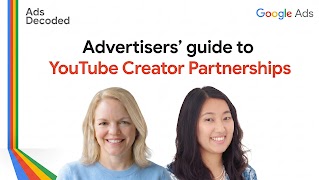
Join host Ginny Marvin as we break down how to discover, manage, and activate creator-driven ads in your performance campaigns.
Episode overview
For a long time, creator marketing was seen as a “big brand” awareness play or best suited for retail businesses. If your focus is on performance, B2B, or lead generation, creator content might not have been in your toolkit - until now.
In this episode of Ads Decoded, host Ginny Marvin is live from the YouTube NewFronts stage with Melissa Hsieh Nikolic, Director of Product Management for YouTube Ads. They dive into how Google is making it easier for brands of all sizes and across sectors to integrate authentic creator voices directly into their performance campaigns within Google Ads and DV360.
They cover:
- The trust factor: Why creators help drive meaningful results for businesses across every industry - including finance and healthcare.
- Finding your match: How to use AI-powered search in the Creator Partnerships hub in Google Ads to identify the right YouTube creator for your brand, no matter how “niche” your business might be.
- Creative freedom vs. rigid specs: Why the magic happens when brands trade strict editorial scripts for a creator’s authentic voice.
- Measuring success: Using Brand Lift with Search Lift and Conversion Lift studies and unified organic/paid reporting to prove performance
Want Ginny’s key takeaways and tips from this conversation? Subscribe to the Ads Decoded newsletter.
Transcript
Melissa: The obvious answer is usually, if you think you’ll be good with creator marketing, you should do creator marketing. But I also take a little bit of the opposite approach, where if you have a product that might be a little harder to explain to the everyday person, or maybe you’ve just run a lot of different types of traditional brand ads and you want a different point of view and how people talk about your products, I feel like those are amazing candidates actually for creator marketing.
Ginny: Did you know that you can start partnering with YouTube creators for your performance campaigns right in Google Ads? I’m Ginny Marvin ads product liaison at Google, and this is Ads Decoded.
We went straight to the YouTube NewFronts stage in New York for this special episode.
If like me, you’re new to the world of creator marketing – maybe you’ve noticed Creator Partnerships under tools in your Google Ads account, but haven’t gone much farther – this is for you.
I sat down with Melissa Hsieh Nikolic, Director of Product Management for YouTube Ads, her teams are building the tools to help advertisers and agencies partner with creators on their campaigns right in Google Ads and DV 360.
I asked her the questions you also likely have: Would this be a fit for my business? How do we find the right creators to partner with? What makes Creator Partnerships successful? And most importantly, how does this drive real results for advertisers?
Let’s go to the stage.
Ginny: Melissa, so great to be with you here on the YouTube NewFronts stage, where earlier you shared a lot of updates about YouTube Creator Partnerships. I’m excited to dig into that. For a long time, it seemed like creator marketing was really for bigger brands, bigger budgets, dedicated teams. That seems to be shifting. We’re also going to be talking about how Google’s making it easier for brands of all sizes to engage with creators on their performance campaigns right in Google Ads.
First, though, I want to talk about who is watching YouTube. Obviously, YouTube’s been around for many years. 20 years. 20 years. Amazing. Things have certainly evolved, shifted. Who’s watching? Where are they watching? What kinds of shifts are you seeing today?
Melissa: I say who isn’t watching YouTube? There’s just so much great content and creators across the platform. And even in my household, we watch everything from comedy to physics videos to engineering experiments to I’m just, like, very obsessed with small kitchen appliances. And it just covers the entire gamut. So I think there’s really something for everyone and all interests. I would say some of the trends that we’ve seen the last few years actually is people really shifting their kind of watching behavior to the living room and that like really juicy big screen TV and taking the opportunity to watch longer form content, 20 minutes plus, or engage or lean back. Really love seeing creators also really embracing that opportunity. A lot of them are also shooting in 4K now. And I think on the other end of the spectrum, YouTube Shorts is also snackable bits. People are coming into the day, getting entertained or learning really quickly. So we’re really seeing kind of shifting on both ends.
Ginny: I’ve seen the shift to the living room in our household from my husband’s early into biking - lot of mountain biking videos. So you’re basically on the trail with them. So, yes, we have a lot of that in our household.
Coming back into the tactical experience and thinking about ways that advertisers can engage with creators.
For many in our audience, creator marketing is not in their portfolio or has not been. How is the YouTube Creator Partnerships now enabling advertisers to take advantage of working with creators? How has that been evolving and what are the highlights of what people can find there?
Melissa: Yeah, as we were really thinking about how to bring YouTube Creator Partnerships to, just, marketers worldwide, we really thought through what is the experience that we want, so every marketer can actually really bring creator marketing and working with creators just like directly into their everyday lives, whether it’s through planning or discovery or actually directly outreaching with them.
So in YouTube Creator Partnerships hub and Google Ads, we also have it in DV360, we kind of cover the gamut of, you are searching for creators that could be a good fit for your brand. And creators of all different sizes, they’re not just the biggest creators, they’re also niche creators, nano micro creators who would love to partner.
We also have ways to discover videos where creators are already in your network, right? They might be doing sponsored content for you already, but you want to bring that as part of your Ads campaign.
We also help creators and brands find each other through brand mentions because we know a lot of creators authentically like sharing the brands they like, the products, the product reviews that they like, and making that accessible to these brands to find really quickly. They know, know, Creator A just talks about my brand and my products all the time. I should actually really reach out and, you know, do a partnership with.
Ginny: And so in Creator Partnerships there’s a search function. You can just type in your brand, your area of interest, your service area, those kinds of things.
Melissa: We actually go a step further. When you go into Creator Partnerships, oftentimes if we are able to already know that creators or videos are talking about your brand, we’ll show them to you already. So it doesn’t have to be like a full cold start, like who should I look for, what should I look for? We’re really bringing the best of AI to serve that up as soon as possible.
Ginny: Is Gemini plugged into this now?
Melissa: So I would say Gemini and AI is across the entire stack and many parts of it in Google Ads to just really bring that to the forefront. With AI, favorite topic of us, obviously, is the ability to understand and process just billions of signals to get to the heart and the insights that I think would otherwise just take hours, hours and hours in order to get to that same.
Ginny: All right, so you’ve never done creator marketing before. You might have gone to YouTube Creator Partnerships in Google Ads, seen the search bar, but not anything else. And now you’ll be able to see some recommendations generated and can start your discovery process that way.
Melissa: Yes, and we also have more robust features like creator lists. So let’s say you search, you’re browsing through discovery, looking at some really key metrics around the creator and their audience. And you’re like, OK, I’m interested. What do I do next? You can actually just hit this little cute icon on the side and actually build a list to explore further, to do outreach. So I do think we really like the idea of there could be an iterative process, especially for folks who are newer to creator marketing and just you know, want to get started on that journey.
Ginny: I want to go a little further into the nuts and bolts of it all. What kind of businesses are best suited for creator partnerships? Is there a certain sector or segment that might not be a great fit?
Melissa: So I would say the obvious answer is usually, if you think you’ll be good with creator marketing, you should do creator marketing. But I also take a little bit of the opposite approach, where if you have a product that might be a little harder to explain to the everyday person, or maybe you’ve just run a lot of different types of traditional brand ads and you want a different point of view and how people talk about your products, I feel like those are amazing candidates actually for creator marketing.
We’ve seen finance firms be very interested because sometimes the, I think, the concepts and how they explain the services can be very technical or deep when they are doing it themselves, as opposed to a creator can just give one or two real life examples and immediately it just kind of hits with the viewer.
Ginny: And also, I think that’s a really good point because a lot of people may think creator marketing is for retail. But I think what you’re saying is creator marketing can be for service industries, B2B, lead gen outside of strict retail.
Melissa: I do think retail is always kind of like a primary example because there’s the way that retailers and brands think about their physical product. But I do think every day in the lives of creators who are using or talking about the pros and cons and bringing in that expert opinion just does push that really far. But I also have seen really great examples of like, sunscreen products and showing the texture, how tactile it is.
Or some of the examples that we’ve seen that have worked with our creators, like Dunkin Donuts releasing a new menu. And we got a lot of great feedback of just seeing people in their everyday lives, like go through the drive thru and just like drinking the coffee or like enjoying the new flavor. And so I think it also heightens just any kind of moment that these brands want to associate with and to get those viewers really understanding what they’re trying to do.
Ginny: Yeah. And I like the piece you said about being able to explain tougher concepts about product services, whatever it is in creators own words, which then brings me to the question of what are some of the things that companies need to be keeping in mind when they are working with creators that is different than managing a standard performance campaign?
Melissa: So I would say we’ve seen a lot of learnings over the last few years as different ranges of brands have started working with creators. I think the two things that have really stuck out to me interviewing and talking to both the brand and advertiser marketing side as well as the creator side is really giving space for the creator to authentically and genuinely talk about that brand or product.
And I think when we’ve seen creative briefs that are just like very specific of how to talk to brand, what words you should use, what is the exact color palette kind of, think brand specs a lot of times. And then the creators may have a reaction that’s like, this is actually like doesn’t feel as native of how I talk about things for my channel or even wanting edits after something is delivered. And you can kind of actually see through the series of edits like this magic, this like direct connection gets lost.
So I really do think that if brands are thinking about really engaging and testing with creator marketing, do you want to think about a different set of brand specs that they would have for their regular campaigns and separate from their creator campaigns that may be more loose? They flow better. They give the creator the space to engage with their viewers and audiences like they normally would.
Ginny: Yeah. And so it is a different mindset than your owned media. While we’re talking on this, you’ve hinted somewhat at some of the things not to do, but any examples or more color on things that you’ve seen are really like this relationship works so well because of what the brand brought to the table.
Melissa: Ooh. So I would say … One of the best examples I’ve seen of this is a gaming company who came out with a new kind of mobile app game. They did a little A-B test on their own actually to evolve and learn. But one set of specs was, this is the game, show these screens, talk about it in this way. This is how we would like our company represented.
And then the other test was, here’s the game. Have at it. Right. And so as we were working with them to actually understand and review and look at what the creatives are coming back, the set around the very specific, this is how we talk about the brand. Those videos, even though they had a broad range of creators actually submitting these videos, felt like plus or minus kind of the same because there was such a strong editorial voice going into the input versus the ones that were like have at it. We saw a lot more kind of framing the videos where it felt like you were doing a, like, live stream play and they were like dictating and playing. And we’ve heard some that were just commentary. We’ve seen some that are like pulling up their phones and like, I’m just so obsessed with this right now. And so I think the sheer variety and just the enthusiasm you can hear from the creators in the second set just lit up in such a different way than when the editorial voice is so strong.
Ginny: And do you ever see examples of what the creators have been able to bring to content then translate into the brand’s content at all?
Melissa: So one of our biggest examples from the past year was this Supergoop! campaign. Supergoop! is a sunscreen company. Their packaging is really fun. And they partnered with Liza Koshy, who also has a very fun personality, does really amazing entertaining, but also informative and innovative videos on YouTube. And just seeing the output of that about like ... how she talks about it, how she innovated. It literally was like a sunscreen holder for a cell phone, because when do you need it the most when you don’t have it? And being built out from there, we’ve seen some of that playfulness actually resonate and move back to overall messaging. It’s great to get creators to help land and push that brand forward in their own thinking of how to evolve.
Ginny: Love that. so bringing back into the YouTube Creator Partnerships in Google Ads, we talked about the discovery piece of it. And then you can also manage the relationships with creators. How does that work? And has that been evolving?
Melissa: In YouTube Creator Partnerships within Google Ads, we do provide the ability to search and to do outreach and do, I would say, like lighter engagements there. I think one of the most important things as we were kind of really figuring out how to bring more marketers and creators together is retaining different communication channels that they may already use.
There is YouTube on-platform notifications and outreach directly there. We do see a lot of brands still love using email because it’s just an open, flexible surface that they can get really deep into. And when they do hire creators or they make lists of creators, that can actually be managed within Google Ads.
Ginny: And what is your team working on now that you’re really excited about?
Melissa: I’m excited about many things that our teams are working on. One is really continuing to push the frontier of AI to get to these non-obvious matches for both brands and creators. And I think just really understanding the heart of the DNA of both of those and bringing those together. So you’ll probably hear me talk a lot about that.
Another one is really around, I think we usually think about it as like ad formats and creatives, but kind of more of the blending of the creative that the creator brings us and flexing the ad format to make sure that marketers are getting the performance that they need and want out of this.
And I think that leads to one of my favorite things is really around reporting measurement and analytics with creator marketing, because oftentimes we see the organic performance and then the paid media performance and having to move back and forth between the two really pulling those together.
So a marketer can just see the entire paid, owned, earned, in one seamless flow. We think that will really push forward and help people understand the value of being able to do paid marketing, performance marketing, creator marketing, and it really is a portfolio of how to reach those goals.
Ginny: That brings me to activation and YouTube Creator partnership boost. And what is it and what does it enable?
Melissa: So YouTube Creator partnerships boost is a mechanism to really boost creator assets as part of a Google Ads campaign. At the heart of it, it’s really about brand partner access, where a creator and a brand can actually come together, grant access. And there’s three big unlocks in that kind of handshake.
The first one is that they get what we call the co-branded format. And what we really see is there’s these cute little avatars where there’s the brand logo and then the actual creator avatar. And obviously, being Google Ads, we’ve done a lot of testing on this. We know that viewers like engaging with the brand. They like engaging with the creator. so with both tap targets and the flow through, it literally is co-branded together.
The second one is advertisers will get reporting that actually has both the organic and the paid KPIs together. And we obviously think that’s a powerful unlock to measure performance. And then the third one, which was a sleeper hit when we launched this, is really about custom segments because the advertiser can then start seeing the incrementality. They can do remarketing and outreach later.
Ginny: You talked about the reporting that’s available. I think that’s also a really important piece of this is the organic and the paid, that they both work better together and lifting all boats.
So it’s an advertiser who’s brand new to creator marketing. They may go into YouTube Creator Partnerships in Google Ads, find maybe, recommended videos, or they can see that there are already existing videos that creators have made referencing their brand. They want to partner with them.
What are the next steps?
Melissa: Yeah, so there’s a few different ways they can approach this. I think the first one is they can initiate the handshake or the brand partner access directly in the Google Ads interface. And that will basically fire off a notification into YouTube Studio that asks the creator, you want to grant access, you have a partnership with them. They read their fine print, check a box and that allows the advertiser to use that creator creative in an ad campaign. That’s probably the most straightforward way to do that.
Another one is as they’re doing their campaign construction, like Demand Gen, for example, in the asset picker, they can also start typing in to add the video there.
So we’re kind of approaching it in many different ways. So it just feels like it is a natural part of the process as marketers are kind of setting up campaigns or starting from the creator marketing entry.
Ginny: That’s super interesting. And I think it’s also just, it’s really important to underscore that you are working with a creator, that there is permission on their end to use their videos and that that is built into the process. And so the other step would be you want to go have deeper engagements with creators, have them create new videos for you.
What does that process look like?
Melissa: So we’ve often seen brands just know ahead of time what creators that they actually want to work with because they’ve seen their content, they like their vibe, it meshes really well. So they can actually do an outreach from Google Ads to the creator.
I think the alternate is if the advertiser, if the brand just wants to start from scratch, we’ve got AI-powered creator search within Google Ads and they can literally say … What kind of audience is there? A category or content type they’re looking for. Get a list of creators back and then really start combing through which ones they’re interested engaging in.
I usually recommend that they can add them to a creator list, just kind of keep something together for them. But within that, they can actually outreach to their creator. And that gives the brand an opportunity to put what they’re looking for, what are some of the assets, how do they want to start that engagement? And then that can go directly to the creator as well.
So we’re kind of giving a little bit of hand-holding with the, here’s what type of brief they’re usually looking for, but also a direct way to connect to the creator that isn’t just like a cold call or a cold email.
Ginny: Great. And do you see brands who are just getting into creator marketing, are they working with multiple creators? Are they identifying one that they really want to work with, understand how that process should work? How do you see brands typically going about this?
Melissa: We do see brands typically actually reaching out to multiple creators, and it could be in the kind of single digits to the hundreds sometimes, depending on how big the campaign is, what are they looking for? You know, what is their bottom line KPIs? But I actually think a bit of it as like either A/B testing or hiring like you want to cast a wide net and see if it fits with what the creator is looking for, and obviously what the brand is looking for, and going through that process.
Ginny: I want to switch gears a little bit to more scalable solutions. Obviously, there are large agencies, creator agencies, and the YouTube Creator Partnerships API is for those larger agencies, tech platforms, to be able to help scale.
Can talk a little bit about any more about who the API is best suited for and what it enables?
Melissa: So we have a multi-pronged strategy, of course. One of them is the 1P within Google Ads DV360 tools. And the other one is really making sure that we’re part of the creator marketing ecosystem and supporting IMAs and SaaS platforms to have up-to-date deterministic data that they can actually plug directly into their tools.
And a large part of this is to make sure that the creator data around their channel insights, what are their views like, anything about the audience is just coming from YouTube at the highest quality and not having to build their own models or assume something about our platform when we can just publish this out.
We also know that a lot of brands really like working with the agencies that they have or are engaging with agencies to lead them and help them through this process. So we do really think being part of that ecosystem is very beneficial for our creators and our agency partners.
Ginny: Okay. There’s also something called Open Call. Can you tell us what that is and how marketers should be thinking about that?
Melissa: So we designed Open Call to potentially be a first foray advertisers that are either seeking new creators to work with or maybe even creators for the first time to very easily put up their creative brief and our AI systems actually help to source which creators to do outreach to. And it’s run a bit like a contest format where the creators can submit the videos that are reviewed, the advertiser watches them. We obviously have reviewers and AI that watch them.
And then from there, they can very quickly identify, are there creators whose content resonates? You know, definitely, they want to have an ongoing partnership with them. Is there something in the creative that they just saw that they want to add to a campaign to really get both the organic and the paid together? Or it’s just to help them better explore how they think about getting their brand represented in the larger landscape of creator marketing.
Ginny: And so it’s kind of getting that process started. Is it in theYouTube Creator Partnerships? Google Ads. OK, it’s all part and parcel of that.
Melissa: Yeah. We’ll continue rolling that out through the year, US and other different markets. I think it’s just, like I said, a really interesting way to not hand-select everything upfront, but just get it out there and see what comes back.
Ginny: All right. So you’ve activated, talking about formats. How are these ads showing up? Where are they showing up? And has that been evolving at all?
Melissa: Yes, I’ve worked on ad formats for probably a decade at Google. So I love a good ad format. We did quite a bit of research and testing with the current format that’s available. And it’s called the co-branded format. But it really is the brand and the creator being co-branded together with different click targets: if you want to explore the creator more, if you want to explore the brand more.
And what we’ve really seen is that viewers stay and watch and engage with the content because of the creator. But the interest and the intrigue for the brand is something that they do want to dive into. So designing this co-branded format that allows for both of that exploration, follow-up engagement is a key part of the value prop, both to the creator and the advertiser. So that’s available on Shorts, on in-stream. We continue to roll it out, innovate on it. But we do think that’s just a really powerful way to have that together.
Ginny: And that brings me to Shorts and in-stream. How long are these ads usually? Are they for Shorts or are there long form options? Is there anything from a length restriction?
Melissa: So there actually is not a length restriction. What we’ve seen is there’s a lot of appetite for Shorts because they’re encapsulated. I think the vibes of Shorts, you know, can be very different and creators are just very comfortable in that space. So we do see quite a bit of brand interest in doing Shorts.
I think because YouTube has a very strong bench of creators who do longer form content, they can be more integrated, we’ve definitely seen these segments go anywhere from 15 seconds to two minutes. Just depending, how does it fit in with the content? What is the narrative? How do they like to do the storytelling and the pacing? And we see it kind of broadly across the spectrum. I would say it’s about 50-50 of brands who want Shorts or brands who want kind of brand segments.
Ginny: Interesting. And I’m assuming now brands who have been more skewed on long form are also looking at ways to maybe take the existing content and use it on Shorts? Are you seeing more brands look at both format options?
Melissa: We’ve seen brands look at both format options because I think uniquely to YouTube is the fact and ability that viewers can go across the entire spectrum of both format lane, landscape, horizontal, TV, mobile - and so brands obviously want to tap into that. And our creators are very comfortable with multi-format.
And we’ve heard some really great stories from creators that say, I have a production schedule that is months in advance. It’s sometimes harder for me to do a branded segment because they’ve got stuff planned in film. But day in and day out, I would love to do more Shorts for engagements.
So we see them be additive to what they’re already doing. We see the flip side for brands who may think more short form first, but then getting really a lot of value from the audiences that are really leaned into long.
Ginny: You mentioned finance firms and thinking about sectors who are in more sensitive categories. Have you seen businesses that are in those more sensitive, regulated sectors? Are they using creator marketing and have you seen sort of an evolution of sectors that might’ve been more standoffish, a little bit more nervous about what working with a creator looks like? Have there been success stories in those areas?
Melissa: The example I was referencing earlier was actually for a traditional banking institution. And I think some of the interesting things there is the way that they had always thought about their marketing positioning was very different from our creators. We had a lot of investing and finance-forward creators who really wanted to bring that to their viewers.
I think on the flip side, when it comes to more sensitive categories, because this is tied to Google Ads, it adheres to the same ads policies. And so we do look at, is it the age gating? Is it the sensitive categories? Are we putting disclaimers on top of it?
And this is one of the values that we feel like is part of the ecosystem because we have the Google Ads platform we’ve built for over 20 years, we have the YouTube platform, and we’re really seeking to make sure that creators know what they’re getting into, but also understanding that we have this two-way connection and our systems that support and monitor that.
Ginny: Very good point about adhering to all the policies from the brand side, what should they know about being in compliance with policies?
Melissa: So for brands that are on Google Ads and have gone through the certifications or the checks or the validations they need, they will be the ones who will be able to engage with creators. For very sensitive ad categories, we are not intentionally trying to open this up to creators and give them more risk exposure, as opposed to advertisers who are on the platform and have completed and finished our policies to be able to partner with creators.
So our goals as we’re building out creator marketing is to make it accessible to different sectors and segments. And I do think if they are already advertising on Google AdWords and kind of covered all the policies and the disclaimers that they need, that’s a very core part of what we’re bringing into the creator marketing space - to make sure that these sectors are able to leverage the concept of creator marketing and have a different voice, really talk about the values of their services or their products.
But on the flip side to make sure that the creators who are in this ecosystem understand enough about the regulatory practices, if disclaimers are mandatory, to know that upfront before they take the engagement or make the creative. So we’re doing a bit of a two-way handshake as a lot of these industries are figuring out how and when to engage with creator marketing.
Ginny: Thinking about, from a role standpoint, a lot of this audience for Ads Decoded is they are, they’ve been running search campaigns for a long time. They’re running PMax, Demand Gen: creator marketing has not possibly been in their remit. How are we seeing those kind of relationships working? Should they be saying, I can now expand my role, I’m doing creator marketing now - or are you more seeing the media buyer role partnering with the creator marketing agencies or freelancers or in-house folks?
Melissa: So I would say we’ve seen it all. It’s ever-evolving. I think for folks who are firmly in the paid media seat, one fairly simplistic way for them to engage if they have existing creator marketing or influencing marketer teams outside of their group is to just say, tell me what the URLs, what are the creatives that are really working that can really help with the paid media campaign? A big reason why we built Creator partnerships boost is to kind of very seamlessly do that handshake.
I think the other one is, especially for smaller firms or businesses where, maybe they start with search marketing and then, you know, with the opportunity and just the engagement that YouTube has to get their feet wet into how can they natively think about the creatives, the outreach, bringing creators into the mix of their brand message. We also have
the discovery, the search tools directly within Creator Partnerships to be able to start those engagements as well.
So I really do encourage everyone to test across the spectrum of what works for them. And I think what we’ve been seeing more over the last year are at the start of campaigns, oftentimes these teams will now come together to really think through the holistic planning of what is, you know, partitioned and will work for paid media or organic or earned.
And then on top of that, as these campaigns are launching, like the flywheel of when to share creatives, to source new creatives, to put more boost dollars towards something. So we’ve kind of literally seen it across the entire spectrum.
Ginny: I want to ask about measurement. Obviously, we want these campaigns to work and drive towards business goals. And creator marketing often can be seen in terms of measurement, like brand lift and awareness metrics. We are talking more specifically about impact for performance and performance goals. So talk a little bit more about what the measurement looks like, what people should be expecting from their creator marketing campaigns that are deployed in their performance campaigns.
Melissa: So for measurement and analytics, we’re building out the whole suite of Brand Lift, Search Lift, Conversion Lift, because we know that performance at the end of the day really is important to marketers and their ongoing relationships with creators. We want to make sure there’s a mutual value exchange.
I do really think that we are seeing when creator assets are added to more performance-focused campaigns, Demand Gen, great example, those creatives can resonate with viewers and potential clients so quickly that they will convert.
And an example that we had from the end of last year, the end of 2025, was Away Travel. And Away makes these hard-shelled suitcases. And just seeing all the places that creators literally are pulling these suitcases, like, airports, tropical locations, like in the snow, just really got to viewers of like, yes, I do. I need that. I need that suitcase to go to this rugged place or that just looks like the perfect opportunity.
And I think that’s a great example of, the creator doesn’t go into the mindset of I’m making this asset to sell suitcases, but I’m going to bring that suitcase with me. As I’m filming my content, getting the same shots that their audience is used to seeing. And that can very quickly lead to a conversion.
Ginny: All right. In closing. For businesses who are relatively new to creator marketing or marketers who have not been engaging in creator marketing directly, what would you say are three must do’s that they can start today?
Melissa: So believe it or not, I was here in the very early days of Search ads marketing. So I think a lot of the ethos can be transferred of like one, just sit down and think about your brand and what you want to test. I think especially for marketers that are just newer to YouTube, like visual element marketing, any of that, is tapping into like, just test it, like get really experimental and know that it’ll take time for you to learn the platform - but this is where people are day-in and day-out doing all types of activities. Just really embrace that mentality.
I think the second one is to lean into creators and their voice. I know we talked quite a bit about this, but that really is the heart and the magic of when we see very successful campaigns on YouTube is the fact that they’re coming together.
And the third one just always comes down to measurement, analytics and insights. I do think with creators and the way that their viewers engage could be very different from the very clear, like, it’s in the search box, you get your result, they go to your website, right?
So, what is that journey and that engagement look and feel different? But additive, and incremental perhaps even, for YouTube and creator marketing. Really understanding what that looks like as part of their business plan and their overall marketing strategy is just a really key part of making sure that’s represented in their portfolio.
Ginny: We’ve talked a lot on this podcast about the importance of the full customer journey. And I think what I’m hearing you say is that creative marketing can run that full spectrum from awareness down to purchase leads, leads to purchase, whatever. That’s a mindset shift, I think, for a lot of people in terms of the power of creator marketing to drive and business goals.
Melissa, thank you so much. This has been great and looking forward to what your teams are going to be doing for the rest of the year in YouTube Creator Partnerships.
Melissa: Thank you for having me. We love ads.
Ginny: Huge thank you to Melissa for joining me on stage to help us understand this evolving landscape of YouTube Creator Partnerships.
What really struck me was Melissa’s obvious enthusiasm about building these tools that enable connections between brands and creators, and they can spark creativity and deliver really meaningful results for businesses and creators of all sizes and across different sectors.
Here are three things I took away to keep in mind as you consider tapping into YouTube Creator Partnerships.
Number one, trust the creator’s voice. I heard this loud and clear. If you want that magic connection with an audience, you have to give the creators the freedom to talk about your brand in their own style. So no overly rigid restrictions or scripts. It was also really helpful to hear about businesses in more regulated sectors who are finding success with Creator Partnerships.
Number two, there’s several ways to get started. You might see custom tailored suggestions already populated in Creator Partnerships, again, under Tools in your Google Ads account.
You can also use the AI powered search function to see if there are creators who are already talking about your brand in their videos. And search for related interests, trends, other keywords that are relevant to your business.
And three, have a plan. Be prepared for testing and experimentation, of course, but go in with a strategy. Prioritize creators that have audiences that align with your brand over their follower counts. And most of all, embrace the relationship building and the creator’s expertise.
All right, your action item. If you or your business are new to Creator Partnerships, this is an easy one. Just start by exploring and getting familiar with YouTube Creator Partnerships, features, and capabilities right in your account. Just starting that discovery process will give you a sense of what’s possible. You can watch related videos without even leaving your Google Ads account.
If you already have teams who are working with creators, reach out to them, learn more, understand how they’re engaging, and discuss potential opportunities for advertising, promoting those videos in your performance campaigns.
YouTube Creative Partnerships could be an entirely new avenue of growth.
As always, I want to hear your thoughts and questions. look for the Ads Decoded newsletter on the Google Ads LinkedIn page a day or so after this first airs.
Post your questions in the comments or email us at adsdecoded at google.com.
And if you find this podcast helpful, please subscribe, rate and review, spread the word cannot thank you enough for all the engagement we’ve seen so far. It just means the world.
Until next time.
