





 Sign in with Google
 While everyone is talking about the transformative power of AI, the real competitive advantage lies in something far more fundamental: the quality of the data that powers it.
As marketers, we trust our AI tools to find our best customers or drive growth, but AI is only as smart as the data we feed it. If that data is flawed, the AI diligently learns the wrong lessons, optimising for outcomes that look good on a dashboard but quietly undermine your bottom line.
Our team works with some of the world’s largest advertisers and we’ve seen firsthand how data can mislead AI. The issue often comes down to a topic that has historically been confined to IT departments: data governance.
As we enter 2026, data governance is quickly becoming the non-negotiable strategic skill that will define marketing success.
From data janitor to data strategist: Why marketing must own the AI’s ‘curriculum’
Think of your AI as a brilliant, eager student. It will learn exactly what you teach it. If you tell it to find more “high-value customers”, but provide it with data focused on average spenders, it won’t question you. It will just get incredibly efficient at finding more average spenders. The campaign volume might look great, but the business value will stagnate or even decline.
This is the silent ROI killer. The problem isn’t the AI; it’s the curriculum. We’ve seen this happen time and again.
Imagine this scenario. A large retailer wants to drive more high-value foot traffic and sales to its physical stores. It wants to do this by training its AI-driven campaigns with the signal of high-value customers.
To achieve this, the marketing team utilises an existing audience segment of “known customers” as source input, expecting this data source to be good enough to find more in-store shoppers of high-value.
However, the team fails to check the data segmentation at the source. The initial data feed for the audience segment didn’t distinguish between customers doing major purchases — like a €3,000 designer or household item — and customers with more consistent low-value transactions, such as accessories. As a result, the campaign treats all customers equally and hunts for any purchasing customer.
The result? The retailer’s AI-driven campaigns diligently optimises for the sheer volume of any purchase, regardless of value, diluting the campaign’s focus on high-spending shoppers. It’s a classic case of unaligned data leading to poor optimisation at an unprecedented scale and speed.
This small discrepancy can take months to troubleshoot, all while your marketing spend is chasing ghosts.
The data competencies that separates top marketers from everyone else
Traditionally, marketing’s involvement in data governance was minimal. It was an IT function, focused on making sure data flowed from point A to point B. Today, marketers can’t afford to be passive recipients. We need to shift from seeing data as a technical asset to seeing it as the strategic foundation of our work.
This means marketing teams must take ownership of the quality and definition of the data that fuels our AI engines.
This doesn’t mean marketers need to become data engineers. Instead, we need people who can embrace a new, or more advanced, suite of competencies within their marketing roles.
The new competencies of the marketer as a data strategist
This isn’t about learning frightening new skills, but about deepening existing ones. The key shift is moving from observing trends to interrogating the definition behind the numbers.
Here are the key skills required for marketers to become true “data strategists”:
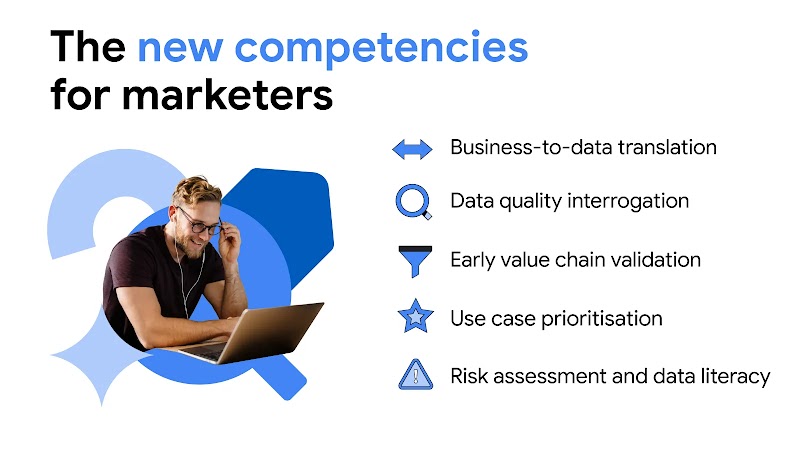
- Business-to-data translation: This competency bridges the gap between the boardroom and the data. It requires the ability to ensure a high-level business objective (e.g. increase profitability) is accurately mapped to the precise, current data inputs the AI uses for optimisation.
- Data quality interrogation: Moving from passive data observation to active investigation. This means proactively seeking alignment on critical data definitions (e.g. Is “profit” inclusive of shipping costs?) across all relevant stakeholders, including finance and operations.
- Early value chain validation: A shift in focus from “validating that data is received” to validating the data quality all the way from the source. Marketers must recognise that if validation happens at the campaign platform, it’s already too late.
- Use case prioritisation: Tightly connecting data collection and governance efforts to high-value use cases. This involves defining what specific data is necessary to achieve a specific business goal before investment is made in collecting it. For example, building prediction models can be costly to source, manage, and implement, so ensuring that it truly solves for a defined business objective before building it, is crucial.
- Risk assessment and data literacy: Understanding that flawed data introduces significant business risk and potential bias. This competency involves embedding basic data literacy within the team to mitigate these risks and confidently scale AI use cases.
These new skills, or competencies, aren’t a cost centre; they’re a value driver. By ensuring the accuracy of the data that guides millions in ad spend, it directly impacts ROI and mitigates significant risk.
A 3-point data quality checklist
Getting started doesn’t require a complete organisational overhaul. It begins with asking the right questions.
Before launching your next AI-powered campaign, our team recommends running through this simple checklist:
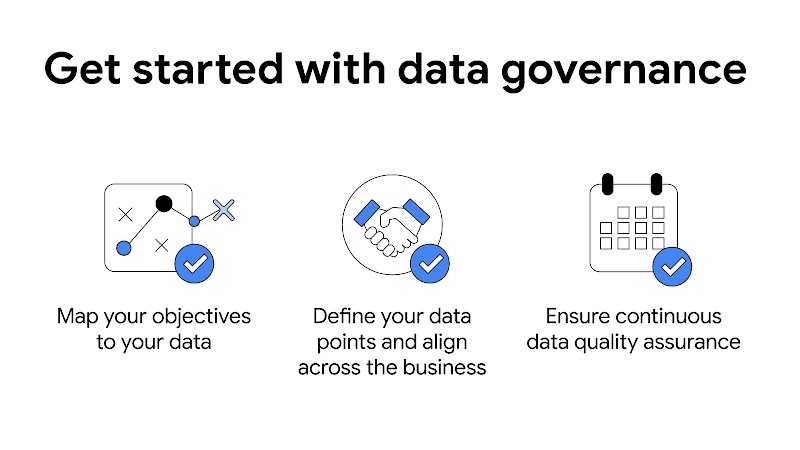
- Map your objectives to your data. Can you draw a straight line from your core business objective to the marketing objective, the use case, and the specific data points required? If you want to grow your base of loyal shoppers, you need to have a crystal-clear, shared definition of what a “loyal shopper” is, and what data points can help support this.
- Define your data points, and align them across the business. Get the key stakeholders in a room — marketing, finance, operations — and agree on the precise definition of critical KPIs.
- Ensure continuous data quality assurance. Business definitions evolve. The way your CFO defines profit in Q1 might change by Q3. Establish a regular cadence — quarterly or biannually — to review your key data definitions and ensure they are still accurate.
Viewing data governance as a restrictive chore is an outdated perspective. Today, it’s your launchpad for growth. It’s the work you do behind the scenes to ensure your marketing efforts have the best possible chance of success.
We believe future marketing teams won’t just be experts in campaigns and creative; they’ll be curators and governors of high-quality data. Mastering these data governance competencies is the single most critical step your marketing team can take now to ensure competitive, profitable growth in 2026 and beyond.


Social Module
Share