





 Sign in with Google
Imagine you’re running a high-impact marketing campaign. You’ve perfected every detail, from the target audience to the media buy to the budget. But you’re guessing on the effectiveness of the most crucial piece of all: the creative.
This is a central challenge facing marketers today. While we’ve become experts at measuring the “container” of our campaigns — the channels, the clicks, and the conversions — we often struggle to understand what’s happening inside. What creative elements are truly resonating with customers and why.
This can mean marketers feel at a loss when asked by their finance teams, or senior leadership, about marketing’s impact on profitability.
This is more than a simple measurement gap. According to a new report by Google, Kantar, and Marketing Week, there’s a disconnect between what marketers believe about creatives and what they can prove. The research reveals that 8 out of 10 marketers see creative quality as a key driver of effectiveness, yet less than half of them are actually measuring its impact:1
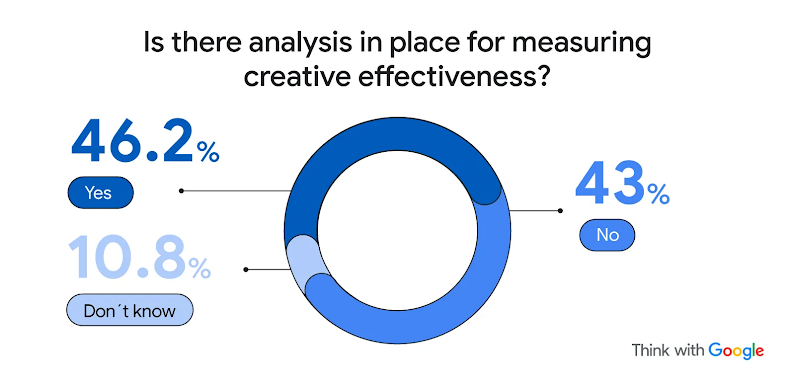
If you’re amongst the majority of marketers who believe quality creatives drive effectiveness, here’s a reassuring data point:
High quality creative can drive 4.7X more profit, according to separate research from Kantar.
Diagnosing the disconnect: Where creative measurement falls short
Today, AI is widely used to generate and scale creative ideas. In fact, 57% of marketers are using AI for creative production, and 45% are using it to produce variants of campaign assets.2 This adoption makes sense because it allows marketers to create content more quickly and efficiently.
However, this is not mirrored in its use for measurement. Our report reveals that less than a quarter of marketers are using any single tech-enabled tool for creative measurement.3
“There are some reasons behind this gap,” explains Simon Atherley, head of marketing effectiveness at Kantar U.K. “Some are structural and foundational, such as a lack of time and budget, especially as the creative process becomes more compressed. Teams are under pressure to launch and iterate quickly, which often means creative analysis becomes a ‘nice-to-have’ rather than a core part of the process.”
Other reasons include a lack of knowledge about creative measurement tools or simply a failure to dedicate a necessary block of time and resources to creative measurement.
But the good news is Google, alongside partners like Kantar, are finding new ways for AI to overcome these constraints and bridge that gap:
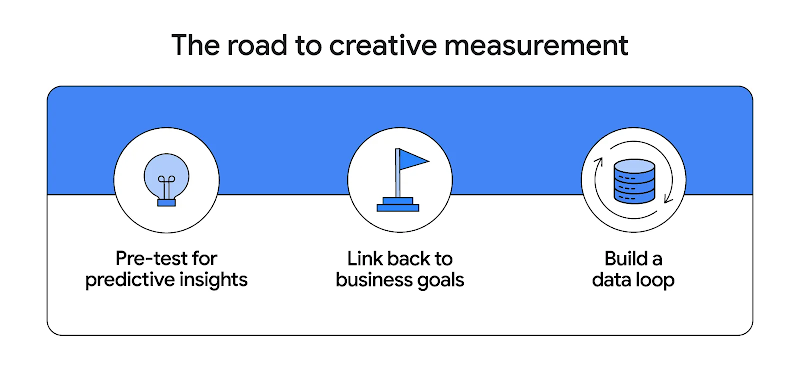
1. Pre-test creative for predictive insights and best practices
The first thing marketers need to look at is how to integrate pre-campaign creative testing into their roadmap. This ensures content is optimised before the media spend begins.
A powerful way to do this is by applying proven principles. At Google, we use the ABCD framework (Attention, Branding, Connection, Direction). This is an evidence-backed set of principles for effective video content.
We’re now prototyping how an AI agent, powered by Google’s AI Assistant Gemini, can automatically assess content against these principles, ensuring best practices are baked in from the storyboard phase.
Imagine your creative team has developed three different concepts for a major product launch. Before you invest in a full production shoot, you can upload the storyboards, or early cuts, to an AI agent. The model analyses each variation and provides a predictive score, highlighting which concept is most likely to drive brand recall or purchase intent with your audience. It might even offer specific feedback, like “the first three seconds are strong, but the call to action is unclear”.
This allows teams to iterate and improve their work with data-backed confidence, ensuring the final asset is the strongest it can be before the first bit of media spend is committed.
2. Link creative impact to business goals
Beyond pre-testing for quality, modern measurement tools must link the creative assets directly to business goals, for example, growing your audience.
Most existing measurement models measure only impressions, which is the product of reach and frequency. As a result, 10 impressions could mean 10 different people saw the ad once, or one person saw the ad 10 times — two scenarios with vastly different impacts if your goal is growing your audience.
Advanced tools like Google’s marketing mix model, Meridian, are built to process both reach and frequency data, allowing us to:
- Understand the sweet spot for brand and specific creative, ensuring you avoid oversaturation or low-frequency.
- Ensure your best-performing creative (identified in the pre-testing phase) is delivered with the right frequency to the right audience to achieve your business objectives.
This shifts creative analysis from simple results to powerful prediction.
“One of the most powerful ways we’re seeing brands linking creative impact to business goals is through integrating creative predictions into MMM models,” continues Atherley. “There’s huge power in showing how creative quality affects ROI. For one client we saw as much as a 4X increase in the sales uplift between bottom and top performing campaigns.”
By integrating the “why” behind creative performance with campaign targets like reach and frequency, we create a powerful and quantifiable link between the art of advertising and the science of business growth.
3. Build a data loop with AI
Without a robust feedback mechanism, AI-powered creative tools can inadvertently build an echo chamber. Trained on an initial data set and a specific objective, they get very good, very quickly, at optimising for that goal. But audiences are not static. Their needs, interests, and the cultural context around them shift constantly.
This isn’t just a measurement problem; it’s a customer experience problem. People feel it when a brand isn’t in sync with them.
You need a mechanism to ensure that you’re not only capturing and documenting the insights from your creative testing, but also consistently using them to inform future campaigns. When your analytics team can tell your creative team that ads featuring people outperform product-only shots by X%, for example, you create a virtuous cycle of continuous improvement.
You don’t even need complex trackers or mind-numbing processes. NotebookLM can be used to house testing insights and reports, so when it’s time for a new campaign you can simply ask it for relevant insights.
Unlock your marketing budget
By embracing predictive testing, linking creative impact to business goals, and building a continuous data loop, the conversation shifts from “what did we spend?” to “what will we earn?” This means it becomes possible to walk into a budget meeting with a forecast for creative ROI, in a language your finance team understands, to help secure investment in marketing.
If you are currently creating in the dark, remember this final insight from the report: 51% of marketers have seen budgets rise after focusing on effectiveness measurement.4 The choice is clear: stop guessing on the effectiveness of your most valuable asset, start measuring its true impact, and unlock the investment your creative deserves.
Social Module
Share