





 Sign in with Google

PepsiCo’s Josep Hernández is vice president of media for Europe, the Middle East, and Africa. He leads end-to-end advertising and marketing investment strategy. He’s built a reputation for overhauling PepsiCo’s AI strategy, moving from isolated tools toward a connected marketing ecosystem.
If you had asked me three years ago what my vision for AI was, I probably would have spoken about ‘tools’ and ‘efficiency’. Today, that answer falls short.
At PepsiCo, we have worked to move beyond the phase of isolated experiments. Generative AI pilots, or trials with AI tools, function as what I like to call ‘islands of innovation’. These are brilliant initiatives scattered across a company’s marketing and brand plan, but they remain disconnected. My experience shows that for this to work at scale, an island isn’t enough; we need an entire connected continent.
When I sat down with my teams to make decisions around AI, it was clear that we had to build an end-to-end marketing ecosystem that integrates AI from start to finish: from the first consumer touchpoint to the final sale.
It hasn’t been an easy path. We have faced new challenges and transformed our work culture. But thanks to that, we now have a roadmap where AI is the common thread that allows us to be more agile, more efficient and, above all, more relevant. Here’s what we’ve learned.
From hindsight to live insights
One of the biggest changes AI has brought us is the speed at which we can truly understand people.
Traditionally, marketers focused on using data to define static profiles, categorise audiences, and identify their interests. Managing a brand in this way is comparable to driving while looking through the rearview mirror: strategic decisions are based on studies that reflect a fixed snapshot of a past that may no longer exist.
Today’s consumer moves much faster and more fluidly. With generative AI tools we have been able to evolve, making use of live cultural insights to understand people’s context and emotions in real time.
This was particularly evident when our Lay’s team in Benelux worked on adapting a global campaign: “Joy is a simple recipe”. Since joy is an abstract concept, we used Gemini to analyse insights from 6,000 consumers. We inputted prompts with native terms such as ‘geluksmomentjes’ (‘moments of happiness’) to decipher the region’s true sentiment.
Gemini revealed key cultural nuances that differentiated neighbouring countries. For instance, Dutch happiness was exemplified more through activities like boating on canals, while Belgians leaned more towards cycling culture.
We used these country-level insights as a creative ally. As a result, we were able to transform the global tagline into 30 personalised three-word creatives under a fixed structure (action + place + twist). This resulted in creatives as specific as ‘koers, kasseien, demarrage’ (‘race, cobblestones, surge’) for the ad in Belgium and ‘bootje, Oude Delft, familie’ (‘boat trip, Old Delft canal, family’) for the ad in the Netherlands.
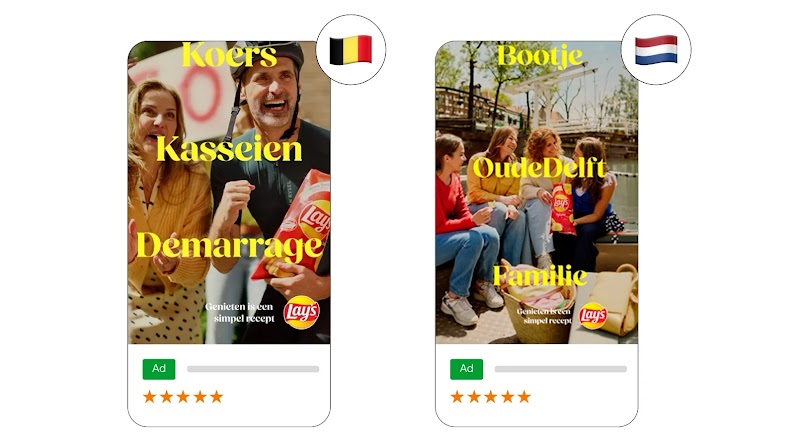
The result was a genuine connection where a global brand spoke like a local one. The campaign performed well; it reached 6.5 million unique users in one month, with a 4 percentage-point increase in ad recall. The cost per thousand impressions (CPM) was 30% below our typical campaigns.
This demonstrates that the true power of AI lies not solely in automation, but in human connection. AI is the key that allows us to transform a generic ad into one that resonates with different audiences at a speed and scale that was previously impossible.
Redefining strategic planning with AI: Connecting with emotion
Integrating AI-driven campaigns is a necessary foundation for driving efficiency. For example, AI-powered Video reach campaigns already account for more than 60% of our YouTube Ads activity and have been key to reducing our YouTube CPM by around 25% year-over-year. But treating optimisation as the AI finish line is a strategic dead end.
The true shift within our AI marketing ecosystem is moving beyond “who” to connect with, towards “when” to connect with them.
We demonstrated this in a world-first pilot with Doritos in the U.K.. We used AI-based emotional detection technology, powered by Gemini, to identify high-intensity “Peak points” that transform an ad from a digital interruption into precisely timed placements, that strengthens the impact of your creative.
It analyses the context of the content the user is watching, beyond the title and description, to show the ad at the exact right moment. For a bold brand like Doritos, we aligned with fun moments to amplify the positive feeling that the audience was already experiencing.
The AI in these campaigns identifies the peak moment of the video (targeted moment) and then places the ad (ad window), facilitating a connection with the audience through emotion.
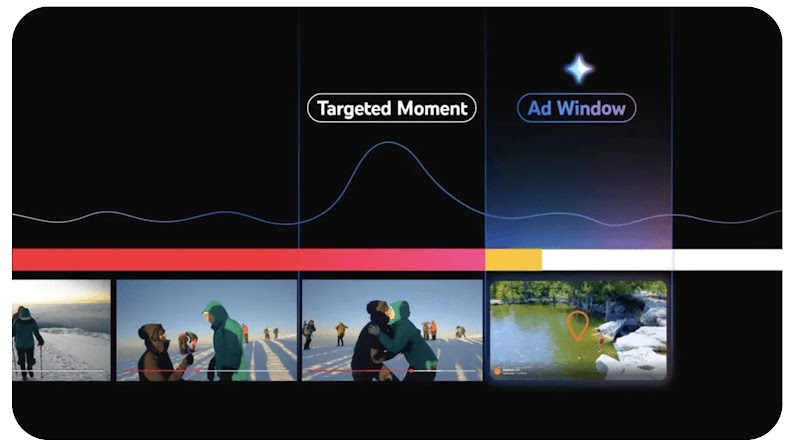
Emotional synchronisation was a success, achieving an 11.6% increase in Brand Lift. But what is most relevant for the business is that it validated our core efficiency model: we achieved this impact without increasing CPM or the cost per user reached.
This left us with a clear lesson for the future: efficiency helps us be seen, but emotional connection helps us be remembered. And AI is one of the most effective tools for uniting both objectives at scale to win the battle for attention.
Closing the circle: From conversion to creative intelligence
One of the keys to our end-to-end AI model is that it breaks away from the traditional view of linear marketing. For us, this is a circle of continuous learning that connects inspiration with action, and action with intelligence.
The first step to closing this loop is the sale. Generating emotion is of no use if we do not capture value. To achieve this, we use AI-powered campaigns that act as the definitive bridge between the demand we build and the actual transaction.
For example, trials with Lay’s in Spain have demonstrated the ability of AI-powered campaigns like Performance Max to connect the inspiration we generate on platforms (such as YouTube) with the final purchase action. The AI analyses thousands of signals in real time to determine where the user is most likely to convert at that exact moment, directing traffic to an e-commerce site or a physical store, depending on the customers’ needs.
But here is the mindset shift: conversion data is not the end of the road. Today’s result becomes tomorrow’s strategic input. We are already working on pioneering pilots, such as one with Lay’s in Poland, where AI uses performance and Brand Lift data from past campaigns to predict the success of a creative even before it is launched.
This is the winning model for 2026: Moving from reacting to results, to anticipating them. The true qualitative leap lies not just in using AI to optimise media buying, but in using past data to fuel a creative intelligence that guides us in the future.
Social Module
Share