





 Sign in with Google
 If 2020 was when millions of India’s shoppers migrated online out of necessity, 2030 will be the year they embrace e-commerce as a seamless part of everyday life.
By 2030, the e-retail market will surge nearly 3X to cross $250 billion, according to the latest report by Deloitte and Google on the future of commerce in India.
That impressive growth will cap a decade of retail ecosystem transformation. From 2019 to 2025, e-commerce reached $90 billion on the back of three structural shifts: the influx of 110 million new online shoppers,1 a doubling of online merchants,2 and the rise of a powerful digital backbone that supports over 400 million Unified Payments Interface users.3
From 2025 to 2030, those shifts will drive an even more dramatic leap: 150 million more Indians are expected to shop online,4 and individual e-commerce spend will double.5 Crucially, the 220 million-strong cohort of digitally native Gen Z will contribute nearly 45% of all e-commerce spend, making digital-first discovery the norm for most of the market.
For marketers, success in 2030 will hinge on mastering inspired, immersive, instant, and intelligent commerce — the four forces redefining the future of retail, and replacing the linear funnel with an always-on loop of shopper discovery, validation, and gratification.
Here’s how brands can leverage all four forces to capture the market’s exponential growth.
Cultivate inspired commerce using creator-led marketing
Forward-looking marketers understand that brand influence is increasingly driven not by mass messaging, but by creator-led content.
By 2030, 1 in 3 retail purchases will be influenced by creators.6 Besides being a key source of inspiration and discovery for shoppers, creators will also drive transactions through formats like micro-storefronts and instantly shoppable videos.
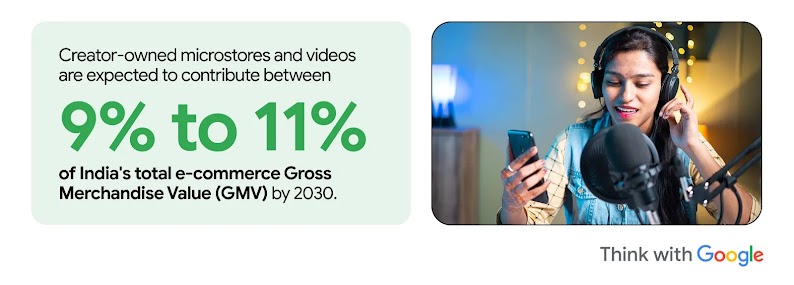
And through their authentic content, live demos and trusted reviews, they will guide up to 60 million more people from Tier 2 cities to start shopping online by 2030.
What brands can do: Replace ad-hoc tie-ups with always-on, scalable, creator-led marketing.
Collaborate with creators participating in the YouTube Shopping affiliate programme. It lets creators tag your products within their content, so audiences can directly purchase.
Additionally, use creator videos in your campaigns via Partnership ads. That’s what shopping platform Ajio did, achieving a 2X surge in conversion rates and 1.5X higher return on ad spend compared to standard campaigns.
Build immersive experiences across digital and physical environments
Future-ready marketers meet consumers’ demands for the best of both worlds: the convenience of online shopping, and the tactile assurance of examining products in-store. Satisfy your customers using immersive technologies such as:
- Interactive in-store experiences
- Shopping carts synchronised across all online and in-store touchpoints
- Augmented reality (AR) and virtual reality (VR) tools that allow shoppers to more accurately visualise products online. For example, Google Virtual Try-On lets users picture how clothing looks on them by uploading a photo.
Shoppers are ready to reward brands offering such features. Our survey shows that 3 in 4 shoppers will pay for in-store experiences, boosting store revenue beyond product sales.7 Better yet, online immersive tools have the potential to drive incremental spend from 1 in 2 shoppers.8
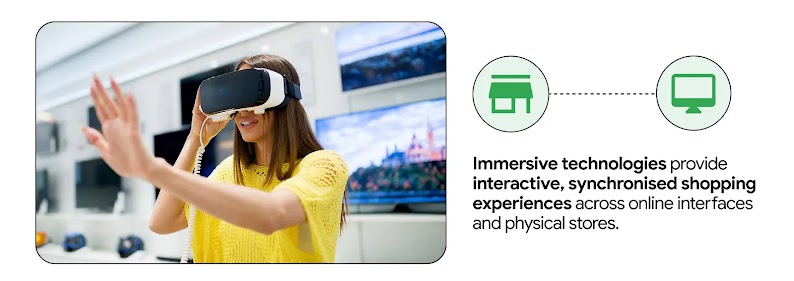
What brands can do: Embed immersive capabilities across your digital and physical environments.
Promoted pins in Google Maps, for example, lets you display image ads from your Demand Gen campaigns. That spurs shoppers to go directly from discovering your products online to checking them out in-store.
And by offering AR-powered “try-ons” of products and virtual consultations, you can shift shoppers from quick browsing to richly nuanced product trials. Platforms like Glance use Google’s Vertex AI and Gemini models to embed personalised avatars and product suggestions on users’ lock screens, spurring real-time purchase decisions.
Drive instant commerce via hyper-localised order fulfilment
Brands are racing to meet customer expectations for delivery timelines, which are compressing from hours to minutes.
That’s creating new instant gratification habit loops among consumers, and fuelling a 6X surge in quick commerce GMV to $50 billion by 2030.9 Notably, 30% of the market will be driven by consumers in Tier 2 cities and beyond, whose growing appetites will be met by retailers’ pivot to micro-market operations and consumer innovations like vernacular, voice-enabled commerce.
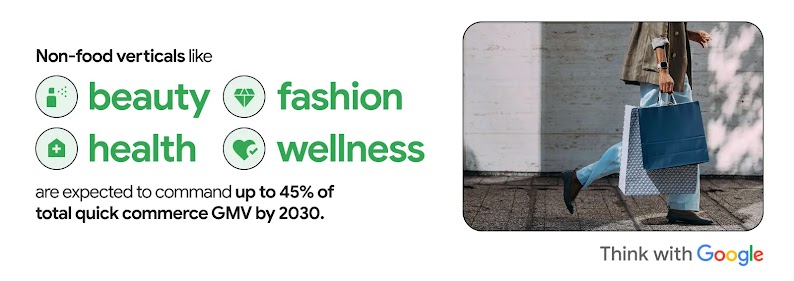
What brands can do: Re-architect your operations, by using agile assortments and dynamic pricing that adjust to meet local demand and supply fluctuations.
Additionally, tap Performance Max for Marketplaces to reach high-intent shoppers across Google’s surfaces and drive them directly to your listings on quick commerce channels. That’s how Renee Cosmetics drove traffic to its quick commerce channel partner, growing sales by 11.5% and lowering cost per acquisition by 48%.
Scale profitability using intelligent commerce
For the marketer of 2030, AI will be a dual lever for profitable growth: It will streamline backend operations and simplify shoppers’ decision-making, boosting retail profitability by 30% to 35%.10
Two-thirds of the increase will be driven by enterprises’ deep integration of AI into their operations.11 Dynamic, predictive automation helps marketers make better forecasts, optimise logistics, and accelerate creatives and product development.
The remaining one-third will come from agentic commerce growth, as shoppers embrace AI.
For metro and Tier 1 shoppers, AI agents can serve as expert advisors that autonomously help them narrow choices, optimise shopping carts, and execute routine replenishments. As for shoppers in Tier 2 and smaller cities, AI can be a trusted guide for simplifying their online shopping journeys.
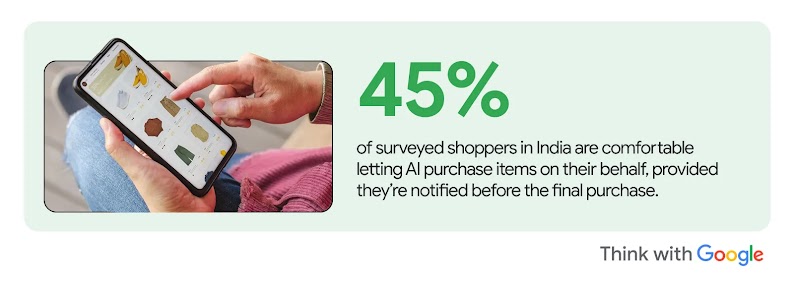
What brands can do: Build your agentic commerce foundation by adopting the full stack of AI solutions across three areas:
- Build intelligent operations. Tailor your offerings to local demand and supply by turning hyperlocal signals into the most relevant actions for each store, region, or audience segment. Delivery platform Swiggy achieved that by using Performance Max to re-engage dormant users. It also tapped AI to personalise creatives and conduct iterative testing, lowering cost-per-session by 70%.
- Create intelligent consumer experiences. Structure product content for multimodal AI-powered Search to enable easy discovery by shoppers and agents. Retail brand Target leveraged Google Cloud to offer visual and intent-led search, improving product discovery relevance by 20%.
- Prepare for autonomous execution. Be ready for the Universal Commerce Protocol, which establishes a common language for AI agents, digital storefronts, and payment systems to work together seamlessly.
The race is on for marketers to harness the four forces propelling India’s commerce revolution. By using the full Google AI stack to unlock India’s massive retail potential, your brand can be one of the winners of 2030.
Contributors: Prashant Gutch, Senior Marketing Manager; Randeep Kaur, Product Marketing Manager; Divyashree Bhat, Industry Head; Harsha Nallur, Industry Head; Nupur Gupta, Industry Manager



Social Module
Share