





 Sign in with Google
 Businesses are honing their marketing strategies to rev up profitable growth in the year ahead.
For travel businesses looking to start 2026 off strong, having early insights about their customers’ needs and travel trends can be helpful for planning.
Google’s latest research with Kantar sheds light on how India’s travellers are getting inspired, researching, planning, and booking their trips.
Here, we zoom in on what influences a traveller’s path to purchase, and strategies for using AI in marketing to maximise conversions and bookings among different traveller archetypes.
The top 2 touchpoints for influencing India’s travellers
Our survey of India’s travellers reveals this consumer trend: YouTube and Google are the key touchpoints travellers use across their entire purchase journeys, from inspiration to research, planning, and booking.
For inspiration: Surveyed travellers use seven touchpoints on average.1 And of these sources of inspiration, the two they use most are YouTube and Google.2
In fact, 68% of travellers use YouTube,3 which sparks discovery of brands and destinations through visually rich content like activity guides and traveller vlogs.
And travellers don’t just watch long-form videos. YouTube Shorts is used by 2 in 5 travellers as a source of inspiration.4
That’s no surprise, since Shorts is the top short-form video platform for travel content, according to another Kantar survey.5
YouTube creators are also a go-to source of inspiration — 41% of surveyed travellers are highly reliant on influencers during trip planning.6 And 59% of those who were reliant on influencers described them as very influential.7
For research and planning: Nearly 44% of travellers take more than a week on average to plan and book their vacation.8
They report using YouTube and Google to find reviews, accommodation details like location and room availability, and flight information such as airline reputation and seat availability.
For bookings: Our survey also found that 85% of travellers prefer to book their trips online,9 and many people use online travel platforms that offer bundled, value-added services.
To make confident booking decisions, they turn to Google and YouTube. According to an Ipsos survey, India travellers say they use YouTube more than any other online platform with short-form video formats when they need to get a decision right the first time around.10
The two-prong strategy for travel brands to drive bookings
The consumer insights show that YouTube and Google critically influence travellers’ entire paths to purchase. So have your brand show up well on both platforms using this two-prong strategy:
1. Help audiences easily discover your brand
Use engaging, multiformat video ads and AI-powered campaigns on YouTube to help people easily find your travel brand. That’s what online travel aggregator MakeMyTrip did to influence the booking decisions of high-value and high-intent travellers.
It created a 90-second cinematic ad to draw the attention of high-value travellers to the brand’s 25 years of quality service. The ad was displayed prominently across formats and screens, using YouTube Masthead, First Position in Shorts, and non-skippable in-stream ads on YouTube on connected TV, to maximise awareness of its brand.
Additionally, it used AI-powered Video view campaigns to deliver a 20-second ad on YouTube to help high-intent audiences discover its brand.
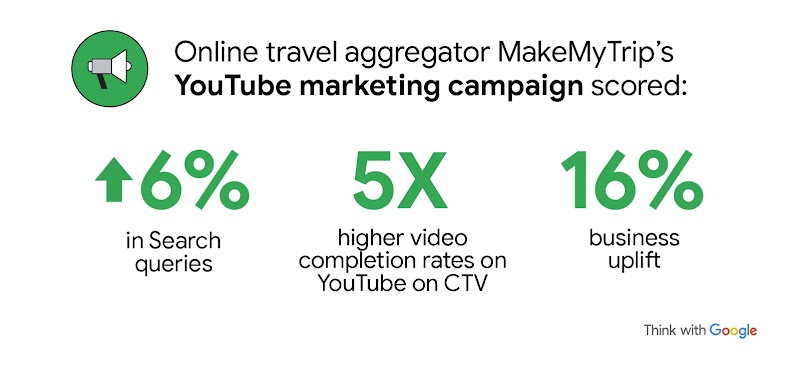
The campaigns’ results were impressive, culminating in a 16% business uplift.
2. Maximise conversions using AI-powered campaigns
Besides helping travellers easily discover your brand, win their bookings by using this trio of AI-powered campaigns, which work together to maximise conversions across Google properties:
- Performance Max campaigns let you reach travellers at scale across all of Google’s channels, including Search, Display, and YouTube, with a single, easy-to-use campaign.
- AI Max for Search campaigns allow you to extend your reach into new queries you weren’t accessing before, by intelligently adapting your ad content to match user intent in real time.
- Travel Feeds in Search Ads automatically enrich your Search ad formats with up-to-date pricing and relevant images, to help you win more of travellers’ conversions and bookings.
Travel technology company OYO wanted to increase conversions among people booking hotels for the holiday season. So it tapped Performance Max to deliver an optimised mix of quality images and high-performing ad assets across multiple formats, including Search, Display and YouTube, to relevant audiences.
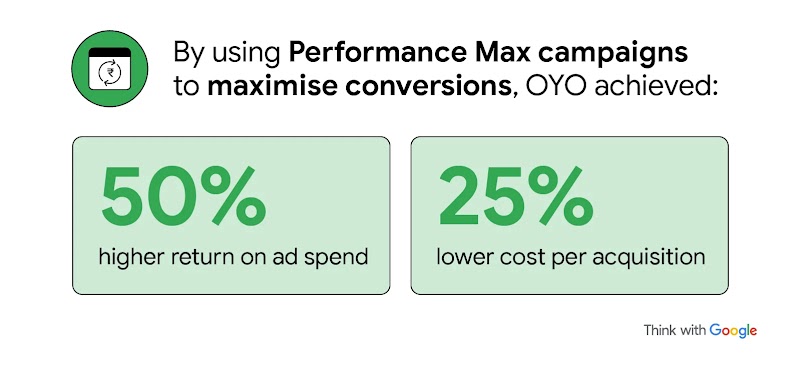
By efficiently driving incremental bookings, OYO increased return on ad spend by 50% at 25% lower cost per acquisition.
The 4 traveller archetypes and how to win them over
Our research reveals fresh insights into the distinct preferences and needs of four types of travellers in India. Here’s how you can tailor your marketing and travel offerings to be highly relevant to these different audience segments and win their bookings.
1. Novice Travellers: 67% of survey respondents travelled, paid or planned a trip for the first time in the last year.11
Since 70% of novice travellers are cost-conscious,12 and 44% find planning overwhelming,13 meet their needs with value-for-money, all-in-one travel packages.
2. Globetrotters: 59% of surveyed travellers prefer to travel internationally.14
They seek luxury, spending 3.2X more than on their last international trip, compared to the average spend on a domestic trip.15 So focus your ad messaging on premium experiences, such as exclusive or tailored services, and lounge access.
3. Religious Pilgrims: 44% of surveyed travellers went on a religious trip to a spiritual destination.16
Since 48% of pilgrims are interested in cultural and heritage experiences and further immersion, versus 38% on average,17 offer convenient travel packages that let them easily perform rituals and explore sights nearby.
Additionally, localise your ads to engage these pilgrims, who research across a more diverse range of languages, including Hindi, Tamil, and Marathi, as compared to other traveller archetypes.18
4. Memory Makers: 39% of surveyed travellers fit this archetype.19 They plan vacations around key moments like sports events and major concerts, or visit locations featured in famous shows. For research, they use up to 10 touchpoints,20 and are highly reliant on creators.21
To win them over with your brand’s rich travel experiences, collaborate with creators and deliver your ads across influential touchpoints.
With these latest insights about India’s travellers, you can tailor your campaigns to meet customers’ diverse needs. And by using AI-powered campaigns on YouTube and Google, you can maximise conversions to help your business grow in 2026.


Social Module
Share