



 Sign in with Google
 Sylvie Bardaune leads Google APAC’s Media Lab, a media centre of excellence for Google’s marketing across the region.
Doing more with less used to be an aspiration for marketers. Now, it’s become an everyday reality.
In the last year, Google’s rapid release of major AI products and leading AI models has helped marketers make great leaps in effectiveness and efficiency.
Those who’ve embraced AI-powered marketing have experienced 65% higher revenue growth, according to Kantar’s AI Global Maturity Research.
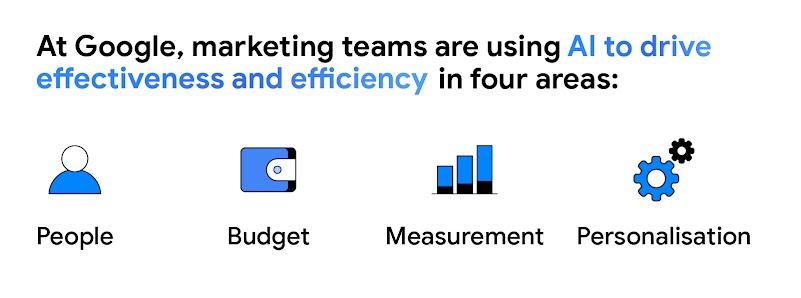
Here are some examples of how we’ve used AI, in the everyday, to power Google’s marketing. We hope it’ll inspire you to do more with less too.
How Google’s marketers use AI to maximise their potential
Since the start, we’ve been using Google’s AI-powered ads solutions to automate the set-up of campaigns and generate creatives at speed and scale.
That’s helped us reduce manual effort, increase marketing efficiency, and get better performance.
More recently, we’ve built AI insights agents to help us understand what our customers care about and how we can meet their needs in relevant ways.
Now, we’re looking at tapping more advanced custom solutions to maximise the ROI that we bring to the business.
One of those solutions is agentic capabilities in Google Ads and Google Analytics.
Watch the video
With new agentic capabilities in Google Ads and Analytics, marketers can move faster from insight to action
The agentic expert and data expert will assist marketers with everything from onboarding and campaign creation to reporting and troubleshooting. That’ll let us move faster from insight to action and be ever more confident in campaign optimisation.
How Google uses AI in marketing to build more creatives at lower cost
We’ve also used AI in marketing to develop creatives at scale, for the many touchpoints in a customer journey, while reducing budget and time.
Gemini Pro in Google AI Studio: That’s one AI-powered solution we’ve tapped to improve creative efficiency.
It was used, for instance, in Japan’s Google Pixel 9a campaign, to generate an extensive range of localised creatives, hyper-relevant to each of Japan’s 47 prefectures.
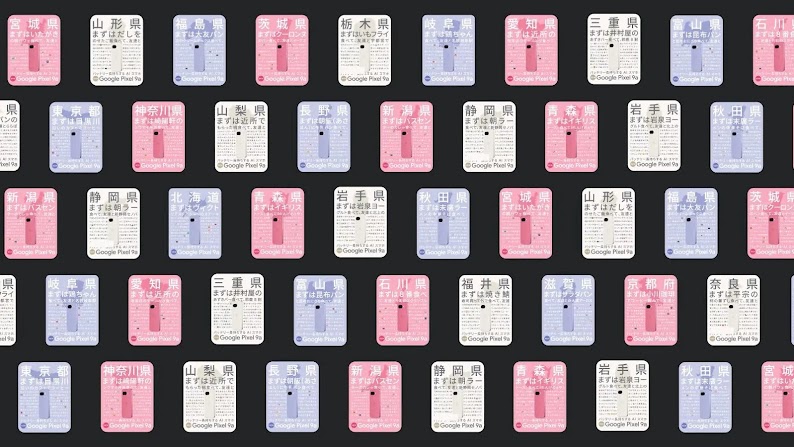
Here are the three series of prompts we used to generate localised creatives at scale:
- We asked Gemini Pro to refer to the ad copy we provided and create variations for each prefecture, highlighting small and medium businesses behind unique local foods and places of interest.
- We had Gemini Pro fact-check the ad copies and the local businesses highlighted, and assess the creatives generated against our brand guidelines.
- We got Gemini Pro to create a framework for evaluation, rate every copy, and provide the rationale for each rating.
As a result, we were able to generate a wide variety of high-quality creatives at 15% lower cost.
We’ve now run over 90 campaigns globally using Gemini Pro in Google AI Studio and we’ve been able to further reduce production times by at least 30%.
Veo: The AI video generator is another tool we use, not only to produce creatives, but to also make the creative process more efficient.
The Google marketing team in Australia, for instance, used Veo to collaborate with a creative agency on the video concept and storyboards for a campaign.
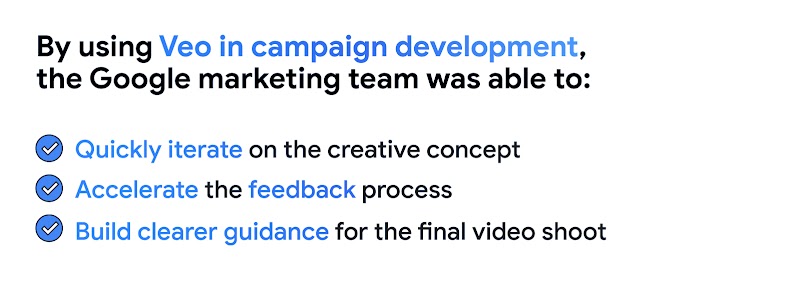
And the cost savings from that, compared with manual scripting processes, was a five-figure sum.
How Google uses AI in marketing to optimise campaigns through measurement
Another way we’ve increased marketing efficiency and effectiveness is by using AI in marketing to better measure the performance of our creatives and media plans.
Creative testing: Traditionally, we relied on in-person testing to get feedback on our creatives. That process often took weeks and it could slow a campaign launch.
We’ve since developed an AI-powered platform to measure and predict creative performance. It’s built on Vision AI, a Google Cloud technology that analyses and understands visual data.
Watch the video
The Google marketing team’s custom AI platform can predict the success of a creative with almost 75% accuracy, as compared with in-person testing.
Here are the three steps we took to set up the AI platform to measure creative performance:
- We used Vision AI to identify our key creative variables.
- We trained the AI model to correlate the key creative variables with performance outcomes.
- We got the AI model to learn what types of creatives work, and what types do not, so that it can predict creative success.
As a result, it takes just hours, instead of weeks, for us to test our creatives. And we can do this at any stage of production to make continuous refinements.
Media measurement: We’ve also built AI models that let us better measure business outcomes across channels, instead of relying on proxy metrics like reach and frequency. That helps us make data-driven optimisations to our media plans and budgets.
We achieved that through a custom model that incorporates data from our use of Meridian, an open-source marketing mix model built by Google, as well as our brand lift studies and geo-based marketing experiments.
Looking ahead, we’re working to create a custom AI planning agent to support faster data-informed decision-making and near real-time budget adjustments across channels and regions.
How Google uses AI in marketing to create personalised experiences
With AI, we’ve also gotten much closer to the goal of highly effective marketing where the right message is delivered to the right person at the right time.
A great example is our Google Pixel campaign “Best Phones Forever.” It’s about Google Pixel and iPhone going on various adventures together.
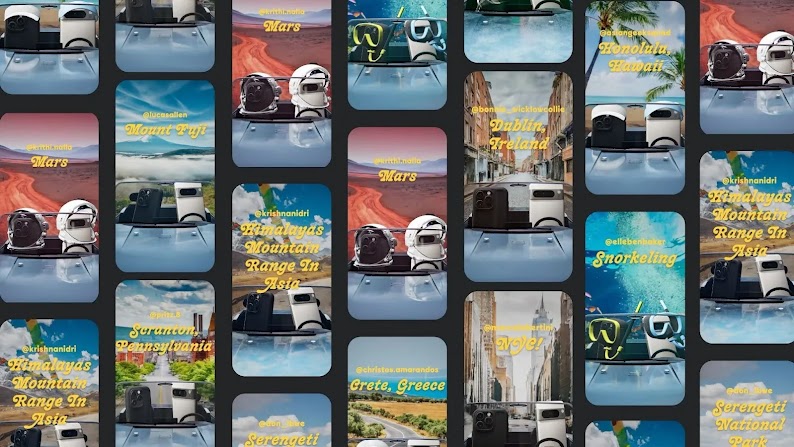
We asked followers on social media to suggest locations and situations that they’d like to see the two phones in. We then created personalised short videos for select requests.
We used AI to write the dialogue and generate background images, and created videos of the phones going on more than 300 adventures across 74 countries. Audiences loved the videos, which drew 97% positive and neutral sentiment.
AI is transforming marketing and the possibilities are endless. If you want to do more with less for your business, use AI in marketing. One step is all it takes to get started.