





 Sign in with Google
In a 60-second YouTube Short for Jimmy John’s, creator Adam W proves that even a neighborhood sub shop can be the height of romance — if you do it “the James Jonathan way.” To celebrate a special anniversary dinner, the comedian transforms a real Jimmy John’s location into an upscale oasis, replacing the standard quick-service experience with candlelight and table service. By leaning into the absurdity of a fine-dining atmosphere, complete with a gondola delivery, the ad turns a menu of sandwiches and wraps into a sophisticated comedic centerpiece, proving the brand is just as bold as the humor.
“That alone ups production value, to do all the crazy stuff we did on location,” Adam W said of the production. “And because I had that opportunity, I was like, ‘I want a boat.’”
The comedian and the brand share a sharp sense of humor, and that synergy delivered far more than just viral engagement. This alignment of creator-led storytelling and brand messaging drove measurable consumer action, successfully bridging the gap between entertaining content and performance marketing, while advancing clear brand goals.
To understand how this collaboration moved the needle on everything from brand sentiment to cost per view (CPV) efficiency, we’re taking a behind-the-scenes look at the creative process. Here’s what marketers can learn from the strategic framework and the spirit of collaboration that powered the Jimmy John’s and Adam W collaboration.
Let audience insights inspire the creative format
Jimmy John’s faced a challenge at the outset of the brief: educating customers about its variety without ruining the joke. The goal was to break customers out of boring food routines by showcasing a range that spans toasted sandwiches, wraps, and desserts. However, featuring so many items risked becoming a laundry list that viewers would scroll past. To ensure the message broke through, the brand looked beyond traditional food influencers in favor of a more strategic fit.
The team needed a format that could deliver multiple product messages while maintaining high viewer retention. By partnering with a creator specializing in high-energy skits, Jimmy John’s transformed a detailed brief into a fast-paced piece of entertainment that showcased its full menu in a way that felt organic to the audience.
“Our platform gave us a clear picture. [The audience] overindexes heavily in bold humor, parody content, and skit-style storytelling,” said Kristen Dolan, SVP of growth at influencer marketing agency Influential. “That immediately signaled that we needed a creator with a big comedic presence, not a traditional food reviewer.”
By using data to identify parody as the right vehicle, the brand recognized that Adam W’s comedic skits offered the perfect environment to seamlessly integrate product messaging.
“Adam W was the right fit because his comedic skit style matched the tone we wanted — funny, fast-paced, and engaging,” said Tommy Tomayko, integrated marketing communications manager at Jimmy John’s. “He knows how to capture attention quickly and make branded content feel like something his audience genuinely wants to watch.”
YouTube creator Adam W takes his date to Jimmy John’s for a romantic dinner out.
Brief with guardrails, not scripts
Identifying the right creator was only step one. The brand still needed Adam W to hit specific talking points about the menu. To ensure the menu discussion felt natural, the brand moved away from rigid scripting. “We operate under ‘guardrails, not scripts,’” explained Dolan. “We outline the brand messaging and the must-haves, but the delivery stays 100% in the creator’s voice.”
Choose creators who naturally align with your brand’s tone of voice, but give them creative freedom to do what they do best.
Adam W immediately took the helm with scriptwriting and directing. In his fine-dining vision, sandwiches are toasted tableside, Tuscan wraps hand-delivered by gondolier, and desserts displayed on silver carts. He credits the brand and the influencer marketing agency for trusting him to know his audience.
“Both companies were great at letting the creator be the creator,” he said. “They allowed me to have my creative freedom and really understood that it was a collaboration. I think that’s why the video turned out so good and performed very well. It just goes to show what happens when you collaborate with a brand instead of just work for them.”
Tomayko agreed, and offered this advice to brand marketers considering creator partnerships: “Choose creators who naturally align with your brand’s tone of voice, but give them creative freedom to do what they do best. Audiences can tell when something feels forced. The best results come when the brand and creator collaborate closely to find the right balance between authentic entertainment and key messaging.”
Turn efficient reach into measurable action
The ultimate test of educational entertainment is whether it performs at scale. The campaign demonstrated that when short-form video marketing is built for organic community connection, it can drive superior media results.
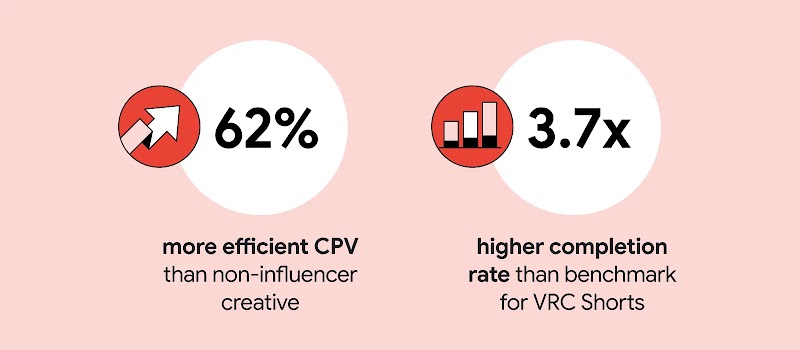
“The video delivered a 62% more efficient CPV than non-influencer creatives, reinforcing the value of investing in engaging creator partnerships on short-form video platforms,” said Lauren Johnson, media strategy and planning manager at Inspire Brands.
The collaboration overdelivered on engagement with a click-through rate 158% higher than the average seen among non-influencer creative.
Equally impressive was the audience’s willingness to stay for the full story. The video’s completion rate was 3.7X the benchmark for Video Reach Campaign (VRC) Shorts, proving that on YouTube Shorts a brand’s message doesn’t need to be restricted to a five-second burst. When content is genuinely engaging, viewers will lean in for the entire duration.
“For a brand deal to get millions of views organically is kind of insane,” Adam W said. This organic traction served as a springboard for paid success, proving that content built for the audience based on insights drives better media metrics than generic brand creative.
One surprising highlight among the results was the click-through rate. “In addition to delivering on efficiency, the collaboration overdelivered on engagement with a click-through rate 158% higher than the average seen among non-influencer creative,” said Johnson. In other words, the collaboration did more than raise awareness among Adam W’s broad audience of comedy fans. It drove action in a way that supported both immediate performance metrics and long-term brand goals.
For Adam W and his generation of creators, there has never been a better time to build a community on YouTube. And there has never been a better time for marketers to tap into those creators’ audiences, mobile-first production agility, and proven creative formats. In 2025, Adam W’s branded content saw over a billion views, and he plans to double or triple that number in 2026, using revenue from those deals to do more “epic stuff” for his fanbase.
“Every brand needs storytelling, right? It’s the base of every single brand,” he said. “There needs to be content that drives that brand, and I think no one does it better than creators.”
Social Module
Share