





 Sign in with Google
Karen Clemens Sørensen is global head of search for Pandora, where she is responsible for the vision and execution of the brand’s global search strategy. She keeps a strong focus on connecting insights to action, to deliver unified, high-performing digital experiences.
What if you could know a customer’s future worth at the exact moment they make their first purchase?
For years, our search strategy at Pandora was mature and effective, built on a solid foundation of optimising for return on ad spend (ROAS). We were good at driving sales.
But our marketing mix models revealed a crucial insight: true incremental growth wasn’t coming from repeat buyers, who often returned on their own. It was driven by new customers.
This presented us with a challenge. We needed to shift our focus from simply driving transactions to acquiring high-value customers. The question wasn’t just how to find more new customers, but how to find the right ones — those who would come back again and again.
As the global head of search at Pandora, my team and I, along with our partners at iProspect, knew we needed to evolve. We had to move beyond bidding on immediate revenue and start bidding on future value.
The challenge: Moving beyond flat bidding to value-based acquisition
The nature of search is that people are often very close to making a purchase. This means a large portion of your ad spend can go toward reaching people who would have bought from you anyway. Guiding that investment toward people who haven’t purchased before makes a lot of business sense.
But not all new customers are created equal. A person who buys a single ring as a one-off gift has a very different long-term value than someone who starts a charm bracelet for their loved one. They are more likely to return for every holiday and birthday to add to that collection.

We needed a dynamic way to differentiate between a potentially high-value customer and a one-time buyer, right at the point of that first click.
We needed to bid higher for the future collector and lower for the gift-giver.
The journey: Uncovering the key predictors of a customer’s future worth
What started as a simple idea quickly grew into what we affectionately called a “monstrous” project. Our initial hypothesis was that certain product attributes would be strong predictors of a high Customer Lifetime Value (CLV).
We dove into our historical data, analysing over 90 million transactions from 20 million users across the globe. And the results surprised us.
“While we initially hypothesised that demographics or specific product types would be the primary drivers of value, the data told a different story,” explains Nicolai Hjelmager, director of strategy and innovation, iProspect. “The single greatest predictor of a customer’s future worth was actually the volume and value of that very first basket.”
This discovery was a turning point. Our team had to rethink our approach and we used Google’s CrystalValue framework to build the CLV model. This is where things get a little technical. CrystalValue is an algorithm, developed by Google data scientists, that uses Google Cloud Vertex AI to help advertisers predict Customer Lifetime Value (pLTV).
We spent a significant amount of time tweaking the variables and testing different look-back windows — one year, two years, four years — to see which timeframe gave us the most accurate predictions.
The solution: Building a predictive AI model and integrating it in Google Ads
Developing a predictive model is one thing; making it actionable in the fast-paced world of search advertising is another. Before going live, we validated our AI model on over 100,000 historical first-time purchases where we already knew the actual CLV two years later.
“We committed to an intensive ‘test and learn’ phase, constantly tweaking variables until our model’s predictions aligned almost perfectly with historical reality,” continues Hjelmager “Achieving a deviation of just 2.6% gave us the confidence to move from theory to live execution.”
The next step was to integrate it into our bidding strategy. We used CrystalValue to pass our custom CLV predictions directly into the Google ecosystem in real-time. Through a Floodlight configuration in Search Ads 360, our bidding algorithm could finally see not just the immediate revenue from a new customer, but also their estimated future spend.
Think of a Floodlight configuration as the central nervous system for your tracking; it aligns your conversion data so that every part of your campaign is optimising toward the same goals.
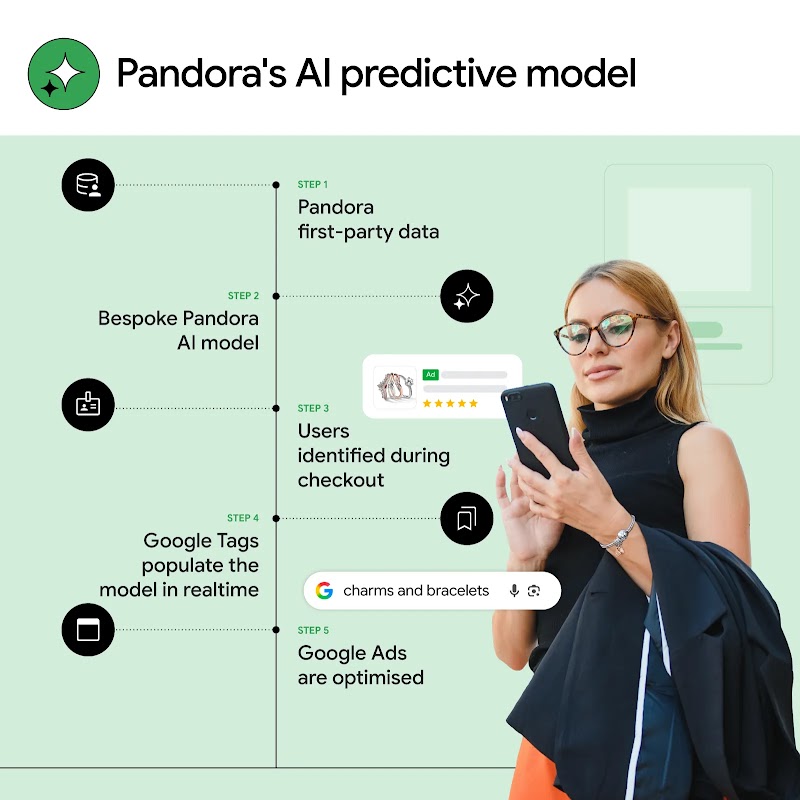
This meant our bids could automatically and intelligently adjust. When the model identified a shopper with the hallmarks of a high future value, our bid would increase. When it spotted a likely one-time buyer, the bid would decrease.
We were no longer just reacting to conversions; we were proactively investing in long-term growth.
The results: Driving revenue uplift and acquiring more valuable customers
Shifting from a short-term to a long-term mindset requires patience, but our new CLV-based bidding strategy has already shown its impact.
In the United States, one of our largest markets, the implementation led to a 3.6% uplift in total revenue. This was achieved not by increasing our budget, but by optimising our existing ad spend more efficiently.
In Germany, we saw the number of new customers increase by 1.32%. While a modest figure, it represents a significant qualitative improvement, as we are now acquiring a higher proportion of customers with greater long-term potential.
We’re still in the early days, as the true value of these customers will unfold over the next couple of years. But we are already seeing a close correlation between our estimated CLV and the actual purchasing behaviour of these new shoppers.
For any brand looking to undertake a similar project, my advice is twofold. First, ensure your historical data is clean and accessible. It’s the foundation for everything and requires consistent processes for data quality and governance.
Second, be prepared to dedicate serious time and resources. We were fortunate to have an environment where we could test and learn, sometimes asking for forgiveness rather than permission.
I believe the future of performance marketing lies in this shift from short-term efficiency to long-term foresight. It’s not about getting as many customers as possible — it’s about attracting the right ones. And with the help of AI, we can now do that with precision.
Social Module
Share