



 Sign in with Google
 In an era of the super-empowered consumer, the path from discovery to purchase has never been more fluid. For modern marketers, this shift has turned the traditional Monday morning reporting session into a complex puzzle. With fragmented signals across searching, streaming, scrolling, and shopping, brands face an attribution paradox. Every platform claims credit for the same sale, but those claims rarely match the actual revenue in the bank.
Agencies are 35% more advanced than advertisers across key marketing use cases, including measurement.
To solve this, the industry is moving past vanity metrics toward the science of demand, decoding the real drivers of behavior through high-quality data and scientific proof. Agencies are essential partners in this journey. Data shows that agencies are 35% more advanced than advertisers across key marketing use cases, including measurement. By working side by side with brands to connect fragmented signals, agencies can help rethink measurement ROI with a single source of truth in three key ways: building data strength, fostering a culture of experimentation, and achieving unified measurement.
1. Building data strength
High-performance AI requires high-quality information. If the data fed into the system is disconnected, the results will be too. Agencies can partner with brands to move away from messy data by building a unified intelligence layer. By implementing tools like Google tag gateway (GTG), they connect online actions to real-world results, like customer relationship management (CRM) data or store visits. This clears the signal fog and can lead to an average observed conversion uplift of 14%.1
Forward-thinking partnerships are moving beyond basic setup to building durable data pipelines that protect a brand’s ability to measure performance in a privacy-first world.
- TRKKN: Faced with data collection gaps due to privacy restrictions, online travel agency DoYouSpain partnered with TRKKN to implement GTG via server-side Google Tag Manager. This technical collaboration streamlined its tagging infrastructure and allowed the brand to observe 11.7% more conversions in Google Ads.
- Kepler: Data gaps often create a “growth tax” — budget wasted because AI tools cannot see the full customer journey. Kepler resolved this for a U.S. B2B software client by integrating the Kepler Intelligence Platform with Meridian, Google’s marketing mix model (MMM), ensuring every data point was standardized for AI. The cross-channel results from the model turned guesswork into statistical certainty for every dollar spent, driving an 8% increase in conversions from the previous year.
2. Encouraging experimentation
Data shows what happened, but brands need to know why. Agencies bridge this gap by proving which marketing actions drive new, incremental value. They work with clients to design scientific tests like geography-based testing to isolate real sales lift. They also use signals like attributed brand searches to show how brand awareness today creates customer intent tomorrow.
By treating the media plan as a continuous laboratory, brands and agencies can move past last-click credit and focus on the strategies that generate real demand.
- Jellyfish: Marketing efficiency often plateaus when a brand overinvests in any one media channel, that is ads shown to people already looking for them. Using its Now-Next-Soon platform powered by the Meridian modeling framework, Jellyfish diagnosed exactly where spending had hit diminishing returns. By reallocating that budget into new growth drivers and verifying the path through geo-lift experiments, the agency delivered a 34% lift in return on ad spend (ROAS) and doubled its client’s reach.
- Dentsu: Last-click reporting often creates an attribution paradox for Display, suggesting minimal value and reinforcing doubts about investment. To bridge this gap, Dentsu designed a geography-based incrementality test in the U.K., balancing regions with CRM and behavioral data. This strategy drove a 5.5% revenue uplift and approximately 9X ROAS for a leading retail client. By reconciling these results with the brand’s MMM, they aligned two independent sources of truth, providing the statistical certainty to continue investing in Display as a proven driver of incremental growth.
3. Unifying measurement
Individual experiments explain the “why” behind a sale, but, to manage an entire business, these insights must come together as one unified strategy. This is how agencies solve the friction of conflicting platform reports. By using open-source frameworks like Meridian, they can reconcile disparate models into a single, verified source of truth.
Rather than looking at each channel in a vacuum, agencies build holistic frameworks with their clients to reveal what is truly driving profit.
- Power Digital: Power Digital worked closely with a brand to get a clear read on why its performance had stagnated and to understand the true impact of media. Leadership was ready to overhaul how media was measured, bought, and optimized. Power Digital led a several month transformation, building a custom MMM based on Google’s Meridian, developing a strategic testing road map, and implementing rigorous incrementality experiments. Armed with clear insights, the brand reallocated its budget toward high-impact tactics, resulting in a significant lift in incremental marketing revenue and a double-digit-percent increase in total YOY revenue.
- Hakuhodo DY Group: To help brands reconcile disparate data into a unified strategy, Hakuhodo DY Group executed a vertical launch of Google’s Meridian across APAC. By integrating Meridian into its analytics agent as a service platform, it enhanced reporting consistency and shifted measurement to dynamic ROI simulations. The agency applied this across clients. For a beverage manufacturer, optimal frequency analysis across YouTube TV suggested approximately 10% ROI improvement. For a health-food brand, offline-to-digital reallocation could achieve a 6% to 11% order increase and 5% to 10% cost per acquisition improvement.
- Level Agency: To help brands align all signals into a single source of truth, Level Agency developed Level Signal, a tool that couples Google Cloud with predictive search signals. By moving beyond static reporting toward active future navigation, it achieved a 48% increase in applications for a client, while simultaneously reducing the cost per application by 30%.
The new standard of agency partnership
Moving from reactive reporting to active growth requires a strategic shift in how brands and agencies collaborate. To gauge your partner’s readiness, ask these three questions today.
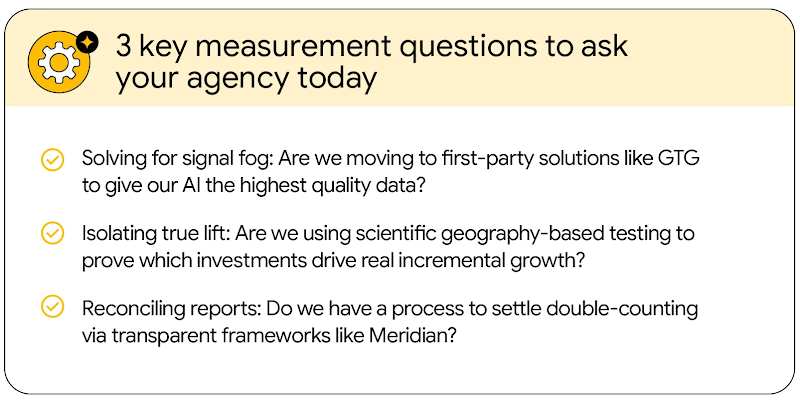
Explore these questions and more to dive deeper into vetting your measurement strategy. To find an agency partner to help you implement these next-generation methodologies, you can find qualified experts through the Google Partners directory.