





 Sign in with Google
A couple of years ago, the global marketing community was asking what AI was. Last year, the focus shifted to separating hype from reality. Today, the question is how fast you can operationalize AI and accelerate its implementation to drive growth.
But while technology moves at breakneck speed, marketing organizations are struggling to adapt. Google’s joint study with McKinsey highlights a stark chasm between leadership’s enthusiasm and operational reality: 96% of CMOs are excited about AI but fewer than one-third of marketing organizations are actually rewiring their teams and workflows to drive growth.
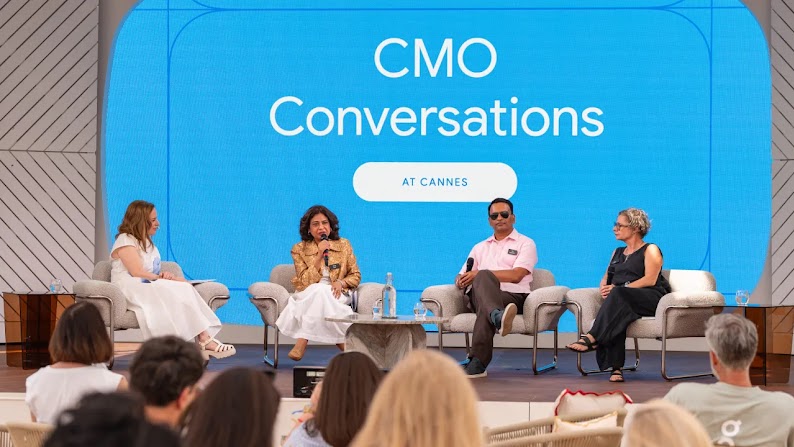
How can leaders close this gap? To find out, we sat down with three CMOs operating at the frontier at the Google Beach in Cannes including Asmita Dubey, chief digital and marketing officer at L’Oréal; Ravi Kandikonda, CMO at Zillow; and Joy Howard, CMO at Back Market.
L’Oréal: Democratizing capabilities, not just outputs
For global beauty powerhouse L’Oréal, scaling AI required looking past software to focus on human potential. Rather than keeping AI siloed within technical departments, L’Oréal deconstructed the entire marketing function into thousands of specific skills and launched a massive upskilling initiative, training over 70,000 employees on its internal, proprietary AI platform.
By using advanced models, L’Oréal built CreAItech, a generative AI beauty content platform where marketers can create brand-safe images and videos. The goal is to empower every marketer to not only imagine creative possibilities but actually build them, Dubey said.
Unless you do it yourself you cannot have the same kind of appreciation. Get your hands dirty and learn.
This hands-on experience fundamentally transforms how L’Oréal collaborates with its broader creative network. “Unless you do it yourself you cannot have the same kind of appreciation,” said Dubey. “Get your hands dirty, learn, and then you can talk to our ecosystem of partners and agencies and say, ‘I would like it done like that.’”
Ultimately, she emphasizes that this is not a one-time training session, but a continuous commitment to talent development. “What we do is have a focus on skill, upskill, reskill.”
Zillow: Flattening marketing workflows and shifting roles
Zillow operates at the center of one of the most emotional and complex consumer journeys: buying or renting a home. Traditionally, taking a campaign from consumer insight to scaled creative execution would take months of linear agency handoffs and legacy approval processes.
In partnership with Google, Kandikonda’s team sought to reduce a three-month brief-to-market process down to 30 days. To do this, Zillow had to have the right tools and the right people in place. For example, using AI tools, Zillow was able to efficiently update rental property photos, swapping snowy landscapes for springtime flowers. And on the people side, Kandikonda stressed having legal partners involved early ensured smooth approvals.
But most critical was fundamentally restructuring roles to drive end-to-end accountability. “For example, product marketing managers are not just writing briefs and handing them to channels,” Kandikonda explained. “They’re actually responsible for taking that product brief and being able to articulate a channel strategy. They’re actually expanding their role and understanding the audience, and then how they go to market. So roles have changed. Processes have been flattened,” he added.
Product marketing managers are actually expanding their role and understanding the audience, and then how they go to market. So roles have changed. Processes have been flattened.
Back Market: Setting the AI vision with transparency
At Back Market, a leading global marketplace for certified refurbished electronics, CMO Joy Howard believes that overcoming AI-related workforce anxiety requires radical transparency about how AI tools solve specific business needs. “I’m a big believer in transparency and financial metrics,” Howard said. “For me as a young marketer, it was so empowering to really understand the P&L — what drove it. For us, it’s been all about anchoring what we do in the mission with intentionality. Having the workforce understand that we need to stay curious in order to stay competitive.”
Howard wants to equip her marketers with the knowledge and tools to dispel fear, and create an optimistic vision for where the business is going, and how people and technology could get Back Market there. “There is a greater need for flexibility and adaptability than we’ve probably ever seen in our careers,” she added.
The executive mandate: Lead by example and use the tools yourself
For each of these CMOs, AI isn’t just changing how their marketing organizations operate. It’s changing how they work themselves. For Howard, it’s inspired her to do her own data analysis quickly and show results to her leadership. “I can do that analysis myself in the space of a half hour, have it be presentation ready for the CFO, and literally just drop it in the link of a Google Doc like, ‘Here you go, buddy. You know, check it out.’”
For Zillow’s Kandikonda, AI helps him be more present for his team. Everyday, AI summarizes all the documents he receives so that he can “actually email each of those people who sent them and say, ‘Hey, I’ve read your document. Here are the points. Here are my questions. What can I do to help?’” Kandikonda said. “It’s all about how we can be more human for our teams.”
And at L’Oreal, Dubey uses no-code AI solutions to test technical hypotheses. “I feel more empowered to say, “Let me at least test what I want to do before I go to my technology and IT colleagues and take their time,’” Dubey explained.
Ultimately, these CMOs said that bridging the chasm between AI excitement and operational reality doesn’t start with the technology itself. It starts with leaders establishing trust, transparency, and personal participation. To truly rewire your organization, CMOs must first rewire how they lead.

Social Module
Share