



 Sign in with Google
 For businesses with a global footprint, the year-end shopping season is too big to miss.
Packed with major retail moments and trends, it’s a massive opportunity for boosting holiday sales, especially when your customers are the world’s biggest shoppers.
Consumers in the U.S. and Europe’s top five economies — France, Germany, Italy, Spain and the U.K. — contribute roughly one-third of the world’s total retail sales, according to publicly available data.
And with consumers open to trying new brands, businesses have new opportunities to win them over.

There’s three things that’ll convince them to buy from your brand: price, product confidence, and purchase convenience.
But our latest holiday shopping insights show that your businesses will need to speak that universal language of appeal in the most relevant, localised ways to win their purchase.
Here’s how you can tailor your holiday marketing and e-commerce strategy to resonate with shoppers across markets and ultimately boost sales.
Help shoppers have confidence in your product
It’s true that price promotions matter: 60% of U.S. consumers and 55% of European consumers are driven by discounts; it’s the top factor influencing their decision-making.1
But they won’t just go for the cheapest item. They want assurance of a product’s quality.
And how they form confidence in products differs across markets. So your business needs to take a nuanced approach to building customer trust.
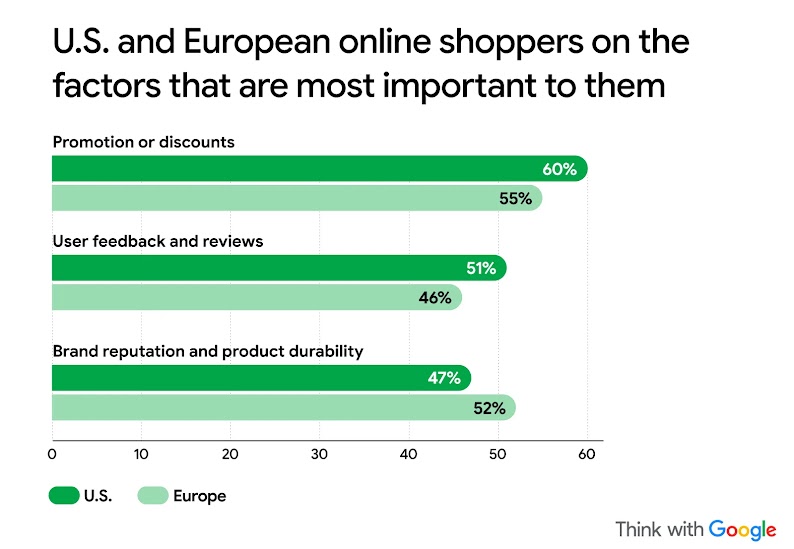
For U.S. consumers, user feedback and reviews are critical for shopping online.2 But for European shoppers, brand reputation and product durability are of greater importance.3
Those in Germany rely on expert recommendations (64%) and value certifications from official bodies (53%) to trust international brands.4 In France, 52% of consumers prioritise brand transparency about sourcing and production.5
It’s not enough, however, to just show up with the right product information and reassurances for the respective audiences. Where you show up with that information is just as important for building their confidence.
Google Search is the No. 1 way shoppers confirm facts like quality and durability, good reviews and ratings, and brand reputation.6
Additionally, 66% of European shoppers are most receptive to ads on search engines like Google when they’re in a purchasing mindset.7
Google Search is the No. 1 way shoppers confirm facts like quality and durability, good reviews and ratings, and brand reputation.
Shoppers also build deeper trust as they stream and scroll on YouTube. According to a 2024 Traackr survey in the U.S., YouTube was ranked as the No. 1 choice for product reviews and product information by all consumers, including millennials and Gen Zs.8
And YouTube creators significantly influence shoppers’ purchase decisions. Surveyed online users are 98% more likely to trust the recommendations of creators on YouTube versus those on other social sites or apps (on average).9
To build trust with customers, engage them with compelling ads, powered by Google AI, on YouTube and Search:
- Capture existing demand with localised Search campaigns and Shopping campaigns.
- Expand your audience reach across Google’s inventory with Performance Max.
- Create demand for your brand among high-intent shoppers with Demand Gen campaigns.
And to have your ads show up on the most influential platforms with highly persuasive content, localise your ad creatives. Have your ads feature seasonal discounts and the types of quality assurances that matter to customers locally:
- For ads on YouTube, like holiday-themed unboxing videos, use relevant video titles, descriptions, and tags to optimise engagement.
- Highlight authentic endorsements and reviews from YouTube creators.
- Share customers’ videos of their product reviews on your channels.
Make it convenient for shoppers to complete their purchases
To secure sales, you’ll also need to meet shoppers’ expectations for a convenient path to purchase. The type of convenience that matters, however, differs across markets and purchase channels.
For American shoppers: Before they’re ready to buy, they expect to see rich visual information, such as high-definition product images and videos (71%), and clear, concise product descriptions (57%).10
You can fulfil their expectations by displaying sharp, 360-degree product views and video demonstrations on your digital storefront in the U.S. Use the free, AI-powered creative tool Product Studio for Merchant Centre to help you generate, enhance, and test product imagery at scale for maximum visual appeal.
For European and American shoppers: Smooth logistics, such as prompt deliveries, affordable shipping, and clear, favorable return policies prevent them from abandoning their shopping carts.
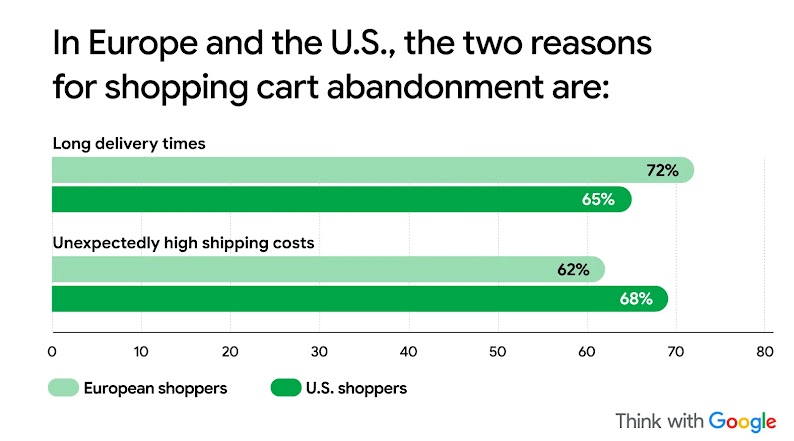
For online shoppers: Accurate, up-to-date product details on pricing and availability help online shoppers place an order easily, so be sure to surface deals and promotions prominently throughout their purchase journeys, from Search to checkout.
Your online customer touchpoints, including your website, should also carry clear information on your shipping and delivery timelines, and highlight return and exchange policies.
For offline shoppers: Even if they eventually purchase in-store, they typically research online first. So meet their need for a seamless omnichannel experience in these ways:
- Use the Google Merchant Center to sync inventory data in real time between your online and physical stores, so shoppers can confirm product availability before buying in-store.
- Ensure your store hours, location, and in-stock items are accurate across Google surfaces by updating these details via your Google Business Profile
- Provide the option to click-and-collect for added flexibility.
This holiday season, you can boost your sales in the U.S. and Europe by helping shoppers there gain confidence in your product, and making it convenient for them to complete their purchases. And by localising your e-commerce marketing strategy with the help of Google AI, you’ll get your best ROI.