





 Sign in with Google
We’ve reached the end of the beginning in this AI era, yet many marketing teams are still stuck in a loop of endless pilots. This hesitation is fueled by a 2025 MIT study claiming that 95% of AI pilots fail, a headline that caused a lot of noise in the industry. However, the study had a major catch: It only labeled a pilot “successful” if it immediately pulled in millions of dollars.
For a CMO, that’s a narrow way to measure value. By focusing only on an instant cash windfall, the study ignored the process: the hard work of changing how teams actually operate so that AI can drive real growth at scale.
A failed pilot isn’t a dead end. It’s a diagnostic tool that reveals operational gaps.
At Google, we’ve learned that successful pilots aren’t isolated experiments. They’re the first step in evolving the entire organization. A failed pilot isn’t a dead end. It’s a diagnostic tool that reveals operational gaps. It’s only a failure if you can’t learn and adapt to fill those gaps.
From pilot purgatory to performance at scale in 3 moves
Google Marketing manages a massive media budget, and we act as our own toughest client. On the Media Lab team, we bridge the gap between media investment and AI innovation. Our team identifies organizational challenges and builds processes and solutions to drive performance on a global scale.
Many early pilots did “fail” but provided useful lessons. Rather than give up, we looked for where things broke and where early potential lay. Here are three moves from Google’s Media Lab that CMOs can use to go from pilot purgatory to meaningful performance.
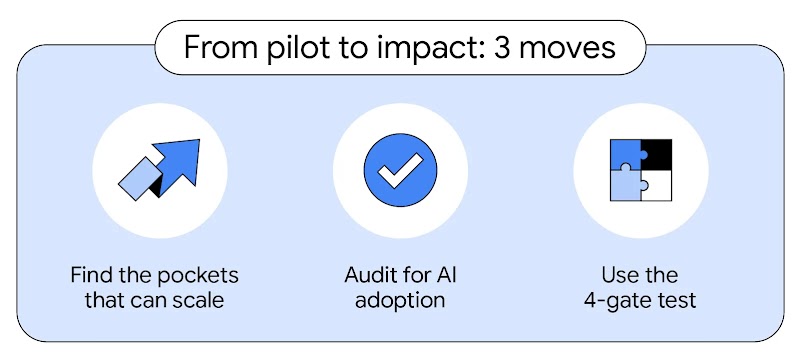
1. Find the pockets that can scale
In analyzing early AI pilots, our team realized that the biggest hurdle wasn’t the code. It was the human habit of waiting for perfection. Instead of seeking a tool that fixed everything at once, we embraced a “V1 mindset” and focused on finding the wins. Our early testing “green teams” were full of marketers with learning mindsets and an openness to fail to succeed. They hunted for the pockets of success that proved the model’s potential.
Early wins provided the practical learnings required to improve testing in other more complex areas. By starting early and testing across myriad outcomes — sales, leads, and usage — we built a deep understanding of exactly where AI worked best. As the technology continues to mature, the organizational momentum is already baked in, allowing us to scale at the speed of the models.
2. Audit partners for AI readiness
We soon noticed the uneven AI readiness of our external agency partners was limiting our pilots’ impact. So we developed a strict series of AI-ready capabilities and audited our entire partner roster according to four characteristics.
- Technological maturity: Do they have a long-term AI road map that matches our vision or just shiny one-off tools?
- Measurement accountability: Can they identify low-hanging fruit? Do they have a plan showing how they will actually implement measurement tools, and is accountability baked in?
- Hard KPIs: Can they demonstrably reduce deliverable timelines, lower fees, and drive incrementality?
- Scalability and repeatability: Can the workflow be repeated across every language and country we operate in?
The outcome? We consolidated our agency roster, centralized our partnership process, and turned a fragmented workflow into a scalable system where AI could deliver measurable impact.
3. Find scalable winners with the 4-gate test
Many ideas are promising in isolation, but only a fraction possess the technical and compliance durability required to move from a stand-alone test to a permanent part of the marketing stack. To identify the viable and sustainable AI solutions, we apply a rigorous four-gate test CMOs can borrow.
- Compliance: Are the tools used secure enough for your core infrastructure, and do they pass legal and regulatory muster?
- Brand safety: Can you turn it off? Don’t scale until you have control. We in Media Lab have been working with our own product teams to help give all advertisers more control.
- Measurement transparency: Is it a black box? If you can’t see the “why” behind the performance, you can’t optimize it.
- Impact: Does it deliver against the right result? In Video reach campaigns, we found that efficient reach optimized for cost but hurt frequency. We pivoted to target frequency to align the AI with our core brand philosophy, which is rooted in research that shows ad frequency is a critical driver of brand lift.
The new management imperative
The challenge of AI adoption goes beyond the technical to the very human challenge of change management. Leadership’s task is to search for like-minded, AI-forward partners who want to test, learn, and scale alongside them. Early wins will provide the proof points needed to pull the rest of the organization forward.
The era of one-off AI experiments is over. To move from pilot to performance, shift the mindset and don’t layer on more tech. Start by recruiting a green team of AI-forward marketers who are willing to endure the friction of V1 models. Then, put every experiment through the four-gate test: compliance, brand safety, measurement transparency, and impact. Stop asking if the AI works, and start asking if your processes are durable enough to handle it.

Social Module
Share