



 Sign in with Google
Lysol has been marketing trusted cleaning products for more than a century. From print and radio to television and eventually digital, the bar for delivering creative excellence to our consumers has never been higher. As these expectations for marketing continue to rise, building high-quality, impactful creative remains an expensive and time-consuming process.
And while the promise of generative AI is alluring, experimenting with generative AI tools isn’t the same as shipping AI-built creative. That’s why I set out to pilot a creative development process using gen AI from end to end with the goal of elevating creative quality and accelerating time to market, ultimately delivering stronger assets that resonate with our target audiences.
The 8-week sprint: From bottleneck to breakthrough
Our test-and-learn challenge was specific: Create broadcast-ready 15- and 30-second spots in an 8-week sprint. The brief? Pivot Laundry Sanitizer, a laundry additive that kills 99.9% of bacteria when added to your laundry routine, from “illness prevention” to “neutralizing stubborn odor,” reminding consumers that bacteria, not sweat, causes the smell.
Phase 1: AI-accelerated ideation
In partnership with BCG and Google, we kicked off the process by using Gemini to rapidly explore consumer trends and competitor positioning to refine our brief, and then had the model generate and score hundreds of concepts. My team manually selected the three most promising routes, compressing ideation from weeks to hours. We established a responsible AI policy at the outset, selecting a “digital twin” approach where we worked with consenting, compensated actors to create AI-generated likenesses.

Phase 2: The synthetic shoot
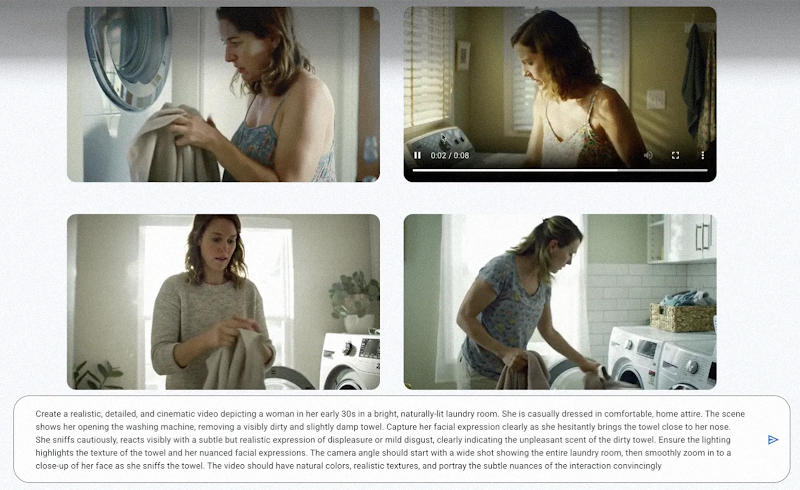
Bypassing costly physical filming, we moved directly to synthetic production using Veo and Imagen. This allowed for rapid iteration.
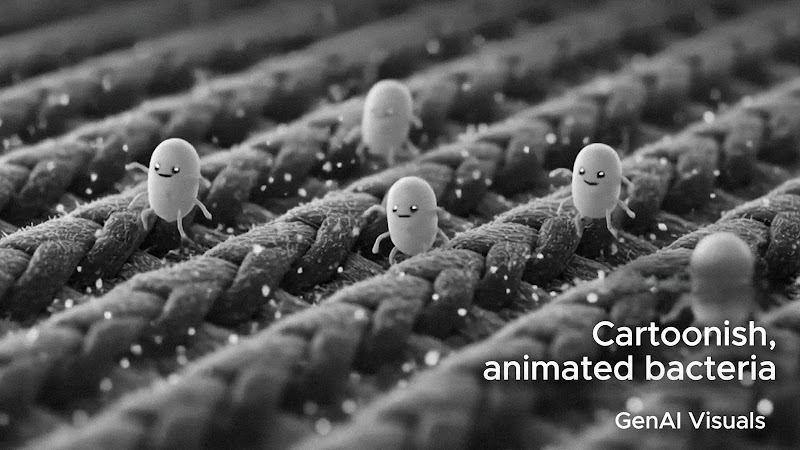
Of course, not every output hit the mark. Some initial drafts had white-coated technicians rampaging through a lab and cartoonish bacteria that looked more like comic strip protagonists than odorous microbes. But with some thoughtful reprompting, we were able to quickly correct the look and feel.
Phase 3: 2-week optimization
In the final stage, we used Veo to rapidly generate creative variations and test them directly with consumers. It took only two weeks of optimization to lock in the final, launch-ready creative assets. This is where most of our creative timelines usually grind to a halt. But Google’s AI-powered tools turned it into an express lane.
The triple-bottom line: Cheaper, faster, and just as good
Our pilot confirms that these gen AI tools deliver a dramatic operational trifecta. Historically, creative production has been bound by the “iron triangle” — the constraint that you can only choose two among speed, quality, or cost. With AI, we are proving this paradigm obsolete.
1. The velocity mandate: We dramatically compressed the brief-to-launch timeline. This speed enables us to capitalize on microtrends and deploy bespoke creative for granular audience segments in near real time. Speed has shifted from a constraint to a source of competitive strength.
2. The cost revolution: We achieved an 80% reduction in cost per asset compared with our traditional process. These figures validate AI-powered tools as a transformational solution for high-volume content needs, not just a niche efficiency tool.
3. Quality parity is the new benchmark: The biggest question — “Can gen AI build creative at speed and quality?” — was answered by the data. Using short-term sales lift studies, our best AI asset delivered effectiveness nearly identical to our top traditional asset. This is a promising start and validates our commitment to integrating AI into our marketing process as we continue to test, learn, and scale.
The strategic blueprint for marketing leaders
We are moving beyond experimentation to understand how this speed and efficiency scales across the enterprise. This pilot proves that the iron triangle of speed, quality, and cost is no longer absolute. For marketers looking to operationalize AI, the blueprint is no longer theoretical. It’s here.