





 Sign in with Google
Jim Lecinski is a clinical professor of marketing at Northwestern University’s Kellogg School of Management and author of “The AI Marketing Canvas” (Stanford Press, 2026), in which this framework originally appeared.
The opinions expressed are his own and may not reflect those of Google.

Across industries, I see CMOs making real progress with AI. Their teams use it to automate reports, speed up content creation, improve workflows, and gain efficiency. These are real wins. They free up time, reduce friction, and signal momentum.
But in many marketing organizations, the AI conversation stops with productivity. Yes, efficiency matters, but treating AI only as a cost-saving mechanism is limiting. It keeps marketers from realizing AI’s broader strategic growth potential.
To avoid that limitation, CMOs need a clearer framing for how AI creates value. Before deploying AI at scale, I advise leaders to consider two foundational questions: What main benefit are we seeking: productivity and efficiency, or transformational growth? And who benefits most: our internal teams or our customers? When CMOs are clear on these dimensions, investment decisions become sharper and priorities more disciplined. When they are not, AI initiatives, pilots, and tools pile up with no clear direction and limited strategic advantage.
Viewed through this lens, I encourage CMOs to anchor their AI strategy around these four distinct use cases.
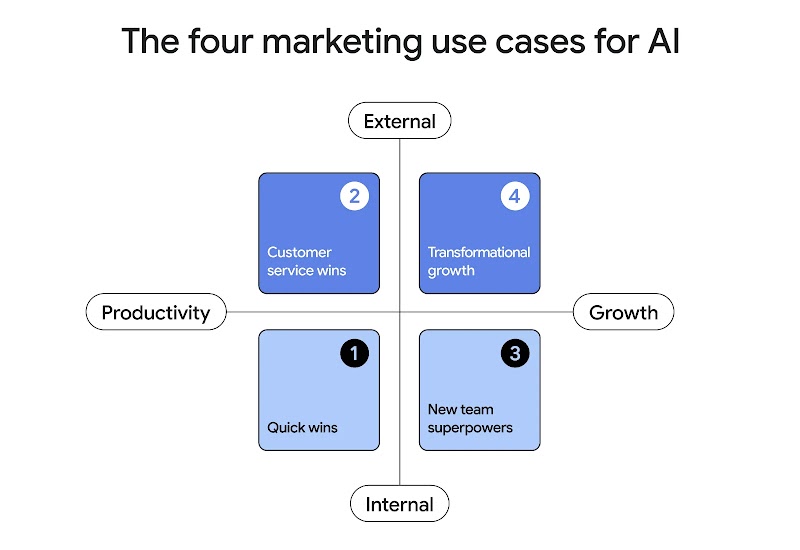
- Internal productivity helps teams work faster through automated reporting, content creation, campaign setup, and internal research. This is where most organizations begin. These are low-risk steps that deliver quick wins and build confidence and momentum, but they must be viewed as an entry point, not the endpoint for AI.
- External productivity means applying AI to make your customers more productive, to have a more efficient interaction with your brand. This typically means FAQ chatbots and AI-powered customer service automation. These initiatives pass efficiency through to the customer experience. They improve performance but still place efficiency over growth.
- Internal growth is where AI begins to shape strategy. Rewired team workflows, advanced forecasting, scenario planning, and opportunity modeling help leaders make better predictive decisions about where to compete and how to allocate resources. At this stage, AI becomes a strategic growth partner, not just a productivity tool.
- External growth is where AI reshapes value creation. Delivering dynamic customer experience powered by predictive personalization and data-driven, rapid product innovation creates new demand and helps you create incremental value. Here, AI becomes a true growth engine, strengthening customer lifetime value and competitive advantage.
Most organizations today concentrate their AI efforts in the first two categories. This is understandable. Productivity gains are visible, easy to justify, and less risky; they deliver fast returns. Over time, however, an exclusive focus on efficiency limits AI’s strategic power. Companies optimize existing workflows and mental models rather than reimagining what marketing could become.
Leading CMOs take a different approach. They don’t abandon productivity initiatives, but they do use them to fund and build growth. They recognize that automation should create capacity for higher value work, not simply lower costs. They ask more ambitious questions. How is AI improving our strategic judgment? How is it helping us create new demand? New business models and revenue streams? How is AI strengthening our long-term enterprise value?
Using AI for productivity builds momentum. Using AI for growth builds advantage.
Which of the four ways are you using AI? A simple test is to examine where most of your AI resources are deployed. If investment remains concentrated in internal efficiency, that reflects prudent risk management. But it’s also a signal that growth potential remains untapped. Your next step should be to rebalance your efforts toward applying AI for growth and acceleration.
The key takeaway? AI transformation in marketing is not only about cost savings and adopting more tools. It’s about making disciplined choices about use cases. Productivity builds momentum. Growth builds advantage. The CMOs who succeed in this next phase will be the ones who use AI not only to run marketing more efficiently but to make marketing more effective.
Social Module
Share