



 Sign in with Google
 Many fear generative AI will make marketing more robotic, but what if the opposite could be true? Paul Aaron, co-founder and CEO of AI innovation studio Addition, breaks down how AI can lead to brand expressions that are more contextually aware, empathetic, adaptive, and, ultimately, more human.
Last holiday season, outside the historic Domino Sugar Factory in Williamsburg, Brooklyn, a Google Shopping ad displayed a simple message: “Sweet deals, no sugar required.” Below the headline was a French press, which happened to be trending in New York City on Google Shopping. The pun was obvious, but the contextual awareness behind it was profound. The ad knew exactly where it was. It understood the cultural significance of the landmark towering beside it. And it connected with passersby the way a local would: with a knowing wink that said, “I get this place.”

This wasn’t traditional geotargeting; it was something new. The AI system that generated this ad generated hundreds of similar ads across New York City, each one personalized to its specific time and place. This campaign showed a level of contextual understanding and real-time responsiveness that hadn’t been possible for brands before generative AI.
Brands in the generative AI era
For centuries, as technology has advanced, brands have become increasingly dynamic, evolving from static symbols into entities that communicate, transact, and participate in culture. Until recently, this was orchestrated through rigid systems and fuzzy data. Marketers could segment audiences and optimize delivery but couldn’t understand nuanced context, grasp emotional and cultural significance in real time, or respond with humanlike flexibility and awareness. Today, generative AI helps make it all possible and allows brands to interact with the world on a more human level.
Embracing this shift requires a wholesale change in how marketers and creative leaders solve problems. Rather than optimizing traditional processes, they should challenge their assumptions about how marketing operates. Together with Google and our parent company, R/GA, we’ve been piloting new ways for brands to show up in the generative era.
From brand rules to brand tools
Brands need to adapt to the world while retaining their DNA. Generative AI unlocks new ways for marketers to encode the essence of a brand into AI, allowing it to shape-shift and adapt to any context.
Take Android, a brand built on self-expression and inclusivity. Partnering with R/GA, Google launched Androidify, an AI tool that turns a user’s photo into a custom Android Bot. The system is grounded in brand guidelines and trained on curated visual examples that enable AI to apply these guidelines flexibly. Instead of rigid rules or a kit of parts, AI can now create infinite variations of the brand for anyone in the world.
Watch the video
Android’s mascot “The Bot” introduces the new Adroidify app, allowing users to create their own personalized Bot with AI.
From digital content to intelligent content
Traditional digital advertising relies on segmentation, dividing audiences into groups and serving each group premade creative. But segmentation is inherently reductive. It treats people as members of categories rather than individuals with unique contexts and needs.
Generative AI makes it possible to move beyond segmentation toward true personalization, where every message is created in real time based on an individual’s specific context. For Google Shopping’s back-to-school campaign, we built an AI system that creates personalized ads for college students riding in Ubers. Each ad is generated based on where the student is heading — whether it’s the library, dorm, gym, or dining hall. The system taps into AI’s understanding of campus culture and geography to showcase relevant products while using language and visual styles that feel native to that specific destination.
An example of a Google Shopping ad shown in an Uber ride to the Herbert Wellness Center at the University of Miami. The ad plays on the school’s mascot Hurricanes with a pun about working out: “Canes get those gains.”
This holiday season, Google Shopping is once again running ads across New York City that adapt to their surroundings. But where last year’s campaign generated contextual headlines and product recommendations, this year’s generates dynamic scenes that place products in relatable situations, all created by combining Google’s Nano Banana model with the latest Veo image-to-video capabilities.
From preplanned to real time
Marketing has traditionally been a planning exercise. Campaigns are conceived months in advance, creative is locked weeks before launch, and messaging follows predetermined scripts regardless of what’s happening in the world.
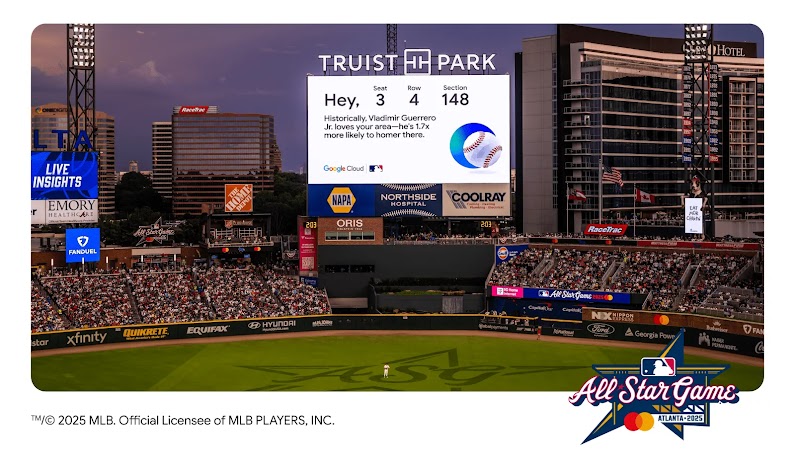
Generative AI enables a fundamentally different approach, one where brands can respond to the world as it unfolds. For Google Cloud during the MLB All-Star Game, we created an AI system that generated messages in real time, based on live game data from MLB’s Statcast API. As plays happened on the field, the system created contextually relevant messages for fans in and around the stadium, turning game moments into brand moments.
Upgrading your ambition
As AI capabilities continue to accelerate, they unlock new ways for brands to connect with people in ways that are less rigid and formulaic, and more adaptive, empathetic, and genuinely human. To realize this potential, marketers must disrupt business-as-usual thinking around brand strategy — not by doing the same things faster, but by reimagining what’s possible.
Rather than automating what you’ve always done, ask yourself what might be possible that wasn’t before:
- If your brand could adapt to its surroundings, what might it say?
- How might you respond directly to the unmet needs of your customers?
- What would a frictionless purchase process look like?
- If your brand could have a conversation with each of your customers, what would they talk about?
We’re at the beginning of an era where brands can operate with human-level understanding, grasping context, responding with empathy, adapting in real time. The question isn’t whether this future will arrive; it’s who will build it.