





 Sign in with Google
 Jens Castenskjold Viborg has over a decade of marketing experience and leads Bestseller’s digital and media team. He helps the Danish fashion house connect to existing and potential customers, across platforms, and in real-time.
In 2026, the fashion industry is facing numerous challenges. Digital advertising costs have risen, while consumer price sensitivity has intensified. On top of this, European fashion consumers are known to have a high return pattern.
At Bestseller — a Danish fashion company behind global brands like Jack & Jones, Only, Vero Moda, Name It, Vila, and Selected — we operate in a world where returns are viewed as an unavoidable cost of doing business. They are expensive to ship, process, and restock.
And they are the industry’s most persistent margin-killer.
We knew that if we wanted to maintain our sustainable growth mindset — while taking market share — we had to stop treating all shopping carts as equal. Shifting our focus to bidding for the product sales that actually stay in the customer’s wardrobe.
The “sizing” anecdote: Why context matters
To understand why returns matters, consider typical Monday evening shopper, Peter, who buys three identical pairs of jeans in sizes 30, 31, and 32.
To a standard tracking pixel, this looks like a high-value “win”. But to anyone in fashion, it’s a red flag. We know with near-certainty that at least two of those pairs — and potentially all three — are coming back to the warehouse.
We needed to build a model that would recognise these patterns, so that we could tell our Google Ads bidding algorithm: “This isn’t a €150 sale; it’s a €50 sale.”
However, many returns come from baskets with multiple other items. So that means the transaction itself often remains valuable, even if part of the order is returned.
And that was the challenging reality we faced when designing the model.
The challenge: Moving beyond gross sales
Our data already drives business insights on product performance, buying accuracy, size guides, and sales channels to improve returns.
So when looking at this challenge, we naturally looked to our own data. Our initial instinct was a classic media and marketing move: identify high-frequency returners and exclude them from our Google Ads campaigns.

However, this hit a wall quickly. A significant portion of our traffic is made up of new or anonymous shoppers. Without a deep purchase history for every visitor, we simply didn’t have enough information to make these exclusions effective.
Within Bestseller, our brands are growth-driven and want to win consumers and market share, so there was a natural concern that being too “defensive” with our bids might hurt our top-line volume.
We also realised that trying to “fix” return rates in isolation was a losing battle. Returns are influenced by everything from the fit of a dress to a country’s local shopping culture. Instead of trying to change human behaviour, we changed our bidding behaviour.
With this new mindset, our goal shifted. After all, if we can predict that an order has a high probability of being returned, we should pay less to acquire that customer in the ad auction.
The journey: From overnight estimates to real-time AI
Partnering with our agency, Refyne, we built an AI-powered advertising system that could predict a return the moment a customer clicks “buy”.
To do this, our team created a digital pipeline to send our business data from its main storage home (Snowflake) into Google’s data system BigQuery, so our advertising tools could actually use it.
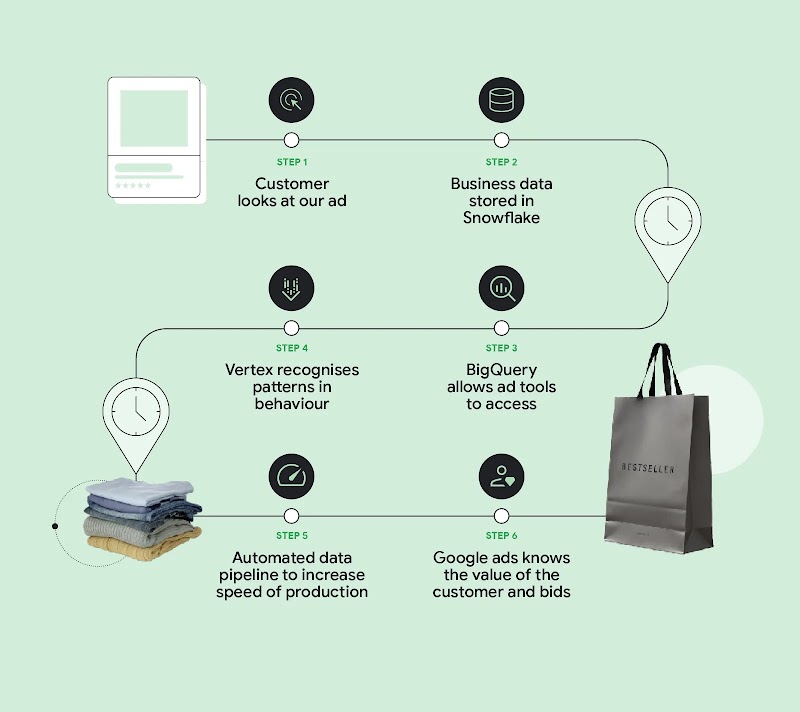
We used Google Cloud’s Vertex AI to then teach our system how to recognise patterns in shopping behaviour. Think of this as the “brain” where the system learns that 3 sizes of the same shoe = a X% chance of a return.
At first, we were doing this manually and slowly. We’d look at Monday’s sales on Tuesday morning, analyse which ones would be returned, and then go back into the records to update the numbers. Because we were always 24 hours behind, the advertising system couldn’t react to what was happening “right now”.
That’s when we upgraded to instant scoring. By setting up a new automated data pipeline on Google Cloud that connects real-time transaction data to our prediction model, our system can now calculate the value of a shopping cart the second a customer clicks “buy”.
It instantly subtracts the cost of predicted returns and tells Google Ads the “true” value of the sale immediately, allowing the ad engine to adjust its bids in real-time. For example, if someone buys $100 of clothes but the system predicts they’ll return $60, it’ll tell Google Ads the sale is only worth $40.
The revelation: Transaction data is the best first-party data
Our model revealed some interesting insights. For instance, we found that the most powerful data wasn’t personal identifiers like email addresses. It was the “DNA” of the basket itself, the payment method, and the basket value.
Once we identified this, we could upgrade the model again to focus on the order rather than the individual. This meant we could respect user privacy, while achieving 93% accuracy in our predictions — not just for known customers, but for all orders coming through.
When we analysed the results from our tests in the Netherlands and Sweden, the impact was undeniable. We saw up to 24.5% drop in CPC (cost per click). And in the Netherlands, ROAS (Return on Ad Spend) increased by 50%.
We weren’t just saving money; we were identifying more profitable customers and new drivers for sustainable growth for our individual brands.
Crucially, we saw that this more selective approach didn’t starve our growth. While we were more conservative on high-risk orders, the savings allowed us to bid more for high-probability “keepers”, maintaining our volume while protecting our margins.
“This collaboration demonstrates the real-world power of predictive AI,” says Frederik Wordenskjold, data and measurement lead for Google Northern Europe. “By activating first-party data to forecast customer return rates and integrating those insights directly into Google’s custom bidding engine, we moved beyond marketing metrics, and turned a complex business challenge into a measurable success, with bottom-line impact for Bestseller.”
What’s next: Beyond the ad auction
The success of this model has opened doors far beyond marketing. We are now working closely with our product insights, assortment, and buying teams to improve our general buying accuracy and predictions by channel and audiences.
In an era of rising costs, the winner isn’t the one who bids the most, but the one who knows exactly what a customer is worth before the bid is even placed.
With our finance departments and the individual brands we use these AI predictions for better month-end and rolling budget forecasting. If we can project returns accurately on day one, we can make smarter investment and trading decisions for day thirty.
And, at the start of this year, we are taking this model global across Bestseller brands.
The lesson for other marketers and media teams is clear: in an era of rising costs, the winner isn’t the one who bids the most, but the one who knows exactly what a customer is worth before the bid is even placed.
By knowing our own business, consumer, and product data better than anyone else, we’ve turned a “return problem” into a competitive advantage.
Social Module
Share