



 Sign in with Google
 Entering new markets, businesses often face the challenge of going up against larger, established players in a busy landscape.
The pressure usually leads challenger brands to base their expansion plans on common assumptions about what works. Except that can actually limit their growth.

For example, challenger brands, working with moderate budgets, tend to focus on converting existing demand. So they don’t typically prioritise converting customers with generic intent or invest in brand campaigns that create future demand.
But challenger brands that break free from the status quo and use AI in their marketing are achieving profitable growth at scale.
A prime example is Castlery. The premium furniture retailer from Singapore has made significant breakthroughs in the U.S. and Australia.
How Castlery’s online revenue grew 200% by converting generic-intent shoppers
Initially, Castlery’s expansion plan relied on Search campaigns to find and convert high-intent shoppers and drive performance.
Like many challenger brands, it’d assumed that converting generic-intent customers would be more expensive and time-consuming.
The common misconception: In a popular category with many established brands, shoppers are less likely to discover and consider a challenger brand. That makes finding and converting generic-intent shoppers inefficient.
The “open secret”: The Google AI-powered Performance Max campaign lets challenger brands efficiently convert customers with generic intent.
How Performance Max supercharges conversions: It uses a wide range of signals, including audience data and user behaviour, to identify customers with a high likelihood of converting, even if they haven’t searched for your brand or product.
It delivers your ads to that broader audience, helping you discover new, high-value customer segments, including generic-intent shoppers, who would’ve been missed out by a specific keyword list.
The strengths of Performance Max led Castlery to adopt the AI-powered campaign and revise its conversion strategy.
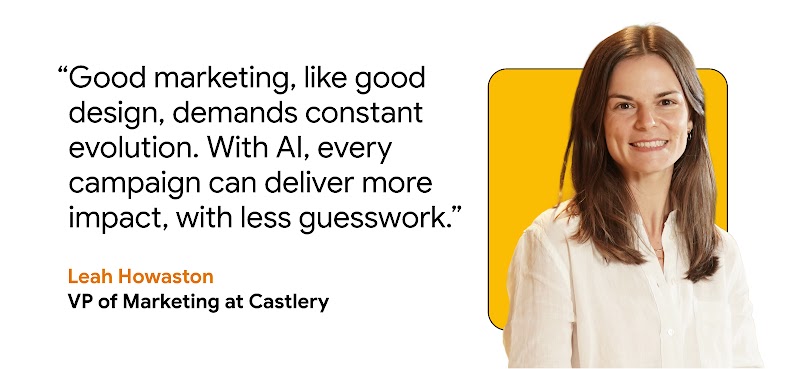
How Castlery’s revised strategy grew returns: Performance Max allowed Castlery to go beyond Search and tap into other ad inventories to expand its touchpoints.
That meant it could reach and engage customers at various stages in their purchase journeys, including generic-intent shoppers. It could also re-engage high-intent customers across multiple Google channels.
So effectively, the one campaign was driving performance across two audience segments — high-intent and generic-intent shoppers.
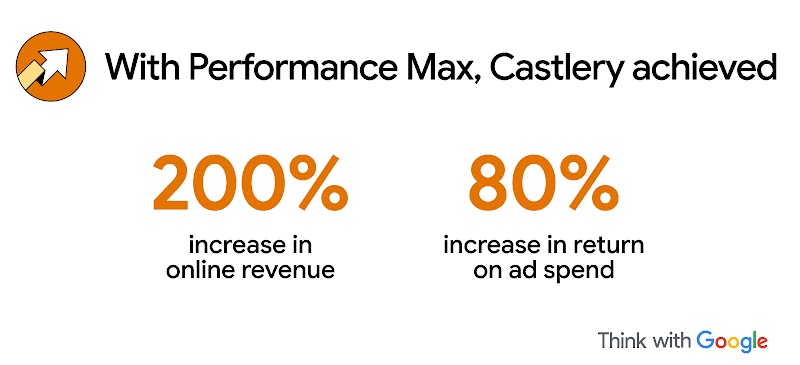
To test the new approach with Performance Max, Castlery conducted a five-week experiment across markets. Its Performance Max campaigns used the same creatives and landing pages as the control group, but added generic queries as search themes.
The result: Its online revenue soared by 200% and its return on ad spend increased by 80%.
How Castlery drove 10% higher conversion with both brand and performance campaigns
Another assumption Castlery overturned is the belief that campaigns which build consideration or demand are not critical for driving performance.
The common misconception: Businesses tend to believe that brand-building campaigns, which create demand, are hard to measure and don’t deliver immediate impact.
The “open secret”: Research shows that a strong brand makes one’s performance more effective and efficient.
Furthermore, advertising experts Les Binet and Peter Field have firmly established that brand campaigns, which drive long-term impact, also help performance campaigns achieve short-term goals. In other words, the “long” sets up the “short,” and the “short” generates revenue.
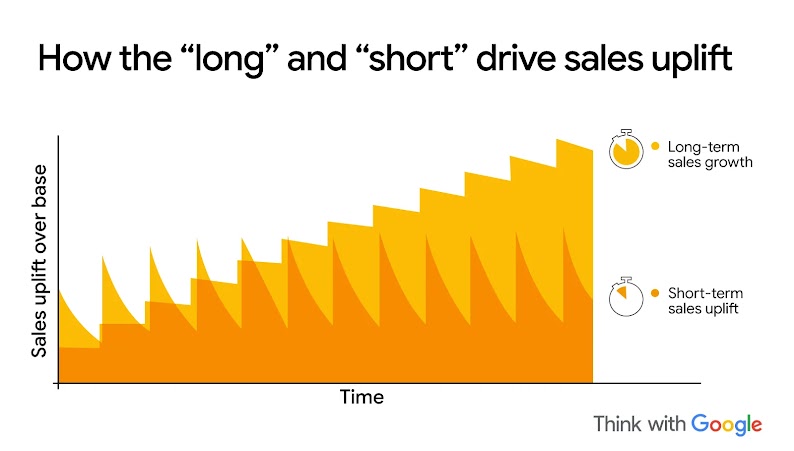
How YouTube drives brand and performance results: Google’s AI-powered campaigns have made it possible for businesses to achieve both long-term brand impact and short-term performance results simultaneously with YouTube.
How Castlery drove conversions with brand campaigns: Castlery ran several brand-building campaigns on YouTube throughout 2024, including during pre-sales moments and for product launches.
It also ran brand-building campaigns via YouTube on connected TV (CTV) in the U.S., since YouTube has ranked No. 1 in U.S. CTV reach for two consecutive years.1
The result: Castlery’s brand-building campaigns drove performance outcomes in addition to brand awareness.
In the U.S. there was a 137% lift in Search for “Castlery” in New York, and a 145% lift for the same in Seattle. CTV also drove the highest ad recall lift in New York, and the highest awareness lift in Seattle.
Additionally, Castlery’s brand-building campaigns increased consideration by 2.4 percentage points in New York.
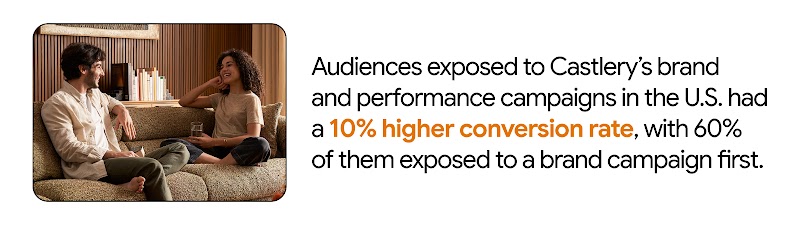
And across the U.S., audiences exposed to both brand and performance campaigns had a 10% higher conversion rate, with 60% of them exposed to a brand campaign first.
Castlery’s remarkable success shows that challenger brands can punch above their weight and rewrite the success formula for expansion. So if you’re looking to go global profitably, be sure to use AI-powered campaigns to increase brand awareness, consideration, and convert customers with generic intent.