




 Sign in with Google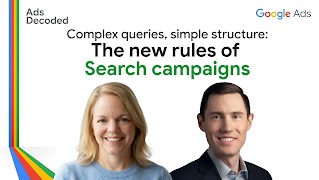
See why consolidated Search structures drive better ROI and control in 2026. With host Ginny Marvin & Brandon Ervin, Director of Product Management.
Episode overview
Hyper-granular campaigns used to be the gold standard. But in 2026, holding onto that legacy structure might be your biggest hidden cost.
Host Ginny Marvin joins Brandon Ervin, Director of Product Management for Search Ads, to discuss why simplifying your Search campaigns is the key to unlocking the full potential of AI Max and Smart Bidding. Learn how to stop chasing keywords and start capturing intent across the entire customer journey.
In this episode, we cover:
- Aligning your campaign structure with your business goals, not just keyword permutations
- How to sandbox your restructure on lower-priority campaigns first
- Using ad group-level geo-targeting and brand exclusions to steer performance without segmentation.
- Community Q&A: AI Overviews eligibility and how autocomplete impacts matching.
Want Ginny’s key takeaways and tips from this conversation? Subscribe to the Ads Decoded newsletter.
Additional resources
Discover AI Max for Search campaigns
Unlock a suite of AI-powered targeting and creative enhancements.
Explore Search campaign best practices
Reach more of the right customers with AI-powered Search ads.
Get the latest Smart Bidding and Budget updates from our product experts.
Get best practices for automating and optimizing your bids.
Transcript
Ginny: What I hear oftentimes is Google just wants us to put everything into one campaign and lose all control.
Brandon: I think about this a lot and when we came out with AI Max, one of the big tenets was, how can we give you performance with control? Control still exists, it just looks different than it did before. So it’s no longer manual bids with single keyword ad groups, it shifts more towards I want to run Smart Bidding, and I really want to pass high quality conversion data and make sure my targets are accurate.
It’s new controls like Brand Controls to say this is a brand campaign, versus a generic campaign. Or some new things like geo controls so you can have really much greater control over the types of queries we match based on the geographic intent that’s expressed in those queries.
And so we want to continue to work with the community to make sure that these controls of the future still give people what they need to feel successful with Google Ads.
Ginny: If you’ve been in Search Ads as long as I have, you might have some baggage. Those years of building out meticulous hyper granular campaigns, it was rational back then - but in 2026, that legacy structure might actually be a big hidden cost.
Today we’re going to address why consolidation is not a dirty word, and how letting go of the old definition of control can actually lead to better performance. Hi everyone. I’m Ginny Marvin, and welcome to Ads Decoded. This show is your direct line to the Google Ads Product Team, the people designing and building the products that you use every day.
And today my guest is Brandon Ervin, a Director of Product Management for Search Ads. His team is at the forefront of how LLMs and AI are transforming search campaigns. We talked about consolidation as a strategic lever for success, and how to transform from legacy hyper-segmented accounts to leaner structures that align with your business goals rather than just your keyword list.
We also discussed why this approach can improve relevance and drive better ROI. Not to mention it’s often easier to manage.
I really enjoyed this conversation with Brandon. I think you’ll find some surprising insights and as always, stick around for Community Q&A at the end.
Ginny: Hello, Brandon. It’s great to have you here on Ads Decoded, and you’re joining us from Zurich. Love for you to tell us about your role and your work at Google.
Brandon: Yeah, thanks for having me, Ginny. I’m excited to be here. I am based in Zurich, so I’ve been at Google a little over 10 years now. I’ve been working in Search Ads since 2015. In my current role, I’m responsible for product across all of what we consider core search and shopping ad automation. So that covers products like query matching, so AI Max, keywords, DSA. It includes creative generation, things like text, customization, Final URL expansion. And also our smart bidding and budgeting products as well.
Ginny: And we are, we’re gonna be covering a lot of those products today. So we are still early in the new year. Did you make any resolutions or have any recent learning that’s kind of shaping your 2026 approach?
Brandon: Yeah, I like this question. So I’ll start with the learning. And so as everybody knows, AI and LLMs are transforming a lot of things, including ad tech, and so I’ve really been making a conscious effort just to try to read the latest interesting research on what LLMs can do, in particular in the relevance or ranking space.
And then I think my resolution is just to continue to be curious and think about what we can do differently with these new technologies.
Ginny: So refreshing to hear you say that things are happening and changing so fast. Because obviously we all feel that, but it’s nice to know that we’re all in the same boat.
And curiosity. I love that you brought that up. It brings me back to my early agency hiring days. And Search was really new. And so hiring somebody with past experience was essentially few and far between. And curiosity was always that spark and that thing that made for a great hire. And I just always think about curiosity being such an essential trait to marketing in general, but just kind of broader achievement. So love that you brought that up.
Speaking of earlier days, I’m gonna shift into our conversation today.
So, I came up in time of PPC in those years of elaborate multilayered campaign structures and account structures. I wasn’t a diehard single keyword ad group acolyte or SKAG acolyte, but there was certainly a lot of granularity and you had to think about, you know, every permutation of a keyword and then segmenting campaigns by match type device, location, and for, and then your tiered bid sculpting to help control all of that.
And the granularity was obviously very effective back then, but clearly laborious and cumbersome, not only to implement, but also to manage. And then we also saw a lot of marketers using or devising their own automation tools to help try to make things easier and more efficient.
In recent years, we’ve seen a lot of folks moving away from that hyper granular approach. And here we are today, and Google is really emphasizing campaign consolidation to maximize the power and effectiveness of AI. And so a concern we often hear is, whether that consolidation will come at the risk of relevance.
So my first question for you is, why is consolidation important today?
Brandon: Yeah, I like this question because it kind of gets at: what people were doing before was quite rational. So when you had manual bidding, when you didn’t have things like creative automation, the way to get control was to split things out so that you could manage ad copy and bids effectively.
But to your point, that was quite laborious. But did tend to work well. And I think the big shift we’ve seen is that with the rise of Smart Bidding, things like AI Max and creative and targeting automation, that the machine in general can do much better than most humans - especially at the scale we see for a lot of these large, modern Search accounts.
And so for us, consolidation is not necessarily the goal in and of itself. We think the new technologies and the improvements we’ve made to the product make the ways of old sort of obsolete. And so you can actually run more consolidated, leaner accounts and get better performance than you used to be able to get. And so that’s kind of where we’re thinking, right?
It’s not so much about, we think you have to consolidate to be successful. It’s more this evolution we’ve gone through allows you to get equal or better performance with a lot less work, a lot less granularity, than you used to have to do.
Ginny: Consolidation is not the goal. That’s I think that’s actually really important because what I hear oftentimes is Google just wants us to put everything into one campaign and lose all control - and we can talk about control and what that means in an AI powered world, we talk about this a lot - but what are some of the reasons where segmentation does make sense?
Brandon: Yes. Let me talk about two things. So one, I’ll talk about the segmentation, let’s come back to control as well.
So the way we approach it is we want to make it as frictionless as possible to take how you do business outside of Google and, you know, try to replicate that in Google Ads so that it aligns with your P&Ls, how you report on things. Basically how you run your business, right?
So there’s no quote, perfect account structure. We just want to kind of give you some rules of the road to say how you can think about doing things that work with your business. And so some things that are very logical that we see work well, are if you have very distinct product lines or different objectives that share their own budgets and bidding goals, those can be separate because that necessitates that setup.
Other things that work well for some companies if they’re more regional focused and budgets are split by region and just internally, how you manage that, also quite reasonable to consider replicating that structure in Google Ads if that’s how you run your business.
And so we’re trying to reduce this mismatch between what you have to do in Google Ads and how you run your business to make that sort of as easy as possible. But there’s a lot of different permutations. We’re just trying to encourage you to think about what could be a very lean, simple as possible account structure and why that’s important.
Coming back to control, I would say. I think about this a lot and when we came out with AI Max, like one of the big tenets was how can we give you performance with control? And control still exists, it just looks different than it did before.
So it’s no longer manual bids with single keyword ad groups. It shifts more towards I want to run Smart Bidding and I really want to pass high quality conversion data and make sure my targets are accurate. It’s new controls like Brand Controls to say this is a brand campaign versus a generic campaign. Or some new things like geo controls so you can have really much greater control over the types of queries we match based on the geographic intent that’s expressed in those queries.
And so we want to continue to work with the community to make sure that these controls of the future still give people what they need to feel successful with Google Ads.
Ginny: Yeah, I completely agree on the control looks different And it is a mindset shift. Going back to what you were talking about aligning to your business goals. Part of what I think is so kind of refreshing - and lightening - from a perspective of being able to approach your account structure and your campaigns through the lens of what matters to your business, is so much more intuitive than ‘how do I structure my campaigns to get exactly this bid and make sure that this ad and this keyword is serving?’
Can you share some of the guidelines for understanding when your ad groups or campaigns have enough data? This is something that we get asked about a lot, like how do you know when you’re consolidated enough?
Brandon: Yeah, so the general guidance we publish externally for Smart Bidding is roughly think of trying to achieve roughly 15 conversions over a 30 day period.
Now we do some smart things like trying to learn across all the conversions you’re giving us from your conversion tracking ID to try to aggregate that. So it’s not necessarily having to come from a single campaign. But other solutions to try to help make sure there’s enough data density would be considered doing things like shared budgets or portfolio bidding.
As long as the budget and performance goal is the same, that way we get a little bit more fidelity, um, in low conversion campaigns to make sure we were able to hit your targets.
Ginny: All right, I want to shift to a keyword discussion. So keywords have long stopped being the strict matching and are now more signals of intent - and you can say whether you agree with that or not. And this is especially the case with broad match and now with keyword list targeting when search term matching is enabled in AI Max research or DSA, Dynamic Search Ads.
So first I’d love to talk about this evolution of keyword match types and matching and what you would say to advertisers who have pushed back, and say that the keyword has been this source of truth and the north star of intent, and expanding what keywords can match to dilutes their effectiveness.
Brandon: Yeah, so we’ve been on this journey, I would say for the last maybe six years now, trying to move from more syntactic or this strict word inclusion-based matching to semantic matching because we continue to see user behavior change, and that’s only accelerating now with the move to things like AI Mode or these longer, more complex journeys.
And so we continue to offer portfolio products, because we think there are a bunch of different use cases. And so exact match for the foreseeable future is going to be here as this product if you really want tight, semantic intent control. And then as you move up the spectrum from phrase and then to AI Max, we of course want to try to expand and achieve more closely aligned with what the business goal you’ve given us - so, much more performance thinking, especially for AI Max.
And again, like a lot of that’s driven by, user behavior is changing. Information needs are changing, becoming longer, more complex. It’d be nearly impossible to try to enumerate 10 plus word exact match keywords to try to capture some of these, longer tail experiences. And so that’s where products like AI Max really shine and also sets you up for the future as behavior and experiences will continue to evolve.
But that said, to the control point earlier, we’re trying to think about ‘what does control look like in this new world’. And that might look different than it did in the old world, but it doesn’t mean that it’s not something top of mind for us.
And we want to hear what you need to make sure that you can still feel like you’re in control.
Ginny: Also, I know that, um, this is one of those areas that’s sort of behind the scenes. There’s constant model tweaking, model adjusting, and improvements that are being made to how matching works. Can you just talk a little bit about that kind of behind the scenes work?
How can people get a better understanding of what may have looking a little wonky or not quite working, you know, several months ago that matching may be much smarter now.
Brandon: Yeah. So. I love this question because my job is really about making sure advertisers can be successful. Because if advertisers aren’t successful, Google will not be successful in Google Ads. And so this is very much a big part of what my team focuses on.
And every year we launch, let’s call it 30 to 50 launches on the backend to iteratively improve query matching. So that’s across exact phrase, broad, AI Max, DSA, and shopping and we’re constantly looking for how can we improve quality? How can we make sure we’re delivering the right volume and precision trade-offs for advertisers?
And what’s really interesting is, um, with the rise of LLMs, we’re able to incorporate new and deeper intent signals into the modeling. And so what can look like a wonky match in particular for AI Max? If you asked the model why it made that decision, you can actually understand the reasoning that went into it and it sort of makes sense.
And so something we’re thinking about is how can we expose these types of insights to advertisers? So you also understand why did Google think this was a reasonable thing to match, even if at first glance, it just looks a little bit off base.
Ginny: I know from working with your team that the feedback loop is also constant, so that’s great. If I’m restructuring my account today, should I even be thinking in terms of keywords anymore? Or should I be structuring really entirely around my business goals, user intent, landing pages, you know, the assets that I have at my disposal. What is the role of the keywords in 2026?
Brandon: Step one is think about what are you trying to achieve? Like, what is your goal? Is it driving conversions? Is it driving conversion value? How does that map to your business goals? Then think about a lightweight structure of how you could represent that in Google Ads.
And then I personally feel that keywords are sort of a means to an end. So they aren’t the end in and of themselves, right? Keywords are a way to make sure that we’re reaching the right user searches that to deliver the outcome that you’ve specified.
And so business goal first to help set out your structure. I think then it depends on how you want to go to market with your messaging, your product lines, these sorts of things.
And then keywords become this nice thematic layer on top that say, this is the general type of user intent that I think is going to resonate with this particular marketing message, for example. And so keywords are a means to an end.
They’re really great at sort of concisely expressing intent. And I think going forward, especially for things like AI Max or broad match keywords are a great way to help us understand the theme of your account or your ad group. Like these types of queries generally are supposed to match here versus over here, so you have that control of where traffic goes around your account. But yeah, I think keywords are an important layer, but they are a means to an end and don’t get lost on that as you think about account structure.
Ginny: I love that framing. That’s really helpful.
Search term reporting, building on what we’ve been talking about. So seeing loosely or even seemingly unrelated queries in a search term report can trigger that visceral reaction and fear that you are wasting budget. Sometimes the search terms seem unrelated to the business generally. Sometimes they seem like they’d be a better fit in another ad group or even campaign.
So as search behavior shifts, how should advertisers be thinking about their search terms? What’s the role of discovery and early stage intent in search campaigns? And we’ve touched on this a bit, but I’d love to drill into it more.
Brandon: Yeah. Super fascinating space we’re thinking about, across query matching as well as bidding because there’s a really interesting intersection here - also on the creative side, right? To make sure your messaging resonates with people in different parts of the funnel.
You know, I think what we’re thinking about is historically people have thought of Search as this sort of down-funnel experience when people are ready to convert and that will remain true. I think search is an incredibly high intense surface, high value. But we are seeing more complex, longer queries, more general categorical-like searches.
And so I think it’s important to be curious about, how could my campaign better serve these use cases or these people searching? And that works across query matching. We wanna make sure we’re matching across the funnel of potential intents.
It works for us across creative customization so that we can actually make a message that resonates for people at different parts of the funnel.
And then Smart Bidding is starting to do a much better job of understanding upper funnel intent versus lower funnel intent, so that the ROI we provide on these different searches also makes sense.
And so going back to your original question, if you see something that doesn’t make sense, be curious, like think about could it possibly be relevant?
And then also it’s important we work closely on the bidding side to make sure that these matches or these, this traffic, these impressions are priced correctly at the right ROI. It might sometimes be tangential, but it’s priced appropriately. ROI should hopefully still be maintained in aggregate.
Ginny: All right. We often talk about tightly themed Ad Groups. What do we mean when we say that and how is it different?
We’ve always talked about ad group theming: is there anything different now, when people should be thinking about Ad Group themes?
Brandon: Yeah, so we think theming is important if you really care about segmenting traffic into general parts of your account. And we don’t have a hard and fast rule at the moment, but you should generally think, if I look at two ad groups side by side, is it sort of clear this ad group has a specific intent versus this other ad group?
Because that’s how the models will try to understand a query about X needs to go to the ad group about X, not to the ad group about Y. And so unfortunately it’s not super hard and fast, but just kind of use your judgment to say, qualitatively, is it clear that these two ad groups represent distinct concepts?
And ideally those are sort of cohesive concepts within those ad groups so that our models can understand how you want to have that traffic segmented in your account.
Ginny: And if you are looking at two different ad groups, take another look at them.
They have the same landing page, they’re in the same campaign, they have the same goal. Maybe that’s an opportunity to think about, like, are we actually talking about the same theme and could they be consolidated?
Brandon: Right. And so I would say, that’s a great question. So because they’re in the same campaign, they likely have the same goal and they have the same goal and they have the same budget.
And so then the question is, what is the segmentation for, especially if you know creatives are maybe similar or the landing page is similar.
And if there isn’t a good reason for that, that’s where consolidation makes great sense, right? Because you should be getting the same traffic in relatively the same place from a simpler structure.
And so, yeah, that’s also a good prompt. We see that quite a bit, right? Maybe for legacy reasons, people created this separate ad group at one point in time, or even separate campaigns, but it’s largely duplicative or highly overlapping with things that already exist. So it’s a good opportunity to think about simplifying.
Ginny: Great. All right. I wanna switch gears. We’ve touched on AI Max for Search campaigns. I wanna dive into it more. So the team designed this as an opt-in in your existing search campaigns with three main components: search term matching, text customization, and Final URL expansion as opt-in. How should advertisers think about this trio of levers?
Brandon: AI Max is our avenue for existing search campaigns to become ready for performance now - as well as performance as Search continues to evolve, which is an ongoing process that the organic team is working through.
And so we think this combination of features not only sets you up for great performance. Now when you opt into all three, you get 14% more conversions or conversion value at the same ROI. And if you’ve already had lower automation adoption, like you didn’t use broad match before, you can see as much as 27% more conversions.
And so in the near term, these are transformational increases in performance for quite a few advertisers.
And then strategically long term, we think this combination of features slightly more query matching flexibility, the ability to tailor the creative, potentially find a different landing page, is what’s going to set advertisers up for success as we start to see more ad experiences and things like AI Mode, for example, which are very different than traditional search ads.
And so it’s a great bet for performance now as well as setting yourself up for success in AI mode as that continues to evolve.
Ginny: It’s been interesting to me to see how AI Max was built and brought to market in very different ways than other launches we’ve seen with opt-in and optionality within the main offering.
So I want to talk about the creative tools and text customization and Final URL expansion are aimed at being able to give advertisers the opportunity to be able to serve more relevant ads to more users.
The team also introduced other creative controls like text guidelines, which are in beta, I believe, and URL exclusions and inclusions to be able to control which pages you’re able to serve in. And then brand settings are also available at the ad group level in addition to the campaign level.
So all that to say, why should advertisers trust that generated assets will be relevant to both their brand and their business?
Brandon: Yeah, so I know people care about queries in the search term report. I think they’re equally, if not more passionate about creative because it’s such a core representation of the business’ brand and what they stand for in front of users on search.
And so we hear you. We’re working really hard to make sure that advertisers feel in control of how their creatives are going to show up, tone of voice, these types of things. Let me walk through a couple things.
So one, the current text customization product is currently very much grounded on the data we get from your landing page. Now, that might change in the future as world knowledge evolves in LLMs and things like that, but pretty much we try to ground everything to stuff that exists on the landing page.
So you should feel comfortable that if the content on your landing page represents how you want to talk about your business, text customization is generally gonna stay anchored on that in the current instantiation.
Now Final URL expansion is a great way to find maybe pockets of landing pages or things on your site you might not have thought about that we predict will perform better.
And then you also have control over what to include or exclude, like you mentioned now to actually have control over what you say. This is where we’re trying to think about what’s next. So you mentioned things like text guidelines. So we’re trying to look at, what is the best way advertisers can tell us how they want to show up on Google and their creative? So things like tone of voice, brand message, things to include, things to never say.
And so in its current version, we have two products that are in beta. One is things, something called term exclusions. You can think of this as negative keywords for your assets or creative techs. So just things you never want to include and we honor that very clearly.
The second is more forward-looking and will continue to evolve. Right now it’s called matching restrictions, I believe in the UI. And so these are natural language mini prompts you can provide to sort of semantically tell us what not to include in your ad copy.
And so far we’ve seen great resonance with people who have tried it to feel comfort that Google’s going to honor my instructions and then not include things in my creative that I don’t want.
And so our goal is to evolve this type of input so that we can do different things going forward to make sure we’re covering the wide gamut of things advertisers care about when it comes to creative messaging.
And so maybe just to summarize, we think that these automation products like text customization and Final URL expansion are on average going to do the right thing for the advertiser and then controls like matching restrictions, term exclusions, allow them to fine-tune specific things just to make sure it’s exactly what the advertiser wants.
And so, very important for us to make sure the advertisers feel comfortable with creative automation. And we’ll continue to listen to feedback and would love to sort of work with the industry as we beta pilot these, these products.
Ginny: I know that’ll be exciting for a lot of people to hear. And also I think this is another area - asset generation - that has seen rapid advancement. And similar to the work that’s done on query matching: if something looked a little wonky six months ago, doesn’t mean you shouldn’t give it another shot.
Okay. With Geo Settings that are also now at the group level with AI Max in your search campaigns, what are some of the use cases for a group level location settings, and or what kind of structural problems can this help solve?
Brandon: Yeah, so I’m, I’m quite passionate about trying to get geotargeting right, or improve geotargeting.
So I think it’s actually quite often misunderstood and we’re trying to not only introduce new things like what you just talked about - ad group level location of interest - but also look at existing geo behavior and making sure it’s aligned with that advertiser’s needs. So that’s an ongoing thing we’re looking to improve, but we built a group level location of interest because we see a large volume of keywords with locations in them.
Think of things like hotels in London or cabin rentals in Nashville, and what we’re trying to get to is, like I mentioned before, keywords are a means to an end, but they’re also relatively short free text strings that can sometimes be hard to interpret. Are we talking about is, I think there’s a London in Indiana or London, England - you know - so sometimes things can be ambiguous, and by moving away from purely keyword-based strings into more structure controls like geo, not only does it allow you to use things like fewer keywords, maybe more consolidated accounts with geotargeting.
But then also we have a much clearer understanding of, this is the specific geo you had in mind, and then we can just be a little bit smarter on the matching side of what we do with that information.
And so we’re trying to look at some of these key use cases. We started with brand, it followed up with geo that sort of fit a more structured control. We think that then allows for both clear understanding on Google side of what you’re actually trying to accomplish. Two, just kind of gives you a better sense of what we’re gonna do and allows you to do some consolidation should you wish to do so.
Ginny: Great. Yeah, I think that was one of the announcements that came in the overall AI Max unveiling that didn’t get enough attention, or people had questions and weren’t quite sure how to think about it. So that’s really helpful. Thank you.
Incrementality. Advertisers are often feeling like AI driven structures campaign quote unquote, cheat, by over-indexing on warm, lower journey brand traffic to make that blended ROAS look good - but failing to actually drive net new customer acquisition.
So how can advertisers help ensure that their approach is actually driving incremental growth and not just harvesting demand that’s already been created?
Brandon: Yeah, so this touches on a couple things. One, going back to theming, you know, try to make sure your account is relatively well themed so that we know the best place to put a query and it sort of reduces its ambiguity. Sometimes queries get, you know, smeared across your account.
I know this is very important to folks like Brad Geddes. I see you, Brad. We listen to your feedback all the time.
The other thing would be on brand versus generic, if that’s important to you, you can use brand control to either include specific brand traffic somewhere, or exclude brand traffic from a generic campaign. They try to help give you that cleaner split if that’s something you want to look at.
The third thing is we’re also looking at how can we provide better experimentation tools that make it easier to tie, to take some of this stuff into account naturally. So today our experimentation products are typically limited to a single campaign A/B test.
Not a commitment, but we’re looking at can we offer multi-campaign A/B type testing such that it would more naturally account for some of the inter-campaign cannibalization that can sometimes occur when you add broader AI Max to a campaign that didn’t have it before.
Those are gonna be just three things that come to mind about incrementality.
Ginny: I wanna talk about learning periods. For anyone who’s been in search for a long time, it’s still a relatively new factor to take into consideration when launching a new campaign, making changes.
So what are some of the things you can talk about in terms of setting expectations around learning periods when you are thinking about consolidation or launching a new campaign or making broader changes?
Brandon: Yeah, so maybe I’ll try to separate maybe what I would consider, on one hand maybe more cosmetic changes from the more substantive changes.
And so on the cosmetic side, if you’re consolidating two ad groups in the same campaign or perhaps two campaigns into one but you know, the creatives remain roughly the same. Like you aren’t making sort of a material change to what the campaign was optimizing for.
Those really shouldn’t require much of a learning period as the models are supposed to be robust against those types of structure changes.
The thing we’re learning sort of starts to kick in is for these more, what I would call substantive changes. So you adopt AI Max, for example, or you change your bidding objective from lead submission to closed leads, for example. You know, cart fill versus purchase. So these things that are a little bit more substantive, um, our models are going to take a little bit of time to try to learn on the new goal as well as the new distribution of traffic that comes in from something like AI Max.
And so there’s no hard and fast rule, but do be a little bit patient with how that performance will converge over time. And oftentimes it’s tied to how long your conversion cycle is and the number of conversion cycles.
So trying to get the models to get a sense of how does this traffic perform, relative to what it was seeing before.
And so I would just caution people to be a little bit more patient with these more substantive changes. The models are very good, but sometimes it just takes a little bit of time for them to learn on the new traffic, especially if it’s materially different from what the campaign was optimizing for before.
Ginny: And also in terms of thinking about traffic volume and how that impacts learning periods. This is also where people have a lot of questions of, do I have enough data for the model to learn quickly and efficiently.
Brandon: Yeah. So going back to some things we just touched on before, like the general guidance is for Smart Bidding is roughly 15 conversions in a 30 day period. Now, if you have multiple campaigns that have the same conversion action, same targets, you should consider putting those in a portfolio bid strategy, so there’s a little bit more aggregation of that conversion intent that would be normally sort of slightly dispersed across those campaigns.
You know, generally the models are good about learning about how things perform across campaigns, but if you were to give it that portfolio strategy, there would be potentially some slight advantages to make sure that that volume is aggregated across those campaigns, and the model will see that volume in aggregate and learn a little bit faster, because of course the data is denser like you were getting at.
And so yeah, I would just consider that be it, either physically consolidating campaigns where it makes sense or considering some of our shared products like shared budgets and portfolio good strategies that allow for some of that sort of consolidation in existing structures.
Ginny: One last thing on that volume piece, if you are not meeting that conversion threshold, right, you can look at a different conversion action, perhaps further up in the customer journey, but that is still a very good signal of customer intent.
Brandon: Yeah, that’s a great point.
Ginny: I wanna talk about migration. For folks who are thinking about consolidating and looking at a new structure approach. Some advertisers have accounts with thousands of ad groups, years of history, they’re wanting to modernize, consolidate, but are held back by fear of the learning phase and what that’s gonna do to performance.
So what is the safest way to transition from a more legacy structure to a more modern, consolidated structure without damaging performance?
Brandon: Yeah, so I would say, you know, one kind of map out what do you want to achieve in the end state. So start with your business objectives. How does your current business map to what you would ideally represent in Google Ads, how that translates to things like creative themes, landing page goals, things like that.
And then once you have that in place, I would look at your existing structure and sort of find, quote, a safe place to start with. And so that might be your lower priority, lower volume, less strategically important set of campaigns.
And I would use that as the sandbox to first test out moving towards this sort of new structure that you previously mapped out.
I think one, you’re gonna get a lot of good learning for how that process is gonna go. Kind of test and iterate.
And then if something goes wrong, there’s much lower risk because we sort of segmented it to a part of the business that while, while there is maybe less important than the core high-volume stuff that you wanna be really careful about.
So map it out and then I would say start safe with a lower priority portion of your account before eventually transitioning it to your whole account.
Ginny: And for many businesses, it’s probably a good time of the year to start testing things. Not a high pressure sales season.
Brandon: So, yeah, exactly. I would never do this for an entire account at once. I think it’s very reasonable to do a handful of campaigns at a time, should you wish to do so, just to make sure nothing, either you’ve configured something inadvertently incorrect or something just is wonky on the performance side.
Now that said, we at Google have been working very hard to make all of our various models, things like Smart Bidding, things like PCTR, robust against account structure type changes.
And so for example, we prioritize putting what we would call like a semantic feature into the model and not a feature like campaign ID or ad group ID, such that if you move your creatives from one ad group to another, PCTR doesn’t have to relearn how those creatives perform because they look the same, because the model didn’t even know they were in different ad groups in the first place.
And so, you know, we’re trying to make it so that there should be no performance fluctuations because account structure shouldn’t have a material influence on what the models are doing.
Ginny: Really helpful. What’s the budget case for consolidation?
Brandon: We see sometimes advertisers will have, for historic reasons, different budgets, but the campaigns have the same bidding goal, same conversion action, same ROAS, for example. And sometimes some campaigns become budget constrained and the others still have budget.
And so our recommendation is if you have the same performance goal for a given set of campaigns or line of business, consider running a shared budget so that budget can now work fluidly across the campaigns that share the same objective.
Now, if you have different budgets for internal reasons, or these campaigns have distinct goals or performance that you want to keep separate, separate budgets still makes sense, right?
We wanna make sure it aligns with whatever your business objective is, but if the campaigns perform the same, same goals, budget consolidation is a great way to make sure that you’re not inadvertently capping the performance of one campaign that might become budget constrained when there is excess budget over here that could fulfill that need.
Ginny: All right, I’m gonna wrap up. What are three considerations for advertisers to think about when they’re mapping out their campaign structure?
Brandon: Yeah, I would just say, you know, again, Google Ads, we wanna make it the best tool for you to achieve your marketing goals. And so that starts with the goals. So like, what are your business goals? What are you trying to accomplish?
How does your business structure - think about how you wanna sort of represent that in the same way in Google Ads.
So it sort of starts with what are you trying to achieve? The second thing is sort of what we talked about a little bit earlier, is what are the general breakdowns or themes in that structure, ideally centered around the goal and the marketing message.
Reminder, keywords are a means to an end. I know they’re very important, but they serve the end goal. They aren’t the goal in and of themselves.
And then number three is, just be curious. Test and learn. Be willing to try new things, be that AI Max, be it something like Bidding Exploration, be it some of our new creative controls you might have not thought about using before - or just text customization - because you were too concerned about control.
We’re really trying to make sure that we meet advertisers where they are and help them achieve their goals in the way they want to achieve them, and so those would be the three things I would summarize.
Ginny: Last question. You’ve talked about some of the things that your team is working on that are on the horizon. Any sort of broad thing that you’re looking at in terms of what you wanna make sure that you accomplish this year?
Brandon: Maybe a couple. I spoke earlier about all the launches we do, and so getting the foundations right year after year is really important for us as a company.
Be that across query matching, bidding, creatives. We just wanna make sure we show up for advertisers and users in as high a quality way as possible. So that’s really paramount for us.
The second thing is like everyone, we are looking at how does Search evolve in this new era of AI? And I don’t have anything to announce now, but we have a lot of really interesting things cooking for GML later this year that I’m excited, you know, that we’ll talk about then.
And then, yeah, the third thing is, you know, keep the feedback coming. We really do want to try to focus on quality of life improvements, be that around creative control, be it about this notion of query matching in different parts of my account. We know that’s an acute problem for a lot of advertisers, or just quality in general.
So please don’t be shy. We do read the feedback. We’re trying to do a much better job about listening and responding, uh, to the market. And so sometimes it feels like you might be shouting into a void, but we are listening, we are trying to, to work and improve.
And so yeah, those are the three things on my mind for this year.
Ginny: Amazing. Thank you. Yes. I do wanna also just underscore the feedback and, um, and thank your team for really being receptive and great listeners to the Ads Community.
So thank you so much for joining.
Brandon: Thanks for having me.
Ginny: Wow. Brandon gave us a ton to think about. I want to highlight a few of the takeaways that I had.
First, I think if there’s one mindset shift to carry away, it’s that control isn’t gone, it just looks different in an automated or AI-powered environment. We talked about several of these levers, like brand settings, location settings, not to mention negative keywords and things like that.
We also talked about this in the previous episode with Eleanor Stribling. We were talking about measurement and analytics and how to use your own data as a control lever.
My second big takeaway is that keywords are a means to an end rather than the end itself in 2026. Think of keywords as a thematic layer to help Google understand the theme of your account or your ad group, particularly when using AI Max or Broad Match. And as Google is able to better understand intent all across the customer journey, you may see these types of queries showing up in your search term report. Brandon encouraged us to be curious and look at ways that our campaigns can better serve these newer use cases.
And third, Brandon also unpacked a big myth about learning periods, making campaign changes, like moving creatives between Ad Groups shouldn’t trigger relearning. So this is because our smart bidding models, as Brandon mentioned, don’t anchor on specific campaign or ad group IDs.
Instead, it can recognize your assets performance regardless of where they sit in a new or consolidated structure. So don’t let learning period fear hold you back from making these types of changes in your campaigns.
So I hope this conversation gave you inspiration to have a fresh take on your search campaign structures. Focus on your business goals. Be curious and use your campaign structure as a strategic lever to let AI work for you.
All right, now it’s time for Community Q&A where I answer recent questions that I’ve heard from the Ads Community.
Question number one is a common one I’ve received lately. How do we ensure that our Ads are eligible to appear in AI Overviews and eventually AI Mode?
To serve ads within AI overviews, we consider both the user query and AI Overview content to understand user intent more deeply. And since the ad is matched to both the user query and the AI Overview content, only broad match keywords or keywordless matching in AI Max for search campaigns and PMax - as well as Dynamic Search Ads - are eligible to trigger ads.
And this is the case, even if there are exact match keywords present in the account because we aren’t showing ads based exactly on the matching the user query, but again, for that deeper intent behind it.
Alright, Toan Tran recently followed up on X to ask me a while back. You mentioned that a keyword in both exact and a broad match in the same ad group would not trigger an ad in AI Overviews because the exact match would take priority over the broad match and exact match keywords aren’t eligible for AI Overviews, is that still the case?
This was a really great question because we’ve since updated this. So the presence of the same keyword in exact match will not prevent the broad match keyword from triggering an ad in an AI Overview. Since the exact match keyword is not eligible to show ads in AI Overviews, and hence is not competing with the broad match keyword.
And lastly, Brandon mentioned Brad Geddes during our conversation. I wanted to surface a recent LinkedIn exchange that I had with Brad. In a recent study, Brad saw some unexpected matches attributed to AI Max rather than the keyword in the campaign, and wondered if AI Max is not following our keyword prioritization rules.
Brandon’s team actually looked into some of these examples. Turns out the matching occurred in these cases because of auto complete suggestion in Maps search.
So for example, a user started typing in something like daycare, and the query daycare near me was suggested in the auto suggest dropdown along with an ad in that dropdown. These are the auto complete suggestions that are shown before you actually hit enter to get search results.
And while the keyword ‘daycare near me’ was in the campaign, standard keyword matching wouldn’t be able to connect that partial query ‘dayca’ to the exact match keyword.
But with AI Max enabled, it could match and deliver an incremental. This is different than standard matching as we are increasingly determining relevance by inferred intent in experiences such as Lens and AI overviews versus by just looking at the raw text query.
We are planning updates in the next quarter or so to improve transparency around these types of searches, and we are also updating the Help Center to explain this use case.
All right. That’ll do it for this episode. If you’ve got questions, you can find me on X Threads and BlueSky at Ads Liaison or Ginny Marvin on LinkedIn. And Reddit, and be sure to check out the companion Ads Decoded newsletter on the Google Ads LinkedIn account.
Thanks so much for tuning in. Until next time.
