





 Sign in with Google
How to find keywords: A guide to keyword research
Finding the right search terms is the foundation of any successful digital strategy. But how do you search for keywords that actually generate revenue? Learning how to find the exact keywords that reflect the queries of potential customers is fundamental to getting your business in front of them the moment they need your products and services. Thankfully, there’s a practical, straightforward way to find the specific search terms you need.
Keyword research: Key concepts
Keyword research is the process of discovering, analysing, and selecting the search terms people enter into search engines like Google. This data helps inform the architectural blueprint for your website content and serves as the foundation for efficient Google Ads campaigns. Good keyword research removes assumptions and replaces them with concrete proof of user behaviour.
Short-tail vs. long-tail keywords
Keywords are categorised by length and specificity. Each of these factors directly dictate search volume, competition, and buying intent and help shape your strategy.
|
Keyword type |
Definition |
Example |
Strategy |
|
Short-tail |
Broad, 1-2 word phrases with massive search volume and high competition. |
“Commercial landscaping” | Used to build general brand awareness and capture top-of-funnel traffic. |
|
Long-tail |
Specific, 3+ word phrases with lower search volume but much higher commercial intent. |
“Eco-friendly commercial landscaping in London” |
Used to capture highly qualified leads who are ready to make a purchase decision. |
Utility for SEO and PPC
Your search strategy will typically rely on the same core data for both paid and organic channels. The same methodology for finding keywords for SEO purposes is also used to structure your pay-per-click (PPC) ad groups. After learning how to find SEO keywords, you can take your findings to optimise your website to capture free organic traffic over time. Simultaneously, you can bid on those exact high-intent terms in Google Ads to help generate leads.
Brainstorming and understanding search intent
It might be surprising to learn, but active listening is the foundation of an exceptional keyword strategy. The way your customers frame their questions, comments, concerns is extremely valuable information for keyword research.
- Sales calls: Note the exact phrasing prospects use when asking questions.
- Support tickets: Review recent inquiries to see how users describe their problems.
- Online reviews: Read through positive and negative feedback to identify recurring themes.
Highly valuable search terms are often found in these everyday conversations. The goal is to understand how potential customers seek information, learn how to frame the problem your business solves, and how they phrase their search queries.
Brainstorming seed keywords
You can build your initial list of topics by breaking down your core business pillars. If you run a commercial landscaping company, your pillars might include terms like “corporate lawn maintenance,” “commercial landscaping,” or “large-scale tree removal.”
Then, you can expand these pillars into seed lists by using the insights gathered from listening to your customers. Browse industry forums to see how people discuss these topics online. You can even prompt generative AI tools to output a list of synonyms and related concepts to speed up the initial brainstorming phase. For example, asking an AI tool to expand on “corporate lawn maintenance” might generate fresh seed keywords for your list like “business park groundskeeping,” “HOA turf management,” or “eco-friendly commercial lawn care.”
Understanding search intent
Intent matching is deciphering the underlying goal behind a user’s search query. Search volume means nothing if the user’s search intent is not met with your content offer.
Consider the difference between someone searching “commercial landscaping benefits” versus “emergency tree removal for office parks.” The first user is gathering information; the second user needs an immediate service provider. Matching your ad copy and landing page content to this specific intent improves your conversion rates and lowers your cost per acquisition.
Targeting long-tail keywords
Long-tail keywords often represent users further down the marketing funnel where they are closer to finalising a purchase decision. Targeting these more specific queries can help you potentially bypass the typically heavier competition for the short-tail keywords and connect directly with potential customers who have a clear idea of what they want. This is a common strategy for smaller businesses with lower budgets than bigger brands. By focusing on highly specific, multi-word phrases, you attract a smaller but significantly more qualified audience.
Using Google Keyword Planner
Google Keyword Planner is designed to connect your initial brainstorming to actual search data. It allows you to go from guessing what people might search for to seeing precisely what the data says. By combining organic content planning and paid campaign forecasting within the Google Ads platform, you will typically use Keyword Planner as your central hub for a complete search marketing strategy. This lets you manage both SEO and PPC in one place.
You can access Keyword Planner directly within your Google Ads account under the “Tools and settings” menu. There are two key features inside Keyword Planner for turning your brainstormed seed topics into actionable metrics.
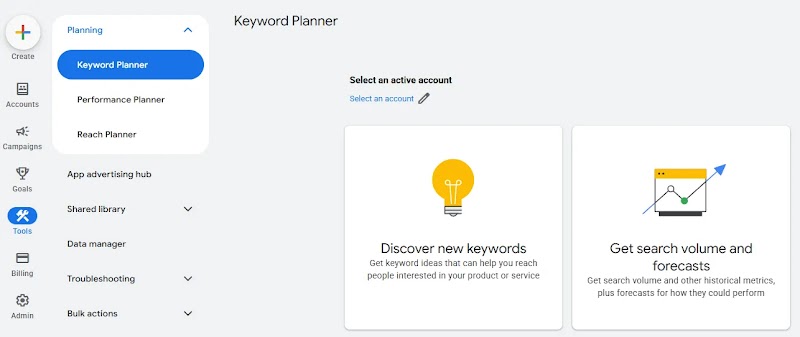
Discover new keywords
Use the “Discover new keywords” feature to expand your initial seed list. You can input up to 10 seed phrases — such as ‘corporate lawn maintenance’ — to generate hundreds of related keyword ideas.
Alternatively, you can learn from your competition: Enter a rival landscaping company’s URL to discover search terms their website currently ranks for. This can help uncover gaps in your own content strategy and highlight other terms you may have overlooked.
Get search volume and forecasts
Once you compile a refined list of terms, a process you can learn more about here, use the forecasting tool to view historical metrics and estimated future performance. This feature allows you to estimate clicks, impressions, and costs based on your specific budget and location targeting. For our landscaping example from earlier, this means estimating how many clicks a £500 budget might generate for “emergency tree removal” before you invest any ad spend.
Analysing metrics and mapping content
Extracting data is only the first step; interpreting these metrics is what helps prioritise your targets and build stronger campaigns.
Average monthly searches
The “Average monthly searches” column shows the sustained volume for a specific query over a 12-month period. New Google Ads accounts, or those without active ad spending, may see broad data ranges (such as 1K–10K) rather than precise numbers. Exact, granular search volumes become available once your account has an active campaign spend.
Competition
The “Competition” metric — categorised as Low, Medium, or High — refers to the density of advertisers bidding on that exact term in Google Ads. While this dictates a potential cost-per-click, it also serves as a strong indicator of commercial intent. High competition in paid search usually signals a highly valuable target for your organic strategy. If competitors are willing to pay a premium for a click, the traffic is likely valuable.
Mapping chosen keywords
Keyword data can only provide value if you deploy them effectively on your website. Map your keywords to specific landing pages. For example, using a broad, higher-volume keyword, referred to as a “primary keyword,” such as “Commercial landscaping” to your specific service page’s H1 and Title Tag. You would then use related, longer-tail “secondary keywords” like “office park walkway installation” throughout your body copy. Well-mapped, highly relevant landing pages help improve your Google Ads Quality Score, which can potentially lower your actual cost-per-click.
Getting started with keyword research
Whether you‘re selling corporate lawn maintenance or another local service, knowing exactly how to find keyword opportunities that reflect real user intent means you can make more informed decisions about your marketing. Log into Google Ads today to start your own integrated keyword research journey and reach more potential customers.