





 Sign in with Google
 On this page
Your next wave of growth is on YouTube, where the world’s most trusted creators meet AI-powered relevance and results. Because Demand Gen campaigns are powered by Google AI, following the ‘YouTube Performance Four’ provides an essential blueprint for high performance.
Advertisers who adopted at least three out of four of these best practices saw, on average, over 40% more conversions and +30% higher conversion value.
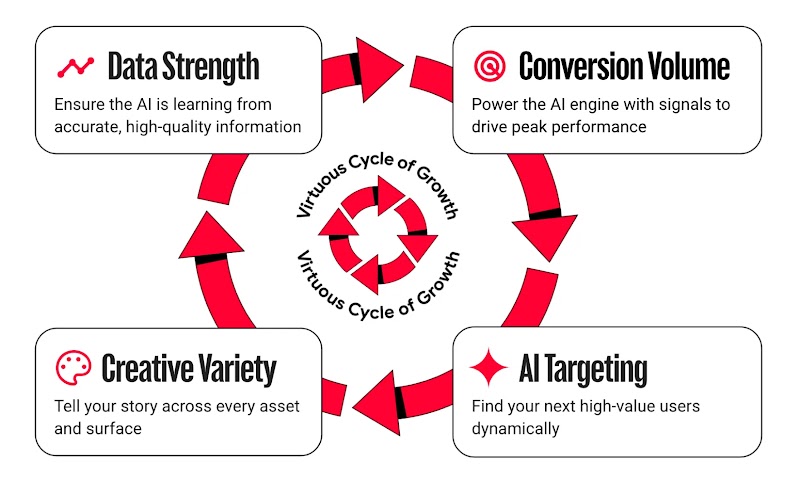
The YouTube performance four to drive conversion
1. Data strength
Accurate measurement is your primary performance multiplier. Ensuring proper foundational data setup is critical to capturing high-quality signals, driving ROI and fully activating Google AI as your performance engine.
Maximise your signal accuracy by:
-
Implementing Google tag gateway with PII
- or
- Using offline data imports with at least three key identifiers. The recommended identifiers include GCLID, PII, IP, transaction ID, gbraid/wbraid or session_attributes.
Pro tips for success:
- Connect all your data sources: Ensure that all your data is connected to your ads platform. Link your Google Analytics and Google Ads accounts to bid for Google Analytics conversions and audiences, including using the Google Analytics for Firebase SDK for app conversions.
- Implement robust site-wide tagging: Use the Google tag or Google Tag Manager to capture the data that matters most to you and upgrade to Google tag gateway to serve tags from your own domain, so that you can significantly improve the accuracy and resilience of your measurement signals.
- Connect your other offline sources: Connect your CRM or other offline sources to Data Manager for a comprehensive view of your customers. Use the Data Manager API to programmatically send data.
- Maximise your signals: Enrich your data foundation with more signals to optimise the accuracy and completeness of your data set. Send customer signals like user-provided email addresses, transaction data and ad interaction signals (Google click ID, session attributes and Braids URL parameters like GBRAID or WBRAID) to provide a more accurate view of your customers and the conversions that you get. Alternatively, use offline data imports with at least two key identifiers (such as PII, IP or transaction ID).
2. Conversion volume
Providing sufficient conversion volume gives the AI the intelligence that it needs to move dynamically beyond the learning phase and drive the conversions that you aim to achieve.
Choose your bidding strategy:
- Efficiency-based bidding: If you have a desired ROI for your Demand Gen campaign, then use a target strategy: Target CPA or Target ROAS.
- Volume-based bidding: If your goal is maximising your full campaign budget, use a Max strategy: Maximise conversions or Maximise conversion value.
- Click-based bidding: If your goal is to achieve the most clicks, use a click strategy: Maximise clicks or Target CPC.
Set sufficient budgets: Ensure that the AI has the ability to optimise by ensuring that your daily budgets can capture the required conversion volume.
- Maximise strategies (Maximise conversions/Maximise conversion value): Set a daily budget of $100 or more.
- Target strategies (tCPA/tROAS): Set a daily budget of at least 10x your target CPA.
Use the bid strategy report to help assess the performance of your bidding over time.
Navigate the learning period: The bidding algorithm needs time to observe the campaign over several days to pick up on trends.
- Wait for 50 conversions: The campaign status will display ‘Learning’ until the algorithm has gathered sufficient data. Do not evaluate performance until the campaign has generated at least 50 conversions.
- The 15% rule: At launch, the bidder learns what works. Changing settings forces the campaign to relearn. Instead of making big changes, slowly flex bids and budgets by 5–10% (and no more than 15%) per week.
- Use shallow conversions: If you are optimising for a deep conversion action (like a purchase), map shallow conversion actions (like page views or add-to-baskets) as non-biddable at the account level. This feeds the system more data to help it ramp up faster.
3. AI targeting
AI Targeting allows you to find your next high-value users dynamically, driving efficient scale. Whatever your objective, Google AI helps you reach the right audience by adapting to your specific targeting goals. Properly setting up your AI targeting can significantly reduce the chance of the ‘Cold Start’ so your campaigns hit the ground running.
To boost overall performance
Enable Optimised targeting on all your prospecting campaigns and combine it with first-party data seedlists for exceptionally good results – this helps the AI look beyond manually selected segments and find high-converting audiences that you may have missed. (If you can’t share first-party data lists with Google, create seedlists based on your high-performing audience like Google pre-built audiences or custom segments).
To re-engage existing clients
Utilise remarketing to directly target high-value first-party segments. This allows you to tailor your creatives specifically for users who have already interacted with your brand.
To acquire net new clients
Leverage the new customer acquisition (NCA) goal to attract and acquire new users – a fully automated approach powered by your first-party audiences that focuses your campaign on potential customers new to your business.
4. Creative diversity
To achieve maximum performance and reach, you must tell your brand’s story across every asset type (video, image), aspect ratio (horizontal, square, vertical) and achieve full surface coverage (run on all channels).
The benchmark for creative diversity is having at least one ad in each Demand Gen campaign with:
- Three vertical images, three square images and three horizontal images.
- One vertical video, one square video and one horizontal video.
- Utilise creator partnership ads with video linking.
- Target Shorts-only with a vertical video.
Pro tips:
- Use the creative framework of ABCD (Audience, Branding, Connection, Direction) to ensure that you’re building high-quality assets.
- Strategically refresh your creatives by following these guiding principles:
- Add, don’t replace: Add new assets where possible before removing old ones. Broadening your diversity is consistently effective at driving performance.
- Make changes gradually: Changing only a small portion of your assets periodically helps the system maintain stable performance.
- Keep top performers: If you must remove assets, only pause those that are low-performing and have had at least 14 days to ramp up.
- Test in new campaigns: If you have a high volume of new creatives (like a flighted burst or holiday promo), test them in a new campaign first to maximise system exploration. Ensure that you account for a new learning period.
Campaign Structure
- Consolidate for performance: Google AI learns at the campaign level. Avoid fragmenting data; instead, combine similar audience themes (e.g. ‘baseball’ and ‘football’ into ‘sports’) to help the model learn faster.
-
Structure for intent:
- Use a dedicated ad group for remarketing/retention to target existing users with tailored creatives, while keeping prospecting ad groups consolidated to maximise reach.
- Consolidate unless you require specific creatives for a distinct audience or strict budget control between prospecting and remarketing.
- Merge sparse ad groups: If an ad group generates fewer than 30 conversions in 30 days, consider merging it with another to improve signal density and AI bidding efficiency.
- Run across all channels: Do not restrict your campaigns to specific channels. Running Demand Gen across all available channels allows for full optimisation and increases opportunities for lower CPAs.
Evaluating performance
- Account for conversion lag: There is a natural delay between when a user sees an ad and when they convert, plus data processing time. Always evaluate trends over a longer period rather than yesterday’s incomplete data.
- Expect intrinsic volatility: Day-to-day fluctuations are normal, especially for campaigns with lower conversion volumes – review performance over longer stretches.
- Evaluate based on your strategy: Maximise strategies are aimed to deliver volume within your set budget, whereas Target strategies aim to hit your efficiency goals. Ensure that you are evaluating the correct KPI.
- Compare accurately: If you are comparing Demand Gen performance against social platforms, use the Conversions (platform comparable) metric in Google Ads reporting.
