Sign in with Google
You can no longer buy attention through brute-force media reach alone. Across mobile, desktop, and in the living room, people decide in milliseconds whether to watch or skip. To get more out of our own budgets, Google’s creative, media, and measurement teams overhauled how we build YouTube creative around three rules:
- Build natively for YouTube. Ground every spot in YouTube’s ABCDs instead of recycling traditional TV cuts.
- Pair creators with brand ads. Run creator-made videos alongside core brand spots in paid media.
- Give AI multiple formats. Supply AI-powered campaigns with horizontal, vertical, and square cuts so they can mix and match the right spot for the right screen.
Each tactic works on its own, but they drive the biggest lift when run together.
1. Build natively for YouTube
Traditional TV ads love the slow reveal, holding back the brand and the point until the final seconds. On YouTube, that’s a recipe for an immediate skip.
Instead, we build our creative around YouTube’s ABCD framework — Attention, Branding, Connection, and Direction — tailored for YouTube Shorts, in-stream, and connected TV. For a recent Google Search campaign tied to “The Devil Wears Prada 2,” we created 13 custom videos, built specifically for how people watch on YouTube. Our top three ads hit over 80% of YouTube’s ABCD standards — and drove a 3% to 5% lift in brand awareness.1
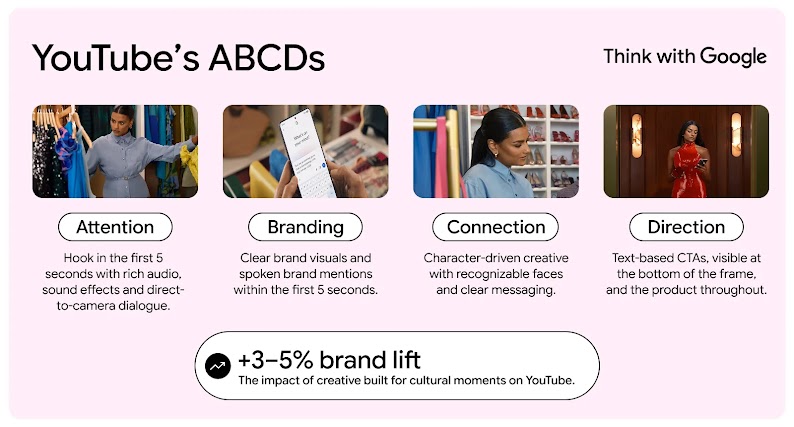
Here is what separated our top performers from the rest.
- Attention: We used tight framing in the critical first five seconds to create a hook with rich audio, sound effects, and direct-to-camera dialogue. “See and say” title cards and dialogue ensured our message got across, whether viewers had headphones or not.
- Branding: Our top assets featured clear brand visuals and spoken brand mentions within the first five seconds. Multiple brand elements and extreme close-ups of the product, like the Google Search bar on a phone screen, made the branding feel natural but unmissable.
- Connection: Much of the creative was character driven, featuring recognizable actors from the film or a beloved YouTube creator. We made sure to have a visible face in the first five seconds to build that human connection and kept the scripted lines focused on a single, clear message.
- Direction: The ads consistently used text-based calls to action, visible on the bottom of the frame, and featured the product, the Search bar, throughout.
2. Pair creators with brand ads
Brand ads build awareness, but creators build trust. Increasingly, shoppers are looking for a trusted third-party perspective before they buy, and they often turn to YouTube.
That’s why we stopped treating YouTube creator partnerships as one-off PR plays and started running creator-made videos directly alongside our brand spots. Instead of chasing raw follower counts, we pick creators whose audiences actually care about the product category.
For the Pixel 10 launch, we paired our agency-made brand spots with videos from basketball and lifestyle YouTube creator Jesser. We put around half our media budget behind our highest-scoring ABCD brand ad, then ran Jesser’s videos alongside it in the same campaign. Together, the two-voice approach drove a nearly 2.5% lift in brand consideration.2
3. Give AI multiple formats and themes
AI-powered campaigns like Demand Gen are great at putting the right ad in front of the right viewer at the right time. But AI is only as good as the creative you feed it. If you just upload a horizontal TV cut, you will miss viewers scrolling vertical Shorts.
To cover every screen, our teams follow a simple rule of threes: one video and three static images for each format — landscape (capturing connected TV and in-stream), vertical (reaching Shorts), and square (powering Discover and feeds).
For Google Chrome’s U.S. desktop direct-response campaigns, Chrome marketing supplied Demand Gen with a full asset mix: horizontal CTV cuts, vertical Shorts, and square feed units in six-, 15-, and 30-second run times. Rather than running a single message, we rotated five core product themes and paired them with bespoke creative for specific audience segments like gamers, shoppers, and business professionals. In testing, our tailored creative campaigns for gamers and shoppers drove an 8% lower cost per incremental install.3
Strategic takeaways for marketing leaders
So to ensure you can create, capture, and convert the demand you need, be sure your team asks three questions before your next YouTube launch:
- Does our creative pass the five-second test? Audit your spots against YouTube’s ABCDs. Show a human face, say and show your brand in the first five seconds, and use title cards that work with the sound off.
- Are our creator videos stuck in a silo? Bring creator-made cuts out of one-off PR budgets and run them directly alongside your top brand ads in paid media.
- Did we build for the rule of threes? Never launch an AI-powered campaign with a single 16:9 cut. Hand your media team 16:9, 9:16, and 1:1 formats in six-, 15-, and 30-second lengths so the AI can actually do its job.