





 Sign in with Google
At Ovative Group, our mission as Petco’s media and creative partner has always been about more than just selling kibble. It’s about nurturing that special bond between pets and their humans. For over 50 years, Petco has been a staple in neighborhoods. But recently, the brand has transformed into a fully connected partner, seamlessly integrating its app, online experience, and 1,500 physical stores.
But bringing this shopping experience to life during the holidays introduces a classic retail tension: How do you drive immediate online sales while also keeping physical store lanes busy?
This challenge is amplified during Cyber Week, retail’s most expensive, crowded advertising window. With competitors consolidating their budgets on social media, bidding up costs, and fighting over a shrinking pool of attention, the pressure to choose between digital performance and physical foot traffic is intense.
Yet we saw this crowding as our greatest opportunity. If everyone was piling into the same social channels, the highest-intent, least-contested audiences were almost certainly sitting somewhere else.
If everyone was piling into the same social channels, the highest-intent, least-contested audiences were almost certainly sitting somewhere else.
Bridging brand and performance
To capture this untapped demand, we partnered with Petco to expand outside the social media bubble. We chose to run Google’s highly visual Demand Gen ads to reach shoppers during their key holiday research and gifting window.
This strategic shift allowed us to reach high-value pet parents we couldn’t find through social platforms alone. We connected with them exactly where they were already spending their time online: browsing YouTube, checking Gmail, or scrolling through their personalized Discover feeds.
Instead of splitting our budget and creative assets into separate online and offline efforts, we built a unified campaign structure to drive both outcomes from a single investment. By adapting existing social videos and leveraging first-party data paired with lookalike segments and automated bidding, the campaign could flex in real time. This allowed Google’s AI to guide individual impressions toward an online checkout or a physical store visit, depending on what each pet parent was most likely to do.
Embracing the ‘work smarter, not harder’ strategy
One of the biggest hurdles for any brand is the perceived cost of net-new creative production. But you rarely need to start from scratch. To maximize performance across YouTube’s surfaces, we optimized Petco’s creative mix for Demand Gen campaigns. We started by using Google AI to efficiently resize assets and then collaborated with creators to craft relevant CTAs for key seasonal moments. This eliminated production overhead, allowing us to reinvest every saved dollar directly into media.
For this launch, Petco’s in-house team reformatted the assets to look native across all aspect ratios: vertical for YouTube Shorts; square for Discover; and horizontal for YouTube, Gmail, and Discover feeds. The horizontal cut carried an “in-store” visual emphasis, using a wider frame to spotlight products and retail store imagery. As Petco’s media and creative partner, we saw the immediate impact of this visual-first approach, where the hook and Petco branding were front-loaded into the first five seconds for an immediate visual and emotional grab.
Translating creative into commerce
To close the gap between inspiration and action, we turned them into a “shoppable storefront” by syncing Petco’s live product catalog directly to the ads via Google Merchant Center. If a pet parent saw a video of a dog playing with a specific toy, that exact toy appeared right below the video, ready for purchase. This shoppable format boosted our returns by an extra 30%.
Next, we used Petco’s first-party customer data to find “lookalike” segments — people who behave just like Petco’s best customers. Feeding these rich signals into automated Maximize conversions bidding enabled Google’s AI to optimize pricing and delivery in real time during a competitive period like Cyber Week, where inefficient targeting gets expensive fast.
Aligning performance with business results
By connecting digital performance directly to the business outcomes that finance teams prioritize — specifically return on ad spend (ROAS), physical store visits, customer acquisition costs, and purchase intent — we turned a marketing experiment into a core business strategy.
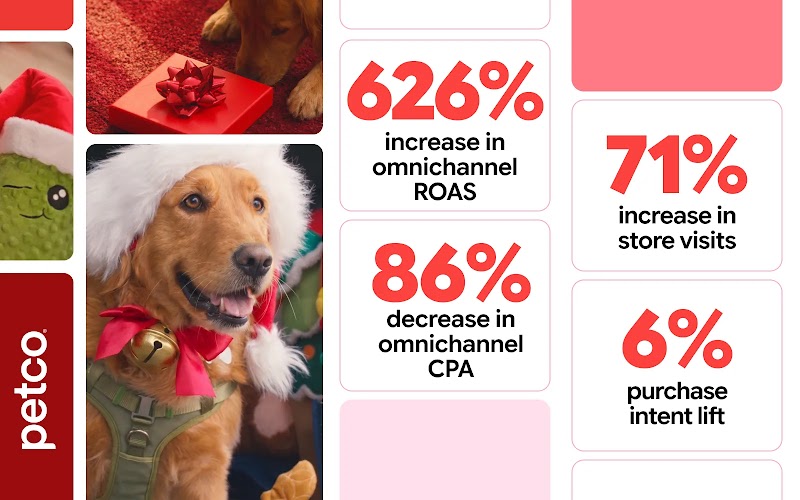
The impact of this visual-first approach was massive. During the Cyber Week rush, we saw a 626% increase in omnichannel marketing ROAS, compared with the previous year’s Demand Gen tests. This was accompanied by a 71% surge in physical store visits, proving that online videos can actually get people to leave their houses and shop in person. Additionally, we achieved an 86% reduction in omnichannel cost per acquisition (CPA), drastically lowering the cost to gain each new customer, along with a 6% lift in purchase intent, showing that shoppers weren’t just clicking, they were actually planning to buy.
Expanding the retail marketing strategy year-round
This credibility turned a successful holiday test into an essential, highly trusted component of Petco’s ongoing media investment. Having made Demand Gen a year-round strategy since the last holiday season, our team is excited to lean in even harder this coming holiday, continuing to leverage the live product feed and invest in high-quality first-party signals.
Don’t wait for a “safe” moment to test a new channel.
Testing Demand Gen during the highest-stakes quarter of the year paid off, because we captured the valuable, untapped demand competitors left on the table. You don’t need a massive production budget. Adapt what is working, feed automated bidding strong first-party data, and let AI help bridge the gap between online and offline growth. For other retail brands and performance-driven agencies, the takeaway from this retail marketing strategy is clear: Don’t wait for a “safe” moment to test a new channel.
Looking to drive performance more efficiently on YouTube? Encourage your teams to leverage the YouTube Performance 4.
Social Module
Share