





 Sign in with Google

Malene Brandt Jensen is responsible for customer data strategy at global jewellery brand, Pandora. Through understanding the “why”, she creates the best customer experiences, powered by data.
Have you ever watched Simon Sinek’s Ted Talk or read his book, “Start With Why”? His core argument is that people don’t buy what you do; they buy “why” you do it. He suggests that while every organisation knows “what” they do, very few can clearly articulate the purpose that drives them.
If you lead a data marketing team, it is easy to get bogged down in the “what” — the APIs, the tech stacks, and the algorithms. But have you ever stopped to define your “why”?
At Pandora, we believe the why of data strategy and governance is simple: customer experience. To deliver the best output — the best customer experience — we must control the data input through discipline and people.
I joined Pandora six years ago, just as data-driven was becoming the industry’s North Star. Over that time, my role has evolved into what I describe as a data detective. A translator sitting at the intersection of business interests, technical possibilities, and strategic enablement.
And ultimately a driver of customer experience, through data.
Scaling through a new way of working
My job is to ensure that a high-level business objective — like increasing profitability — is accurately mapped to the data inputs our data models and AI tools use for optimisation.
It is about being the connective tissue that allows the boardroom to talk to the server room.
However, this role is only effective if it has the right people to talk to. At the start of every project, we now bring together, what I call, “The Three Musketeers”. These are representatives from the privacy, digital and technology, and the business teams (e.g. marketing or commerce).
The magic happens when these three teams stop working in sequence and start working together. Without all three perspectives in the room from the beginning, you risk building a technical solution that marketing can’t use, or a campaign that privacy has to shut down six months later.
As a trio, we bring unique expertise from very different fields, but mastering data-driven requires a symbiosis. A common understanding, respect, and curiosity to define the right solution.
Mastering the reactive to enable the proactive
This new way of working was essential to help us navigate the biggest shift in our data journey: moving from reactive to proactive data governance.
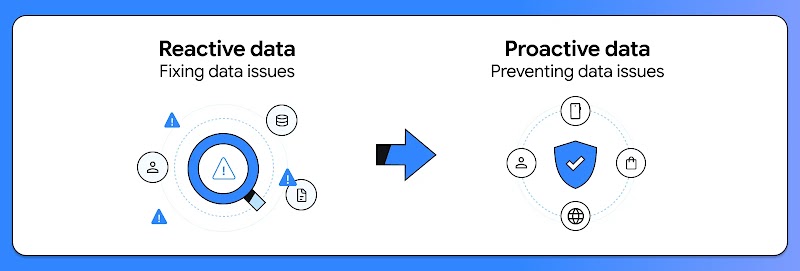
Think of it like a library. Reactive governance is like a pile of uncatalogued books where you only start looking for a title when a reader asks for it, leading to a potentially slow search.
Proactive governance, by contrast, is having every book indexed and shelved correctly from the start, so that when the reader arrives, you can hand them exactly what they need instantly.
Let’s put this into a real-world scenario.
In the past, we often fell into single-stream or channel-driven requests. For example, during a busy Christmas campaign, the marketing team might have said: “We need to activate consented, first-party data with this specific media platform. This will allow us to optimise our holiday ads to customers looking for gifts on that platform.”
In that reactive state, we would build a one-off data pipeline for that request. But if the finance team asked for different metrics a week later, or a second social platform requested the same data in a slightly different format, we had to start the technical and legal review all over again.
We were duplicating efforts and creating silos. As a result, some of our most promising projects — like enabling sales data across different sources — stalled for over a year.
Building for Pandora, not the vendor
We realised we needed to stop building exclusively for individual media platforms and start building for Pandora. We began with foundational data standards that apply generically across the brand, rather than for one specific campaign or platform.
This shift meant that instead of waiting for requests to come in, we could proactively go out to other teams with opportunities. We could say: “We have already consented and governed the customer purchase history data for Pandora, across all channels. We can see an opportunity to optimise holiday ads for customers searching for Charms and Charm bracelets, enhancing their customer experience”
And the impact from all these changes has been great to see. For instance, we have seen a significant reduction in time-to-market. Ad campaigns that used to go back-and-forth between departments are now being deployed in record time because the “why” was answered before the first line of ad copy was even written.
Furthermore, it has fundamentally changed our internal efficiency. When data quality is high and pre-consented, our teams spend less time hunting for inputs, and more time building value.
Why marketers need to shift to data sustainability
This brings us to what I believe is the most important mindset shift. Moving from data governance to data sustainability.
Data sustainability means balancing our present needs without compromising our future possibilities.
I’ve always found the term “governance” boring, and it makes it misunderstood and underrated. I prefer “sustainability” because it perfectly captures our “why”. Just as we treat environmental resources with care for the long-term, we must treat our customer data with the same responsibility.
Data sustainability means balancing our present needs without compromising our future possibilities. That could include asking if we can achieve our goals with five attributes instead of ten, to keep our data lean and compliant. And it’s always on, needing continuous attention.
In the end, the winner won’t be the brand with the most data, but the one with the deepest, most sustainable understanding of the data they have. That way they can ensure that the output — whether it’s a personalised ad or a relevant discount — is exactly what the customer needs.
When you get the why right, the data doesn’t just drive the business, it can build your relationship with your customer.
Social Module
Share