





 Sign in with Google
As Head of Performance Marketing for British Gas, Kathy Connolly-Livings has been instrumental in enhancing the performance of its boiler business.
In performance marketing, a digital lead is only as valuable as the revenue it ultimately generates. Yet, for years, an invisible wall has separated the clicks we celebrate online from the cash that actually hits the balance sheet, leaving marketers to optimise based on half the story.
I’ve spent my career navigating this exact divide. As head of performance marketing at British Gas, my team and I recently found ourselves facing a classic digital paradox: our online metrics weren’t telling the complete story of our business impact. We needed a way to connect the dots between digital intent and offline reality.
Running on fumes: Great digital leads, cold conversion stats
We operate in an increasingly volatile and competitive market. The cost-of-living crisis and aggressive new market entrants have fostered a strong switching culture among consumers. Yet, within this environment, our boiler installation business remains a highly profitable, high-margin area. However, our marketing team was facing a significant hurdle with it.
We were highly successful at generating online inquiries for boiler installations. But the critical business events — the deposits and final purchases — happened offline and were recorded strictly in our customer relationship management (CRM) system.
This created a massive marketing blind spot. Because our campaigns relied on a traditional Target CPA (cost-per-action) model, we were optimising for sheer lead volume. We were spending budget to acquire inquiries without knowing which of those clicks actually transformed into paying customers. To articulate our true return on investment to our CFO, we had to shift our strategy from volume to value.
Laying the pipeline: Connecting our CRM and Google Analytics
To get rid of this marketing blind spot, we had to tear down the organisational data silos separating our sales and marketing platforms. This was as much an internal educational journey as it was a technical one, requiring us to work closely with our CRM team to map the specific data fields necessary for marketing intelligence.
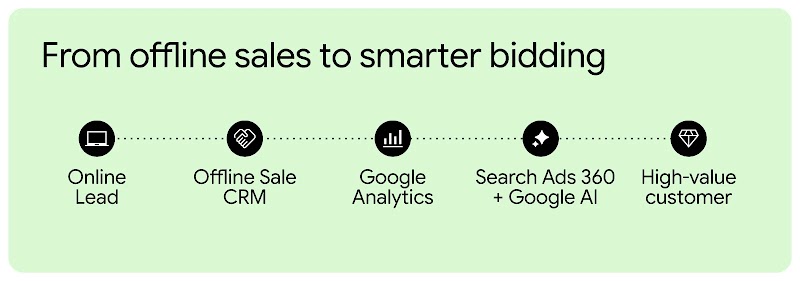
We partnered with our agencies, OMD and TRKKN, to build a robust data pipeline. The objective was to bridge our offline sales data directly into Google Analytics and Search Ads 360. By closing this loop, we could finally see exactly which digital touchpoints were driving real-world revenue.
Setting the thermostat: Shifting from Target CPA to Target ROAS
Once the pipeline was established, the real transformation began. We stopped optimising for a simple lead count and started feeding actual business intelligence back into our buying platforms. By seamlessly integrating our first-party offline data, we were able to teach Google’s AI what a genuinely high-value customer looks like — i.e. someone who doesn’t just fill out a form, but follows through with a high-margin boiler purchase.
This integration enabled a pivotal shift in our bidding strategy. We moved away from the lead-focused Target CPA model and embraced a revenue-focused Target return on ad spend (ROAS) approach. This allowed the AI to optimise bids based on actual expected revenue rather than just a web lead.
Reaching boiling point: The A/B test that delivered a 4.3X sales surge
In marketing, you don’t just flip a switch and assume success, you have to validate it. So, to achieve this, we ran a rigorous A/B test to compare our old lead-focused strategy directly against the new value-based bidding model.
The results were nothing short of transformative. The treatment campaign, (powered by our new data) achieved an incredible 4.3X increase in actual sales volumes compared to the control group.
And (as if that weren’t enough) it also drove an 11% blended ROAS growth. We were — and remain — delighted. By simply giving the algorithm the right data, we drastically enhanced both our revenue and our marketing efficiency. We proved the efficacy of optimising for high-value offline sales in a low-volume, high-margin business.
Powering up growth: Turning the heat up on predictive customer value
Our partnerships with Google and TREKKN — combined with this technical integration — both solved a single campaign challenge, and provided a sophisticated, data-driven blueprint for our future growth. Which means we now optimise for high-value conversions in real-time.
I believe the future of marketing depends on anticipating what a customer will do next, rather than just reacting to what they did yesterday. Now that we’ve successfully connected our offline data, our team is looking at how we can scale these principles across other areas of the business.
Instead of looking backward at what energy customers used to pay us, we’re now looking forward to predict who will be worth the most to us over time, and focusing our marketing and business efforts on finding and keeping those specific people.
By breaking down data silos and trusting AI with the right inputs, we’ve turned up the heat on our sales and illuminated a clear path to smarter, more profitable growth.
Social Module
Share