


 Sign in with Google

Most marketing teams are already using AI to move faster and save time. The bigger opportunity for CMOs is using it to drive long-term business growth — and to prove that impact to the rest of the C-suite.
To see what separates the fastest growing companies from the rest, the Institute for Real Growth (IRG) interviewed more than 700 executives across 15 markets and analyzed over 6,000 leadership reports and investor calls for its new Marketing2030 study.
Think with Google sat down with IRG founder Marc de Swaan Arons and Marketing2030 lead Mariana Peneva to talk about what they found, including how marketing leaders can demonstrate marketing value, get on the same page with their CFOs, pair AI with human creativity, and drive growth the whole C-suite can see.
Below are edited excerpts from our conversation.
What is the Marketing2030 study, and what do marketing leaders need to know about this final phase?
Marc de Swaan Arons: Marketing2030 is, to the best of our knowledge, the largest global study of marketing strategy, structure, capability, and CMO leadership in the AI era, led in partnership with more than 25 marketing organizations. We deliberately didn’t start with AI, though. We started by asking what kind of world we are asking marketing leaders to help the business grow in. What we found wasn’t a list of trends, but a set of tensions CMOs have to hold simultaneously: short term and long term, human and machine.
Mariana Peneva: This final phase pulls all of that learning together and makes it practical. And, because a static report alone isn’t enough, this phase also marks the launch of the IRG Inspirator, powered by Gemini, where any marketer can take the Marketing2030 benchmark survey and receive tailored advice and recommendations at no cost.
Where did you find marketing can make the biggest impact across the broader business?
Swaan Arons: We identified and validated four areas where colleagues are already asking marketing for help, and where marketing’s core skills — understanding people, shaping perception, and driving meaning — are what the business is missing.
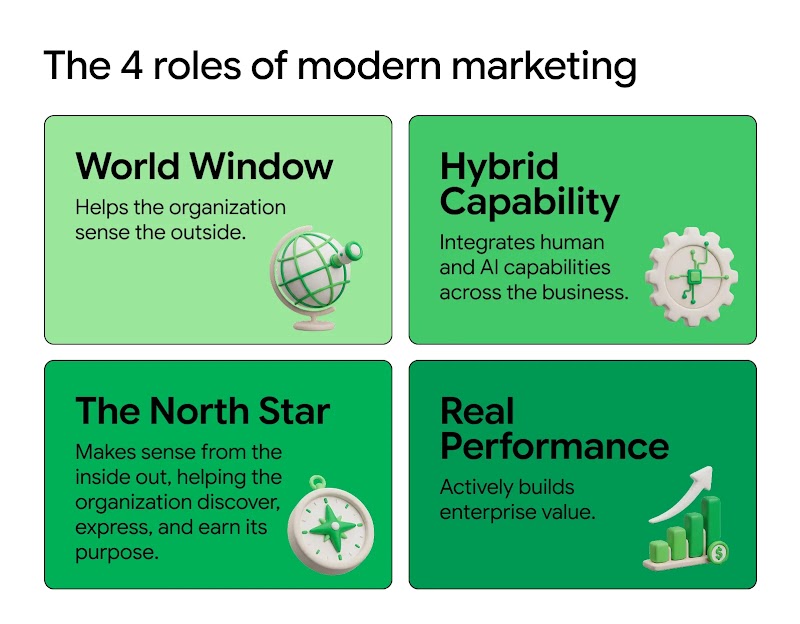
- World Window helps the organization sense the outside. Most companies look at the world through portholes. HR talks to employees, finance talks to investors, marketing talks to customers, and nobody holds a 360-degree view of what all stakeholders expect. No one is better positioned to provide that view than the marketer.
- North Star makes sense from the inside out, helping the organization discover, express, and earn its purpose, extending brand thinking, trust, and reputation to the whole company.
- Hybrid Capability moves from automating marketing’s own processes to helping shape how human and AI capabilities work together across the company.
- Real Performance actively builds enterprise value, working with finance to get the full value marketing creates — including intangibles like brand equity and pricing power — onto the executive dashboard.
CMOs believe AI will unlock efficiency first, and the best of them already treat it as a growth engine.
Everyone is talking about AI. How are the fastest growing companies using it differently than everyone else?
Peneva: Almost every leader we surveyed (95%) sees AI predominantly as an opportunity rather than a risk. About 7 in 10 companies use AI for cost efficiency, which is table stakes. Where the revenue-growth overperformers separate themselves is that 76% of them use AI to drive growth, compared to 51% of underperformers.
Swaan Arons: So the honest answer is that CMOs believe AI will unlock efficiency first, and the best of them already treat it as a growth engine. The companies that outperform run two engines at the same time: an AI-powered efficiency engine that drives speed and scale, and a human-powered engine that builds trust, shapes culture, and creates lasting relevance.
Businesses that optimize only for efficiency risk becoming commoditized, while those that invest only in meaning risk losing investor support. You need both, backed by shared metrics. Unfortunately, fewer than half of organizations (45%) measure intangibles like trust and brand equity today, whereas 62% of revenue-growth overperformers explicitly set both short-term and long-term targets, compared to 32% of underperformers.
What needs to change inside companies for marketing to play that bigger role?
Swaan Arons: First, a word of caution. This must not become an excuse for a marketing land grab. What needs to change first is not the org chart. It’s the habit of deploying marketing skills only to sell products. Companies use us for campaigns, not to find growth markets, recruit talent, or shape the investor narrative.
Our acid test is simple: Ask a CMO whether their company’s HR-led communication is as strong as their brand campaigns. Almost everyone says no, even though recruitment is crucial to their business. As Marissa Jarratt of 7-Eleven told us, the question is not whether marketing should own more, but whether the company applies its best human-understanding capabilities where they matter most.
Marketing is underresourced, because the company isn’t measuring all the value it creates.
What was the toughest feedback you heard from CEOs and CFOs about marketing leadership, and how are top CMOs rebuilding that trust?
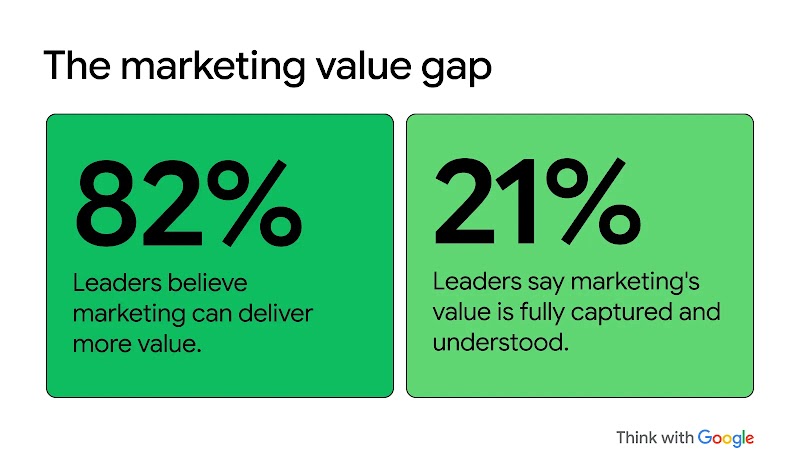
Peneva: The toughest data point came from every function, including marketing itself: 82% of leaders believe marketing can offer more value to the business, yet only 21% say the value marketing creates is fully captured and understood. Even our peers agree that the value is not being seen.
Swaan Arons: Most board members admit they don’t fully understand how marketing contributes to business growth, and there is still no generally accepted definition of the CMO role — which is also the no. 1 reason CMOs leave.
At the root sits a measurement problem. Marketing is underresourced, because the company isn’t measuring all the value it creates. In winning organizations, the CEO codesigns the CMO role around agreed outcomes, and the CFO co-owns the measurement framework from day one, so marketing reports progress using a shared logic rather than defending spend.
One CMO told us their CFO had become the “unlocker, not the blocker,” because marketing was finally judged on the same business-growth KPIs the CFO used.
AI is trained on what already exists. By definition, originality, creativity, and empathy cannot be.
How are winning CMOs building AI capability and human capability at the same time?
Mariana: Access to AI is now table stakes; capability is the gap. Some 93% of leaders we surveyed say their teams need more support to understand and adopt AI, and 78% admit they need it themselves. Only 12% say their teams have the skills they will need in the next three to five years.
AI is trained on what already exists. By definition, originality, creativity, and empathy cannot be. Cutting people to fund AI tends to cut the exact capabilities that set a business apart, and revenue-growth overperformers are roughly twice as likely to explicitly value human skills like empathy and judgment.
In winning teams, the practices are practical. Learning time is protected on the calendar; leaders visibly use the tools themselves, a “try, learn, retire” discipline turns failed pilots into learning rather than career risk; and there is a clear line on which work is human led and which is AI enabled. In fact, marketing AI capability is so critical that we are now launching a dedicated task force to help CMOs navigate it.
As AI-generated content floods feeds — and AI agents reshape how consumers search and shop — how are leading CMOs protecting their brands?
Swaan Arons: Every competitor reaches for the same tools and the same signals, and the output starts to look and sound alike. One CMO put it plainly: Fully machine-led brands eventually feel disposable.
The winning response has two sides. First is the human premium. With up to 30% of content forecast to be synthetic, consumers say they will pay 10% to 40% more for products and experiences that are unmistakably human made. Patricia Corsi of Kimberly-Clark told us the premium now sits in content that is raw, unmistakably human, and intentionally imperfect. Second is curating coherent “brand worlds” with a distinct vision and signature. AI can scale and sustain a brand world, but it cannot originate one.
Trust, preference, and pricing power built over years are what let a brand override the algorithm.
That brand strength matters even more as AI agents and LLMs become part of how people discover products. As one CMO warned us, if an agent chooses your lipstick or your detergent, the only way back into the decision is for a person to ask for your brand by name. Trust, preference, and pricing power built over years are what let a brand override the algorithm.
Peneva: Asmita Dubey of L’Oréal shared a line on AI we keep coming back to: It is not about what AI can do for us; it is about what we, as a business, need AI to do for us. The common thread is taste: knowing what to let in, what to amplify, and what to resist.
If a CMO can only prioritize three shifts over the next 12 to 18 months, what should they be?
Swaan Arons: First, align with your CEO on the scope of your role and how far beyond traditional marketing campaigns you want to take what marketing knows about people.
Second, sit down with your CEO and CFO, and agree on how marketing’s value will be captured, measured, and seen in the language of the business. Get trust, brand equity, and pricing power onto the same dashboard as this quarter’s numbers.
Third, build hybrid capability deliberately. Map the work into what is human led and what is AI enabled. Fund training in days, not slides. Create a safe environment for people to experiment. Put the human in the lead, and let AI support.

Social Module
Share