





 Sign in with Google
 A significant opportunity to maximise your brand’s revenues is hidden in plain sight.
It lies in a key performance metric of Search advertising: impression share.
Marketers know that when a Search ad shows up for most of the potential ad impressions that it’s eligible to receive, that’s good for sales.
But what happens to sales when an ad’s visibility falls short of its full potential?
Many marketers lack clarity into exactly how much incremental revenue they miss out on due to Search lost impressions. So the full revenue opportunity from their paid Search ads was hidden — until now.
A new measurement study, conducted with 80 retail brands and item categories in Australia and New Zealand (AUNZ), reveals that for every $100 of revenues earned from paid Search ads, an additional $39 on average may be left on the table due to lost impression share.
Google and Analytic Partners performed this analysis to meet brands’ modern measurement needs. Here, we unpack our research insights to help you increase revenues from Search ads.
The need for fuller evaluation: Why lost ad impressions matter
With people shopping on Google more than 1 billion times per day,1 Search is a key channel for brands to drive sales.
And to maximise your brand’s revenues, deciding on the right budget and bidding options is critical. That improves your paid Search ads’ performance in highly competitive ad auctions.
And to make better decisions, you need robust measurement insights to help you fully evaluate the effectiveness of your Search ads, based on their incremental contribution to revenues.
The catch is, you can only get part of that picture from traditional marketing mix modelling (MMM). The statistical method, which estimates the impact of media, promotion, and external factors on KPIs such as revenues, only measures Search ad impressions or clicks.
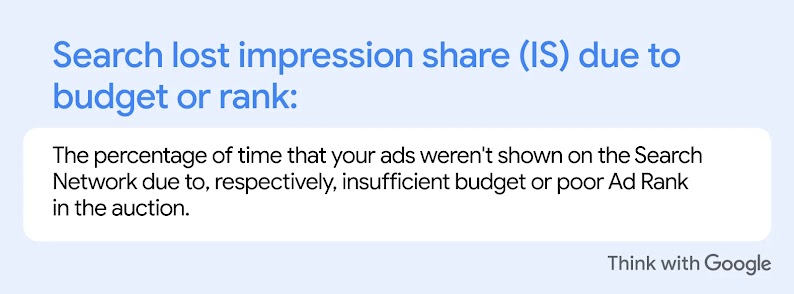
So it doesn’t provide full visibility into how your incremental revenues are impacted by competitive pressures. That is, how much revenue you missed out on during the times when your ads weren’t shown on the Search Network, because your ad budget or Ad Rank were lower than your competitors’.
We recognised that advertisers need to accurately evaluate the true revenue impact due to lost impression share. So we set out to address the measurement gap.
The MMM solution: Measuring missed revenue opportunities
In our study, the first of its kind to measure and evaluate the revenue impact of lost Search impression share, we incorporated lost impressions data into 80 MMMs of retail advertisers across AUNZ, and analysed their Search ads.
In MMMs run by Analytic Partners’ MMM meta-analysis of omni-channel retail advertisers in Australia and New Zealand, Paid Search contributed an average of 2.4% to total revenue. However, businesses saw a 0.9% loss in total search contribution, with 0.5% attributed to budget constraints and 0.5% to Ad Rank.2
What this means for advertisers: For Australia’s retail businesses, the 2.4% revenue contribution of their paid Search ads is key to helping them keep pace with the industry’s growth, which reached a year-over-year rate of 4.9% for turnover in mid-2025.
If they do not invest enough to protect that 2.4% revenue baseline and capture the 0.91% incremental revenue opportunity, they may risk losing market share.
Additionally, the revenue opportunities they cede to competitors could be even greater if their lost ad impressions are from high-value customers, or take place during peak demand windows.
Our study quantifies this missed opportunity: For every $100 of incremental revenues driven by paid Search ads, advertisers in our study missed out on an additional $39. Of this amount, $20 was attributed to Search impressions lost due to budget constraints, and another $19 was linked to Search impressions lost due to low Ad Rank.3
The data-driven decision: How to increase revenues for Search ads
Our findings crystallise the full ROI opportunity for Search advertisers. By integrating lost ad impressions data into your budget decisions, you can optimise existing Search campaigns for maximum revenues — and at lower incremental cost compared to investing in new channels. Here are two ways you can capture that opportunity:
1. Integrate Search lost (IS) data into measurement
Collaborate with Google and MMM providers such as Analytic Partners to use modern MMMs like Meridian, which can measure the impact of lost search impressions on your incremental revenues.
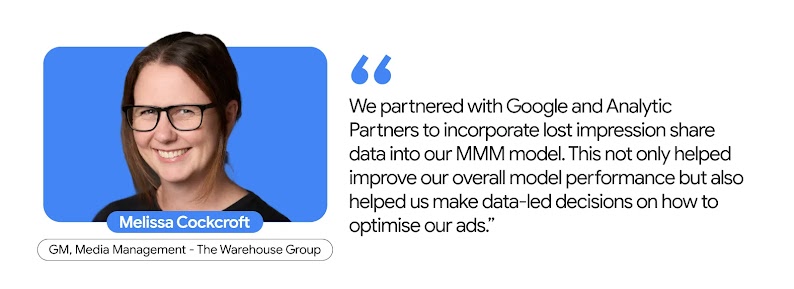
That’s what The Warehouse Group, one of the retailers participating in our study, did to improve its MMM performance and business decisions.
2. Improve your Search advertising effectiveness
Use modern MMMs to predict whether investing more to raise ad visibility can pay off for your brand. To illustrate the potential revenue impact from improving your Search impression share, we use the analogy of Search ads as a storefront on a main street.
Your paid Search ads have secured you a prime location, winning incremental revenues of $100. And to drive additional revenues, you take the following steps:
- Increase your ad budget: That allows your storefront to stay open longer, positioning you to earn higher incremental revenues from high-intent shoppers, who would otherwise have gone to other open storefronts. Indeed, for the retail brands and item categories we studied, total incremental revenues from paid Search ads potentially rise to as much as $120 on average.

- Enhance your Ad Rank: That means improving factors like your ad quality and bid prices so that your ads will perform better. In other words, you invest more to make your storefront highly attractive and ensure it’s seen by more shoppers. Doing this together with an increased ad budget can potentially drive incremental revenue even higher — to as much as $139 in our study.
- Keep your Search ad budget flexible: That lets you easily add budget during peak sales moments and draw even more high-value customers to your storefront, potentially reaping outsized returns.
Advancements in MMM have revealed the substantial value in using your Search lost (IS) data to help you make better ad budget decisions. By investing to keep your storefront open and inviting, your Search campaigns can reach their maximum revenue potential.
Contributors: Baris Can Akkaya, Analytical Lead; Eduardo Maia, Media Effectiveness Lead; Tim Jacobs, Media Effectiveness Lead; James Haydon, Media Effectiveness Lead; Christoph Roscheck, Analytical Lead; Marcelo Mello, Analytical Lead


Social Module
Share