





 Sign in with Google

Elissa Lee is the senior director of measurement and optimization for Google Marketing’s global media. Elissa and her data science team focus on incrementality and measurement solutions to understand the impact of advertising and marketing, from reach and awareness across channels to sales and ROI. She earned her Bachelor of Arts, Master of Arts, and doctorate degrees from Stanford and joined Google in 2011.
For many marketing leaders, discussing results feels like a defensive crouch. You present a 20% lift in “brand sentiment” as the CFO looks at their watch, mentally scanning the marketing budget for a line item to raid to cover a Q4 margin shortfall.
I’ve sat in enough of those rooms to know the feeling. At Google, we realized that if we wanted to stop being the piggy bank for EBITDA gaps, we had to stop speaking the language of clicks and start speaking the language of capital allocation. We don’t just use a measurement strategy to get a number. We use it to build a process so bulletproof that finance stops checking our math and starts to co-author growth plans.
Here is the behind-the-curtain look at the nine steps we at Google take to strengthen marketing and finance alignment — and how other high-spend marketing and media leaders can do the same.
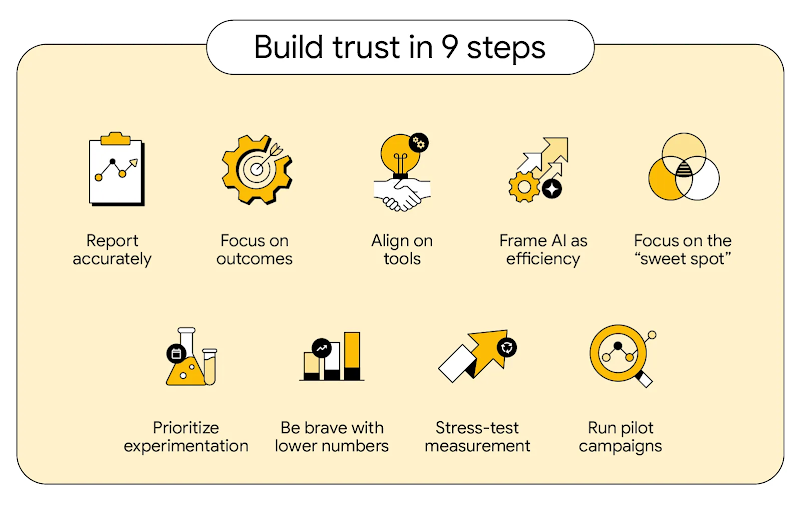
1. Stop throwing reports over the fence
Traditional reporting often feels like a client-service model. Marketing works in a silo for 90 days, then tosses a report over the fence to finance. We broke this cycle by partnering closely with global marketing finance. We co-author plans to hit our targets, navigating uncertainty together to drive real growth.
2. Focus on outcomes, not budgets
If you are debating about the budget, you’ve already conceded. Our collaborations with finance are founded on outcome-based plans, not just spend. To do this, we reframe marketing as a capital investment portfolio with risk-adjusted returns. This moves the conversation from “How much can we spend?” to “How much growth can we drive with marketing?”
3. Align on incrementality
Each party needs complete trust in the numbers. If you’re still talking about which numbers are “real” or accurate, you have a systemic issue. We advocate for preapproved tools, like our open-source marketing mix model Meridian with experimental priors, to create a shared foundation of truth.
4. Frame AI as efficiency, not innovation
CFOs are naturally skeptical of shiny objects. Instead of pitching AI as an abstract innovation, we frame AI-powered tools as mechanisms for improved decision-making, cost transformation, and operational efficiency. By showing how building data strength makes growth more predictable and accountable, AI becomes a tool for governance.
5. Focus on a ‘sweet spot’
Volume for the sake of volume rarely works for us. Instead, we use lifetime value curves to identify the zone where acquisition costs and net profit intersect. This creates a “sweet spot,” allowing us to pivot strategically and choose between long-term value or maximizing short-term cash based on the macro environment.
6. Prioritize always-on experimentation
Stop asking for test budgets on a case-by-case basis. By aligning on an annual incrementality plan at the start of the year, finance is in the boat with us from Day One.
7. Be brave enough to share lower numbers
The blended ROAS trap is tempting, because it makes your numbers look massive. But finance sees right through it. We prioritize incremental and marginal views, even if the reported numbers look lower than traditional attribution. Accuracy builds the trust you need to survive a transition, whereas vanity metrics only erode it. It also allows for optimization to higher performing strategies and channels, and clear reinvestment cases.
8. Stress-test your windows
Measurement is only useful if it changes your behavior. We recently used conversion lift studies to prove that the vast majority of incremental conversions happened within days of a click, not weeks. We immediately used that data to shift our windows and cut out the noise, proving to finance that we are disciplined enough to self-correct.
9. Prove and scale through pilots
Not every media buy is a guaranteed win, and we don’t pretend it is. We start with focused pilots, agreeing on specific testing windows and incrementality plans up front to ensure the data is well powered. This gives finance the confidence to fund the initial learning phase without demanding immediate efficiency, providing a clear road map to scale once success is proven.
The path forward: Growth governance
The ultimate goal of this partnership isn’t just a bigger budget; it’s what Gaurav Bhaya called “growth governance” in his recent interview with Joshua Spanier. It’s the discipline of managing marketing like an investment portfolio — bets sized with intent, guided by evidence, and calibrated over time.
When marketing leaders stop treating measurement like a defensive report card and start using it as an offensive engine, they change the fundamental chemistry of the C-suite. By aligning with finance on causality and capital, CMOs can earn a reputation as growth experts and drivers: people who can accurately predict future returns based on smart investing.
Social Module
Share